

Outlooks
Oil Is Estimated to Ease in 2027 as Suppliers Adapt to Hormuz Disruption

- Goldman Sachs Research forecasts that Brent crude will average $88 per barrel in 2027, easing to $78 by December, under its base case assumption that there are no major changes in the ongoing tensions in the Middle East.
- The oil market likely tipped into a surplus in October 2026, and our analysts expect the surplus to reach 2 million barrels per day in 2027 amid a growing tanker fleet and new oil pipelines in the Middle East.
- European LNG prices are also forecast to fall from €85/MWh today to an average of €45/MWh in 2027, although a colder-than-average winter could drive up prices.
Oil is forecast to ease gradually in 2027 as suppliers in the Middle East adapt to disruption from the war in Iran, according to Goldman Sachs Research.
What is the prediction for oil prices in 2027?
Our commodities analysts expect benchmark Brent crude to average $88 per barrel in 2027 under their base case assumption of no definitive diplomatic breakthrough in Iran and no re-escalation with major long-term damage to oil infrastructure.
Under the same base case scenario, they project that Brent will fall from $93 per barrel today (as of November 17) to $78 by early December 2027 as a sizable surplus decreases Brent’s fair value from $90 per barrel today to the high $70s by the end of 2027. Goldman Sachs Research expects the risk premium in oil prices—which now appears relatively low—to gradually normalize.
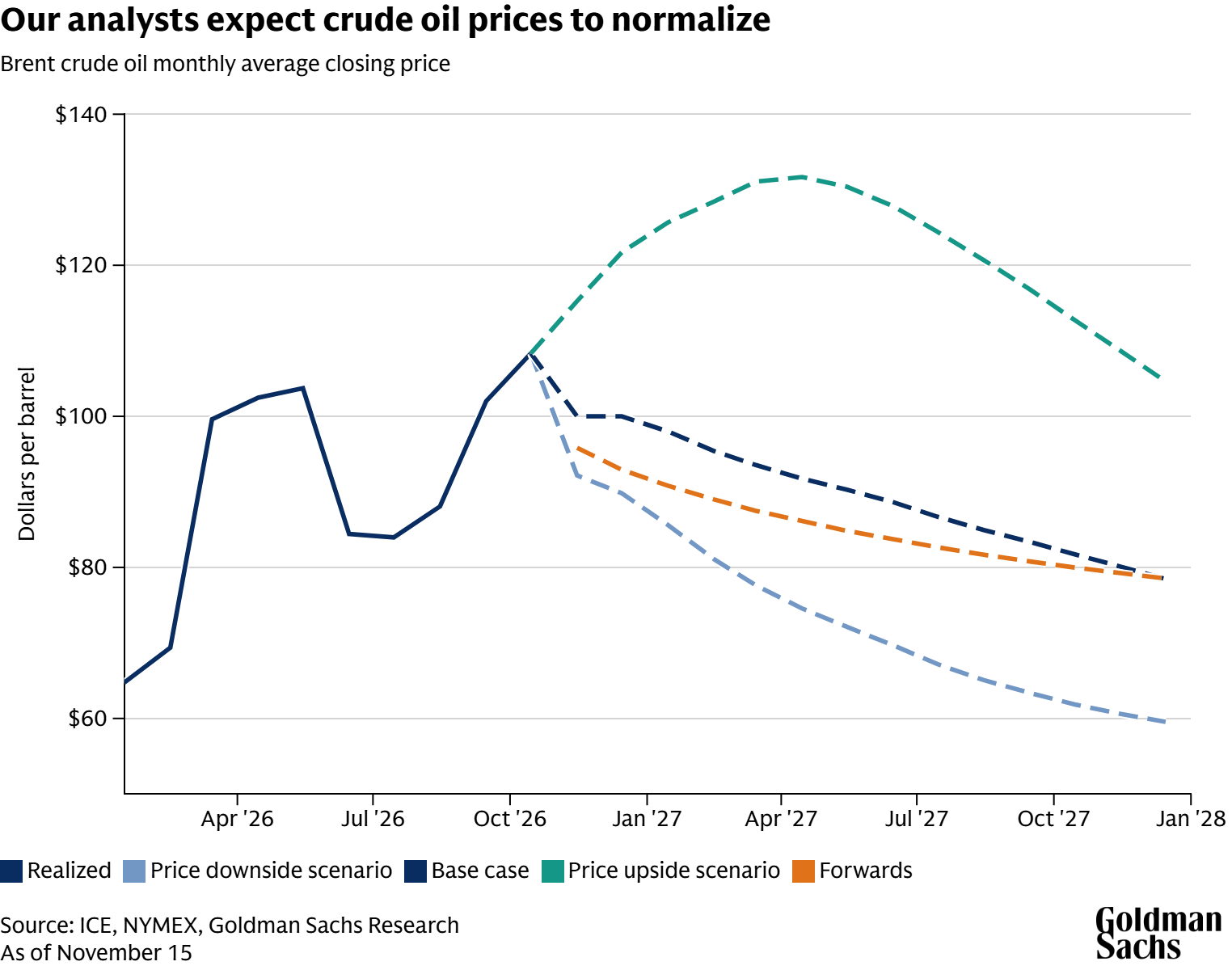
Oil prices have risen less sharply this year than expected given the length of shipping disruptions in the Strait of Hormuz, writes Daan Struyven, co-head of global commodities research and head of oil research, in a report by his team.
In part, that was because of “remarkable oil market adaptation” to the war in Iran, Struyven adds. This included Gulf exporters redirecting supply through pipelines, dark exports, US Navy escorts, and ship-to-ship transfers.
The adaptation also included lower oil demand in response to higher prices—notably in China, which switched some of its energy demand to power and coal—and strong output of oil outside the Gulf, especially in Brazil.
“For 2027, we again expect a contest between high supply disruption risk and continued market adaptation,” Struyven writes.
Will oil stay in a surplus in 2027?
The oil market likely tipped into a surplus in October 2026. The key driver was a rise in the supply of oil from the Persian Gulf in October—Goldman Sachs Research estimates that Persian Gulf crude exports recovered in October to their 2025 average, increasing 2 million barrels per day compared with the previous month.
Under Goldman Sachs Research’s base case scenario, our analysts expect the surplus to grow in 2027. They estimate that it will reach 2 million barrels per day in 2027 despite slowing growth in output from outside the Persian Gulf and continued supply disruptions.
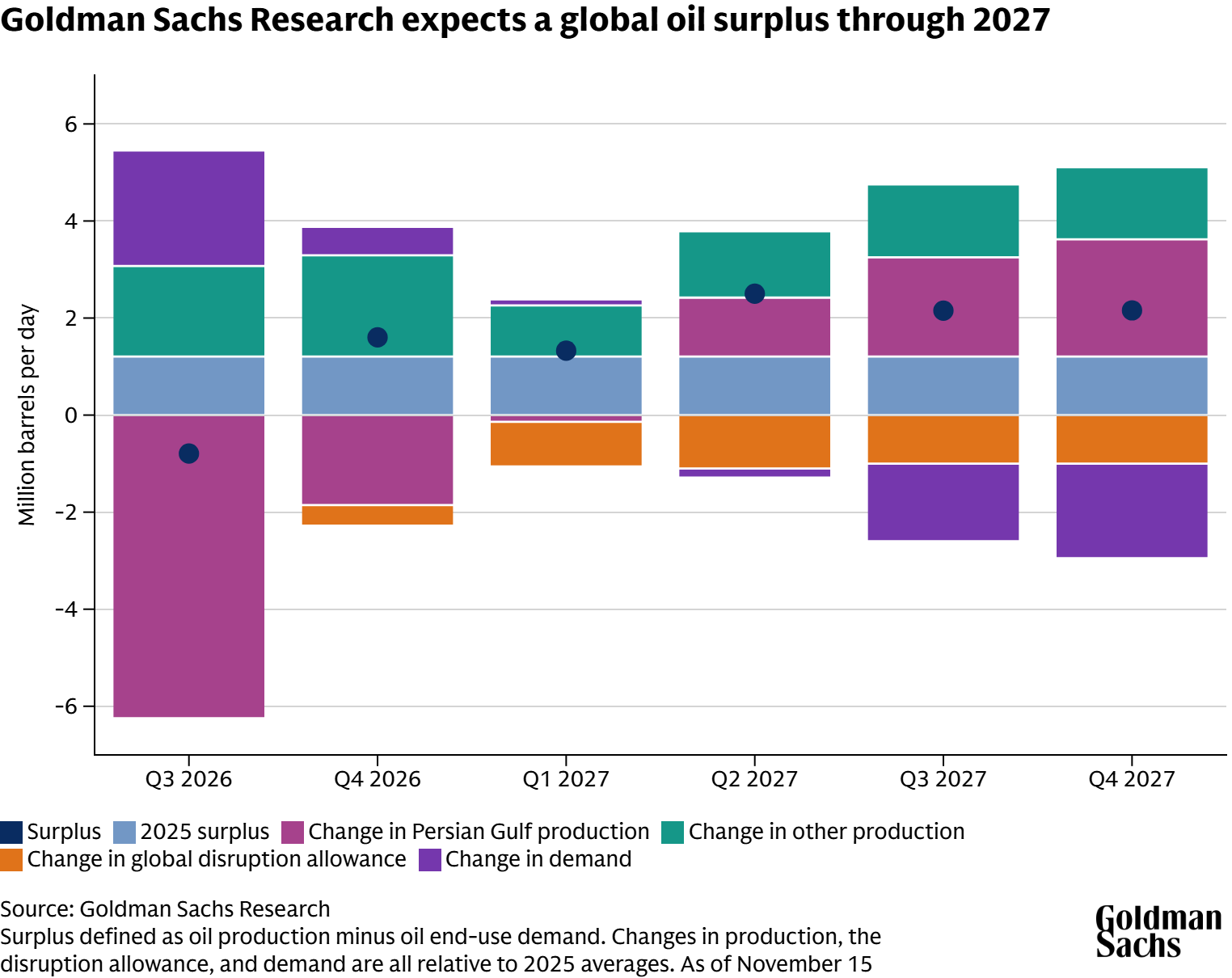
Our analysts expect the recovery of output from the Gulf to trend higher as adaptation and added transportation resources, especially a larger tanker fleet and pipelines, support further growth in production.
Goldman Sachs Research expects an additional 3.8mb/d of pipeline capacity to come online over the next year as oil producers in the Middle East invest in pipelines that bypass the Strait of Hormuz and transport oil directly to the Gulf of Oman, Red Sea, or Mediterranean Sea.
Struyven’s base case assumption sees 2027 oil output from the Gulf exceeding its 2025 average by 1.4 million barrels per day.
The outlook for Chinese oil demand
Global demand for oil took a hit from the conflict in the Middle East. Goldman Sachs Research expects global demand, with the exception of China, to recover to its pre-war trend once the availability and affordability of oil products improve, consistent with the rebounds in global demand following negative oil supply shocks in 2011 and 2022.
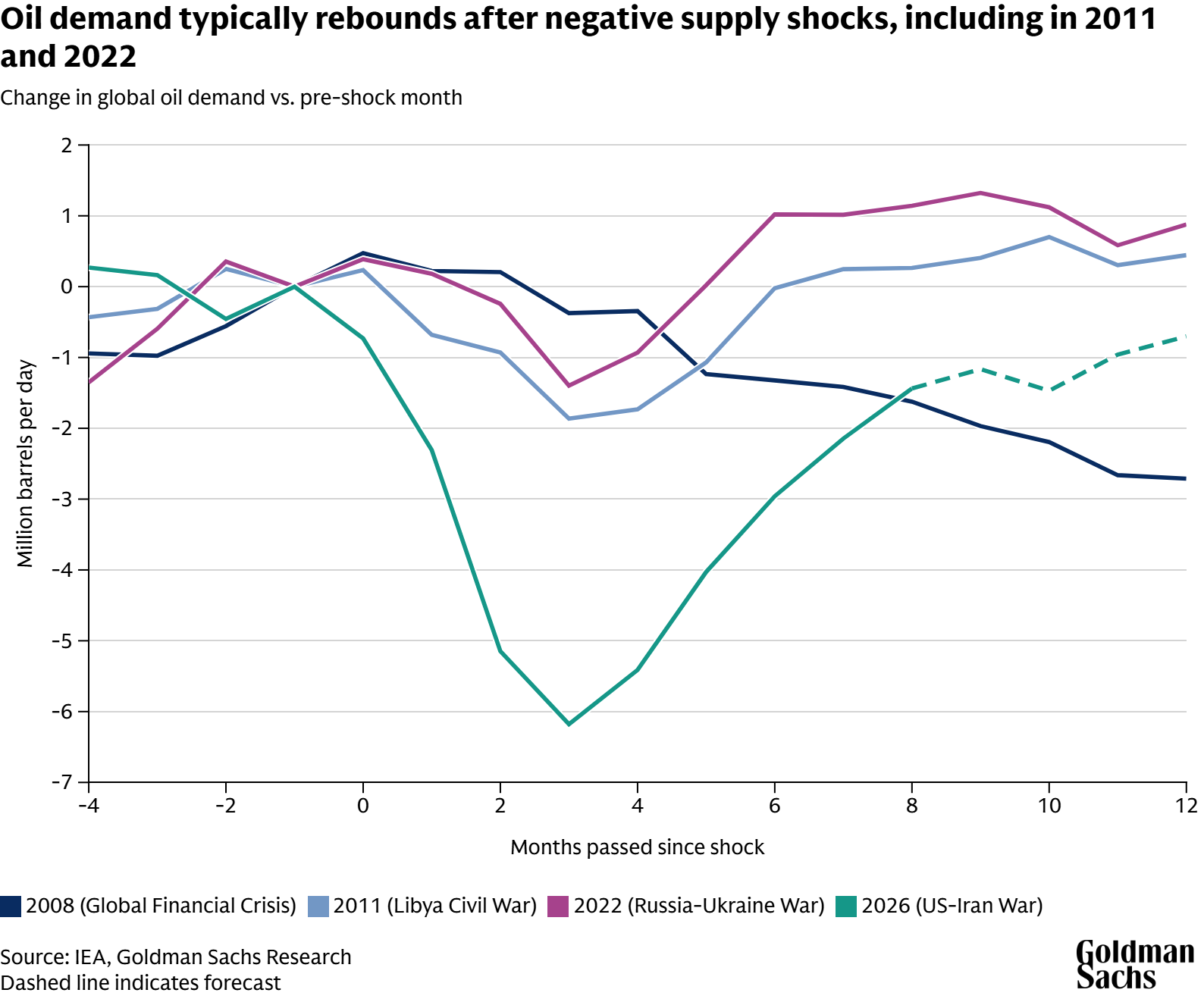
In China, our analysts expect persistent weakness in road fuel oil demand to drive 0.4 million barrels per day of “scarring” to global oil demand by the fourth quarter of 2027. The surge in use of electric passenger cars and trucks likely accelerated China’s energy transition, helping drive a 0.7 million barrel-per-day drop in Chinese gasoline and diesel demand in September 2026, year over year. Half of that decline is likely to persist, according to Goldman Sachs Research.
“Taken together, we estimate that China’s total oil demand peaked in 2025,” Struyven writes.
Will European natural gas prices rise in 2027?
Goldman Sachs Research’s base case assumption is for European liquefied natural gas (LNG) prices to average €45 per megawatt hour in 2027 as supply from the Middle East continues to adapt. That would represent a decline from €85/MWh today (as of November 17).
“Yet even as supply adaptation has spread, it has worked less well for other commodities than for crude oil and has sharply raised shipping costs,” writes Samantha Dart, co-head of Global Commodities Research, who also leads the team’s global natural gas research.
The complexities of transporting LNG, which needs to be kept at very cold temperatures, make ship-to-ship transfers harder than for oil. And because it is more flammable than oil, transporting LNG can be more dangerous for the crew in the event of an attack, Dart explains.
European LNG could rise to near €150/MWh in the first quarter of 2027 if Persian Gulf LNG exports average 25%-30% of pre-war levels this winter and if Europe's winter turns out one standard deviation colder (0.7° Celsius) than average, Dart writes. If Gulf LNG exports stall at around 35% of pre-war levels through end-2027, her team estimates that European LNG prices would average €104/MWh in 2027.
This document has been prepared by the Goldman Sachs Executive Office and is not a product of Goldman Sachs Global Investment Research. The opinions and views expressed herein are as of the date of publication, subject to change without notice, and may not necessarily reflect the institutional views of Goldman Sachs or its affiliates. The material provided is intended for informational purposes only, and does not constitute investment, legal, or tax advice, a recommendation from any Goldman Sachs entity to take any particular action or be used as a basis for any other investment decision, or an offer or solicitation to purchase or sell any securities or financial products. Any forward-looking statements, case studies, computations or examples set forth herein are for illustrative purposes only. Past performance is not indicative of future results. Neither Goldman Sachs nor any of its affiliates make any representations or warranties, express or implied, as to the accuracy or completeness of the statements or information contained herein and disclaim any liability whatsoever for reliance on such information for any purpose. Each name of a third-party organization mentioned is the property of the company to which it relates, is used here strictly for informational and identification purposes only and is not used to imply any sponsorship, affiliation, endorsement, ownership or license rights between any such company and Goldman Sachs. This material should not be copied, distributed, published, or reproduced in whole or in part or disclosed by any recipient to any other person without the express written consent of Goldman Sachs.
What themes will drive the global economy in the year ahead? Explore the 2027 Outlooks from across Goldman Sachs, from specialists on the trading floor to economists and analysts from the global research team.

Subscribe to Briefings
Our weekly newsletter delivers the latest insights on economic forces shaping markets—from Goldman Sachs leaders, economists, and investors around the world.
You can unsubscribe at any time. For information about how your personal data will be used, visit Privacy Information and Resources.