

Exchanges
John Waldron on GDP Growth, AI, and the M&A Outlook
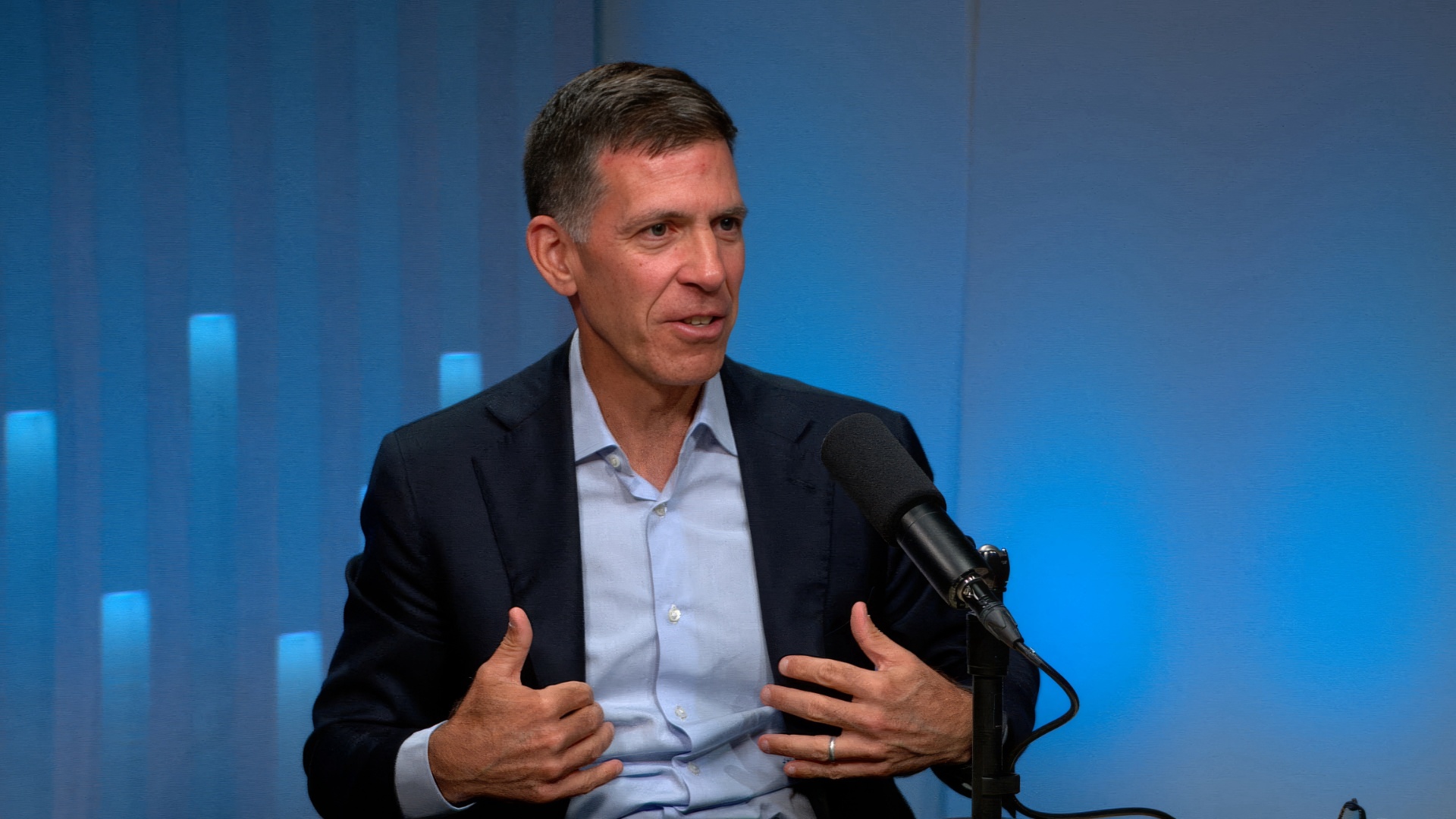
Goldman Sachs President and COO John Waldron says clients have a cautiously optimistic outlook and the surge in M&A is a sign of that confidence. In the Exchanges podcast, he also discusses opportunities in asset and wealth management and how AI can help the firm serve clients better.
Subscribe: Spotify / Apple Podcasts / YouTube
Key takeaways:
The momentum in M&A should continue: Corporate M&A could rise 30% to 35% in 2026, supported by strong pipelines for dealmaking and companies pursuing both scale and sharper strategic focus.
Investors are optimistic about economic growth in the US and Asia: While economic expansion in Europe is more muted, Waldron says the environment there is constructive and may be better than “the narrative suggests.”
Recent acquisitions and AI are an important part of the firm’s strategy: Waldron says targeted acquisitions are building strength and capabilities in asset management, and discusses AI use at the firm
Transcript:
Allison Nathan: Markets are navigating an unusual mix of resilient growth, shifting rate expectations, and rapid technological change. Against that backdrop, how is Goldman Sachs reading the moment and positioning the firm for what comes next? I'm Allison Nathan, and this is Goldman Sachs Exchanges. Today, I'm joined by John Waldron, President and Chief Operating Officer of Goldman Sachs.
We'll discuss the current sentiment among business leaders and investors, the outlook for markets and the economy, and where Goldman Sachs sees its next avenues for growth. John, welcome back to Exchanges.
John Waldron: Thank you, Allison. Good to be here.
Allison Nathan: John, let's just start with a quick gut check. There's so much going on in the world, and markets, as you well know, have been increasingly volatile. You spend much of your time with our corporate and investing clients. How would you describe the mood among business leaders and investors today compared to, say, a year ago?
John Waldron: I think still, generally speaking, optimistic. Maybe a little more cautious at the margin versus where it would have been six, 12 months ago.
Inflation is higher, and that feeds through a lot of businesses. So particularly for CEOs running large multinational corporations, inflation is a real challenge. I think geopolitics continues to be a challenge. It hasn't necessarily gotten any better, maybe a little bit worse, particularly when you think about the Iran situation.
And so I think more caution around the impact of the geopolitics on inflation and then obviously on rates. So, the environment we're in today versus where we would've been six, 12 months ago is we have higher inflation, we have higher rates. And so the cost of capital in the economy is higher. The cost of doing business from an inflation standpoint is higher.
Fortunately, nominal growth is very good, so most companies are seeing pretty strong end demand, and we still have very strong earnings. So, I'm still on the side of optimism when I think about our clients and what they're feeling. A little bit more caution and a little bit more concern in the full in the 2027 planning. I think more of a concern about the continuous impact of higher prices, whether it's in inflation terms or in cost of capital terms.
Allison Nathan: When you speak to CEOs and boards, what's really driving their decisions right now? Is it that more challenging financing environment? Obviously, you just discussed the geopolitical situation may be a little bit worse. There's regulatory uncertainty as well. Is that beginning to weigh on their risk appetite, or what are you observing in terms of their decision-making?
John Waldron: I think, first of all, we've had an extraordinary capital-raising year, so that tells you that companies are ... Obviously, AI is in the frame and everybody thinks it's all AI.
So, there's a lot of capital raising going on in the economy. People are building and growing and stands to reason the US economy is going to have nominal growth of north of 6%. So, there's plenty of good things going on, and people are investing and spending accordingly.
And the consumer is still very resilient. So I think whether it's the consumer end markets or the wholesale end markets, the enterprise end markets, markets are strong. Obviously, it's not all the same all over the world, but I think particularly in the United States, demand is very good. So companies see that.
They're investing into that. I do think there's a big bias for scale. So, we see that in M&A business, where there's been a lot more corporate M&A of scale. The bias is the larger companies are attracting more capital. They're generating better returns on that capital. They're being treated better in the marketplace.
There's more of an ability to spend into the AI theme and thesis and actually get the value for the compute that is obviously very expensive. And so I think that theme continues to play forward, and I think we will see more M&A on the forward from a corporate standpoint, which is generally speaking, a pretty good indicator of CEO confidence.
CEOs are not going to do M&A transactions if they're not feeling confident in their own business.
Allison Nathan: Let me ask a couple follow-ups to that. As you said, the economic resilience, it's actually been pretty striking. But the market has become more volatile. It may be pricing a little bit more uncertainty.
How is the firm viewing the economic outlook ahead?
John Waldron: We're constructive. As I said, nominal growth in the US looks like it's going to be north of 6%. We obviously are running with hotter inflation, so real growth is in the twos, let's say. And I think our, you would know as well as I do, I think our forecast is kind of 2.5% real growth plus minus.
That's pretty strong. It could get to 3% if things break in a certain way. We obviously think as a firm inflation will start to migrate down, and that could be quite helpful. So I'd say we're generally pretty constructive on the US economy. I've been spending a lot of time in Asia.
The Asia economies are very strong. China obviously it's almost a tale of two cities. It's kind of a weak domestic economy, but very strong innovation economy and a lot of export growth. But generally speaking, growth in the US and Asia, very strong. Growth in Europe, more muted. A little better than I think the narrative suggests.
People are very down on Europe. That's actually a little bit better than would be the narrative. But I'd say generally speaking, Europe is underperforming from a growth standpoint. But generally speaking, the environment's pretty constructive.
Allison Nathan: Do you sense a difference in sentiment in Asia? Versus Europe relative to the US.
John Waldron: For sure. The sentiment in Europe is not good. I think the combination of politics, geopolitics, lack of energy security, the war in Ukraine, the war in Iran, probably having a disproportionate impact on the European economies. I think the China export machine has been pretty pernicious for the European economy, particularly in places like autos where they're really feeling that excess supply coming into their marketplace at lower prices.
And so I think the sentiment in Europe is generally speaking not very good. I always feel like I have to give people a hug when I'm visiting European clients. I don't think it's as bad as they feel it, but they certainly feel it in a negative way. When you get to Asia, there's more buoyancy and more optimism.
I'll take a market like Japan, where I was a few weeks ago. Japan has had a long run of relatively muted growth, but all of a sudden, Japan's having a real moment where there is more growth, there is more loan demand. There's a little bit of a yield curve to work with now. There's more of an asset management push to unlock a bunch of those lazy deposits.
So, Japan all of a sudden has much more positive sentiment. And so, there are plenty of places in the world where the sentiment is quite strong. Europe, I would say, has the worst sentiment among those markets.
Allison Nathan: And a lot of political turbulence as well. You already started talking about actual activity versus sentiment. We think about where we are in the M&A cycle. There have been some starts and stops. It feels like there's more positive momentum now. Do you see that continuing?
John Waldron: I do. We're going to see corporate M&A up 30%, 35% this year. So that's a pretty healthy growth factor on what was already a pretty strong base.
Should be a record year in M&A this year. And we look at our backlogs and our pipelines are very strong. With all that volume still coming through the marketplace, we still see a lot of appetite on the forward. And so you can feel pretty positive momentum. And it's back to what I said earlier.
I think the bias for scale is real. And these transactions, it's an interesting marketplace to me because typically in M&A, you'll have a theme, scale or maybe de-merging, and no scale or lack of scale or less scale. We actually have scale arguments going on at the same time as we have fit and focus arguments going on.
So we see a lot of spins, a lot of carve-outs. So, companies are getting bigger and stronger in the places where they see growth and where they think they can win, and they're getting out of the businesses or getting smaller in the businesses where they don't see those dynamics in play and selling them to private equity firms or spinning them out to the public markets and finding ways to get out of those businesses.
And so that, that is driving kind of an offensive and defensive part of the M&A cycle. And I think that continues. I think the marketplace rewards companies that are large and growing and predominantly positioned in their areas of focus. But companies are being rewarded for getting out of businesses where those factors aren't in place and the market is really rewarding that type of activity.
Allison Nathan: With all of that in mind, John, where does the firm stand on its key priorities? Where do you see the most compelling growth opportunities over the next several years?
John Waldron: I think financing is still an enormous opportunity in the world. There's an enormous need for capital. Obviously, the AI build is front and center. There's a lot of infrastructure that needs to get built in the world. There are still decarbonization opportunities in the world. So, there's a lot of capital that's going to need to be sourced to finance this activity.
And frankly, I look at governments as becoming a little less relevant at the margin because they're pretty levered. We came out of COVID and the governments were the engine of fiscal stimulus to bring us back from the COVID challenges. And so governments have levered up, and now the private sector, I think is going to have to be a bigger engine of that capital formation.
So, we're pretty optimistic about the opportunity to raise a lot of capital in the coming years, and Goldman Sachs sits at the center of a lot of that capital formation. So I'm very bullish on that opportunity set. I'm quite bullish on Asia. I think there's going to be a lot of economic growth. I think there's going to be a lot more opportunity.
Ad again, we've got a very nice business there, and we've put a lot of investment on the ground in the important markets in Asia. And so I see a lot of opportunity across the marketplace in Asia. And then I'd get back to asset and wealth management as big opportunities, certainly for Goldman Sachs, but I think for many firms.
There's obviously an enormous amount of wealth creation that has occurred over the last five, 10 years and I think will continue to occur. And that wealth creation needs to be asset managed. People need access to good products and solutions to manage their wealth accordingly, and firms like Goldman Sachs are exceptionally well positioned to do that.
Allison Nathan: We've already talked about AI a few times in this conversation. It's really impossible not to talk about it, given the pervasiveness of the technology. We're incorporating it in our core strategy at Goldman Sachs. Talk to us a little bit about how we're using the technology, the impact it's making.
John Waldron: Yeah. AI is having a huge impact on our firm and I'm very encouraged about the progress we've made at Goldman Sachs. We basically have a four-pronged strategy.
The first of which is literacy and adoption. So we want to get our employees as literate as possible and as comfortable using the tools as possible. So we've really done a lot of work putting tools out for our employees to use and then teaching them how to think about using them and putting a lot of training out, and I think we've done well in that first pillar.
The second is really around software development and software development life cycle, which is probably where we've seen the early wins in terms of efficiency and productivity. If you talk to the coders at Goldman Sachs, they would wax on about how valuable tools like it have been to Goldman Sachs in terms of driving a lot of coding efficiency and productivity across the whole life cycle.
And we think that will continue to accelerate. And that has a huge impact on Goldman Sachs because we write a lot of code in this firm, either because we're trying to deal with deferred maintenance on older systems or because we're trying to build new systems, new capabilities, new tools for our clients.
The third area is what I would put in the broad bucket of re-engineering the firm, which is automation. So we're not a manufacturing organization, we're a human capital organization, we're a services company. If we were a manufacturing company, we'd be talking about getting some robots on the floor.
We're using a lot of digital agents to start automating a lot of the processes that run across our organization. I call them the interstate highways, so they run across state lines, and they need to be automated because they've really not been automated in any real way over time.
They're much more human-centric processes. So, there's a big opportunity for us to unlock and make the firm more resilient, more scalable. Not really just about taking cost out, but frankly about building a stronger foundation from which we can grow.
And then the fourth area is really around tools for clients. Can we use the Goldman Sachs data, which is extensive and now in a much cleaner shape than it would've been five, 10 years ago plus our human capital, our judgment, our experience, plus the technology of LLMs and digital agents, and can we package all that together and can we give our clients better advice faster?
And that I'm very excited about. I think we're just on the beginning stages of coming up with some tools that we can bring to our clients in an environment that is the Goldman Sachs environment, coupled with our human intelligence. I think those two things married together can be quite powerful, and I think we're going to make a lot of progress.
So, we're putting a lot more tools out there. We're building a lot more use cases. We're working with a lot of partners, LLMs and hyperscalers and other compute providers, to make sure that we have the capacity to do what we want to do. And I'm very encouraged about the progress, and I think 2027 is going to be a much bigger year for Goldman Sachs and our deployment of AI than 2026 was, which was also quite a good start for us.
Allison Nathan: So, a lot going on and a lot to look forward to on the AI front. Let me just get back to the growth front for a moment. The firm has recently made a series of targeted acquisitions: Industry Ventures, Innovator, NEOS Investments, and LCN Capital Partners. What's the strategic thinking behind these specialized acquisitions? Why now? And how do you approach integrating several unique platforms simultaneously?
John Waldron: So, we have one of the top five asset managers in the world. We are very scaled. We're north of $4 trillion of assets on our platform, and we've long believed that global broad and deep is an important thought process around running a scaled asset manager.
So, we want to have the capabilities in all the important asset classes. We want to be very deep with our expertise, and we want to obviously be very global in our approach. When you think about it that way, there are places where we are either not big enough or we don't really have the capabilities that we want to have, and we could, of course, go about setting our course on building those capabilities, but there are acquisitions you can make to make that go faster and to really fill in those gaps in an important way.
So, the gaps would be either around solutions, asset classes where we want to be stronger and better, or distribution. So, I'll give you a good example. We actually did a partnership with T. Rowe Price. It wasn't an acquisition. We just formed essentially a partnership together with them. T. Rowe Price has one of the largest and best retirement platforms in the United States.
Goldman Sachs doesn't have that. We're not very likely to build a retirement platform from scratch anytime soon. But we can partner with T. Rowe Price and have access to their retirement platform, and we can marry their expertise and our expertise in public markets and in private markets to design products and solutions that fit the retirement savers in America.
And so we're going about doing that, whether it's model portfolios, private credit, interval fund structures, multi-asset public-private structures. We're starting to really work on some pretty interesting solutions that serve their retirement customers and clients and also serve the broader wealth channel.
Industry Ventures is a venture capital platform embedded in the Silicon Valley ecosystem, very synergistic for Goldman Sachs, phenomenal track record of raising capital and deploying capital and venture capital transactions up and down the ecosystem. We've done transactions in leasing net lease platform which is LCN, Innovator and NEOS are ETF platforms.
So in each area, we're building strength and capabilities where we otherwise were small and not as strong as we want to be, or we don't have the distribution heft that we would like to have. And so we're finding places to know, fill in those gaps. And then your integration question is a really important question.
So we have not done that many acquisitions in our history at Goldman Sachs. This firm has been relatively organically built. We are now building the capability to integrate acquisitions and find ways to build playbooks and be more systematic about how we acquire something and make it fit into our company.
And I think we're getting better at it. Every transaction we do, we get a little bit sharper. And we're trying to build something that we can repeat. So yes, each transaction has its own elements. The most important thing is culture. We have to make sure that when we buy companies or assets and people, that we think the cultural fit will be strong, and we can actually bring those people into our firm, and they can feel like they're part of Goldman Sachs, and they've always been part of Goldman Sachs.
And so, we spend a lot of time on the early part of the diligence process thinking about that, and then we get to the integration part. We work hard at making sure those cultural integrations are strong. And I think so far we've done a very good job in these recent acquisitions, and I'm encouraged about our opportunity to do more of those.
Allison Nathan: Let's expand on that culture point. It is so important. We often say that culture is the defining asset of Goldman Sachs. Our people are our defining asset. How do you preserve what's distinctive about the firm's culture as we grow, as we diversify and bring in a new generation of talent, some of which may be AI agents?
John Waldron: Yeah. Listen, culture is the most important thing at Goldman Sachs. We are a human capital organization. We're going to be a human capital organization. Yes, we're going to deploy digital agents, but we're still going to be a human capital organization. We rely on that talent to really propel the firm forward, and talent on its own, not working collaboratively together, is not going to get it done.
We have to bring that talent together and have that talent really want to work as a cohesive unit. That's really all about One Goldman Sachs. One Goldman Sachs has been successful because we've been able to take the talent that we have and get it to work together to be even more powerful than any individual talent would've been.
And so I think for us, to me, culture is about narrating the words. What does it mean? When we say collaborative, what does it mean? Let's bring it to life. So, I think both in terms of the actual narration, the examples of the words that you want to use, showing people what it means, celebrating those victories when you see it in action.
Helping people understand when you see things that are not core to the culture happening in the firm, how we get rid of that, how we stop that, how we change that. I think teaching people how to embrace AI and use AI and make it a core part of what makes the firm special and unique, and how it can be in the service of clients, is going to be really important for us.
So yes, having digital agents will be part of the firm. They've got to be in the name and service of clients, or in the name of service of making the firm more resilient and scalable so we can serve our clients better, and I think that'll be the way we narrate and work hard on that aspect of the culture.
Allison Nathan: I think that's a good note to end on. But I do have a final question, which is: What advice would you give to someone starting their career in finance today, and has that advice changed given that the nature of work itself is changing?
John Waldron: Yeah. I think intellectual curiosity, to me, is pretty important. It's always been important. Right now, it may be even more important. Now the good news with all these tools that we have in LLM modeling capability is you can learn a lot quickly. And I think when you come into a firm like ours, being intellectually curious and being willing to learn is going to serve you very well.
We can give you a lot of information, the technology can amplify that, and your willingness to absorb all that and be willing to take some risks and learn things that you don't otherwise really know well. Work on your weaknesses, get a little smarter in areas where you haven't had that same kind of background in your development.
I think all those areas are really important. So that's what I say to young people coming into the firm is be very open-minded. Be a sponge and just learn, because we're going to show you and offer you an enormous amount of information and perspective and experience and judgment that you can learn over time, and that's going to be the most important thing.
Allison Nathan: I mean, it's never been a better moment, I think, for young people to embrace that experience and learn.
John Waldron: I agree. I mean, I think there's a lot of concern on college campuses. I see it in the eyes of young students when I go to those campuses, that they're worried about can they get a job?
Is this world going to be hospitable for them? I'm much more optimistic. I think particularly if you're willing to learn and you show that desire to stretch your mind, this is an extraordinary time. We need a lot of talent at Goldman Sachs. We need to onboard young talent, young energy.
They're going to be very facile with the tools. I think it's going to be an extraordinary period for young talent in our firm and in the economy more broadly.
Allison Nathan: Thanks so much for sharing your insights, John. Always a pleasure.
John Waldron: Nice to be here. Thank you.
Allison Nathan: This episode of Goldman Sachs Exchanges was recorded on Tuesday, November 3rd, 2026.
If you enjoyed the show, we'll hope you subscribe to Apple Podcasts, Spotify, or wherever you get your podcasts, and leave us a rating and comment. I'm Allison Nathan. Thanks for listening.
This episode was recorded on November 3, 2026.
The opinions and views expressed herein are as of the date of publication, subject to change without notice, and may not necessarily reflect the institutional views of Goldman Sachs or its affiliates. The material provided is intended for informational purposes only, and does not constitute investment advice, a recommendation from any Goldman Sachs entity to take any particular action, or an offer or solicitation to purchase or sell any securities or financial products. This material may contain forward-looking statements. Past performance is not indicative of future results. Neither Goldman Sachs nor any of its affiliates make any representations or warranties, express or implied, as to the accuracy or completeness of the statements or information contained herein and disclaim any liability whatsoever for reliance on such information for any purpose. Each name of a third-party organization mentioned is the property of the company to which it relates, is used here strictly for informational and identification purposes only and is not used to imply any ownership or license rights between any such company and Goldman Sachs.
A transcript is provided for convenience and may differ from the original video or audio content. Goldman Sachs is not responsible for any errors in the transcript. This material should not be copied, distributed, published, or reproduced in whole or in part or disclosed by any recipient to any other person without the express written consent of Goldman Sachs.
Subscribe to Briefings
Our weekly newsletter delivers the latest insights on economic forces shaping markets—from Goldman Sachs leaders, economists, and investors around the world.
You can unsubscribe at any time. For information about how your personal data will be used, visit Privacy Information and Resources.