

Exchanges
Wellington’s Jean Hynes on the Art of Investing and Finding New Markets
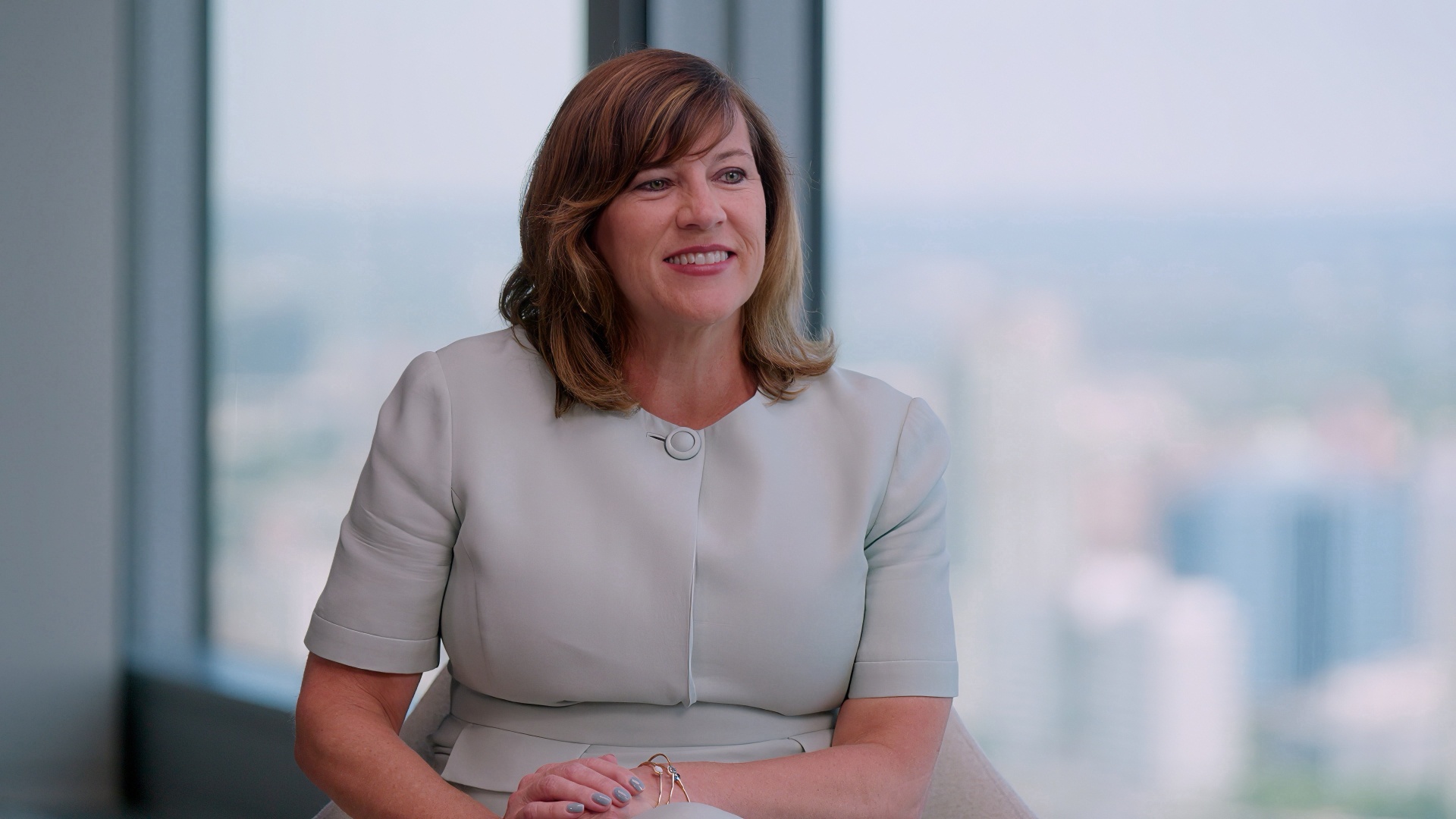
Jean Hynes, CEO of Wellington Management, has more than 35 years of experience at the firm. But she spends most of her time looking ahead, trying to envision what the world might look like in a decade and building portfolios around nascent opportunities. In an interview with Goldman Sachs’ Alison Mass on the Great Investors podcast, Hynes discusses innovation in the biopharma sector, how Wellington is using AI, and her path to the C-Suite.
Transcript:
Jean Hynes: The art of equity investing is really dreaming what is the potential of something that could be so transformational that people can't imagine it.
Alison Mass: I'm Alison Mass, chairman of Investment Banking in Goldman Sachs' Global Banking & Markets group and your host for this episode of Goldman Sachs Exchanges: Great Investors.
Today, I'm sitting down with Jean Hynes, who's the CEO of Wellington Management, an investment management firm specializing in equities, fixed income, hedge funds, and private assets with over $1.3 trillion in assets under management.
Well, welcome to Great Investors, Jean. So happy to have you here.
Jean Hynes: Thank you so much, Alison. Really, really glad to be here.
Alison Mass: So, I like to start these interviews by talking about your background. You majored in economics. But your college experience was somewhat unusual. So, tell us about that.
Jean Hynes: Yeah, so I went to Wellesley College. Just maybe a little bit of background. My parents were Irish immigrants. And so, I didn't know where I was going to go to college. Just going to college was a big thing in my family. And I arrived at Wellesley. I had pretty much a full scholarship. So, I loved the Wellesley alums ahead of me that provided that.
And my mother, being Irish immigrants, my mother wanted something she recognized. So, my first semester was computer science, which is the only C I got in my whole academic career. But I found my way to economics the second semester. And I loved it.
And actually, the interesting thing is I loved microeconomics, which is actually what I've done for my whole career. It wasn't just macroeconomics; it was the micro part where I really excelled at.
Alison Mass: Were you a first-generation college student?
Jean Hynes: I was.
Alison Mass: In your family?
Jean Hynes: First.
Alison Mass: So, they must have been really proud.
Jean Hynes: Yes.
Alison Mass: Yeah. Now, you've been at Wellington for over 35 years, which is amazing.
Jean Hynes: Today. Today is my 35th--
Alison Mass: Today? Congratulations.
Jean Hynes: My third-- Monday, of 35 years ago I started.
Alison Mass: Wow. July 20. That's fantastic. What a milestone. So, tell us a little bit about your first role at Wellington.
Jean Hynes: So, going back to Wellesley, I took one course. I didn't know what I was going to do. I loved economics. But yeah, I didn't really know about the finance world or the research world. But I took a sociology class, and I got a job in my junior year of college. And that's how I got introduced to the stock market. Got introduced to the world of finance.
I want to learn why stocks go up and down. I could verbalize that leaving my senior year of college. And back in 1991, it was not a great job market. You had the Iraq War. But I found my way to Wellington. And Wellington was a pretty small firm at the time. Under 300 employees. And I took a job as an administrative assistant in the research department of Wellington.
Alison Mass: That is a great story.
Jean Hynes: And I remember the recruiter telling me, "This is a great company. Don't worry about the title." So, I always say--
Alison Mass: We use that same line at Goldman Sachs.
Jean Hynes: "Don't worry about the title." And it was true, actually. It was very true. And I immediately did research assistant-- it was sort of a combination of administrative assistant, research assistant. I worked with three analysts, global industry analysts. I worked on models. And I opened mail. So, I was very fast at opening mail because I was very interested in sort of the research aspect of it.
Alison Mass: So, you say when you joined there were 300 employees. How many do you have now?
Jean Hynes: 3,000.
Alison Mass: Wow. That's a big difference.
Jean Hynes: Yeah, it's a big difference.
Alison Mass: So, you've said you didn't initially see yourself as a future CEO. So, tell me about when that changed.
Jean Hynes: So, I never saw myself as a CEO. I think it began to change in 2014 when I became a managing partner at Wellington. And I was working with an executive coach for the first time. And she asked me in the beginning of our session, "Do you want to be CEO some day?" And I said, "No, absolutely not."
I mean, I was managing $70 billion in assets from Vanguard Healthcare all the way to Longshore Biotech. I love investing. I love healthcare. And so, it just wasn't my ambition. The managing partner part of it was like a leadership part of it, talent part of it that I was super interested in the talent leadership part of it.
And then after working with Brendan Swords, our CEO for about a year, I could see, like I could actually see, well, the decisions he was making were very similar to the decisions an investor makes. Like, operating in that gray zone all the time. And so, I could see myself in him in some ways. And then I said at the end of that year of coaching, maybe I do want to be CEO.
And she gave me really good advice. And she said, "If you think you even have an inkling, then maybe we should continue working together." And that was really good advice. Because over the next six, seven years, it was really about could I be it? Did I have the skills to be it? How do I gain the skills? Did I want it? How did I want to spend my last period of time, my last decade at this great firm? Did I want to do it in this role? Or did I want to stay and really shepherd the healthcare business? So, it was good to have a thought partner.
Alison Mass: Well, there are a lot of people who are very glad you made the decision. That's wonderful. So, when you joined Wellington in 1991, the company was primarily focused on equities. And walk us through the growth from then to now in terms of the asset classes and the business base.
Jean Hynes: Yeah. So, I love thinking about Wellington in decades. I think it's a great way to look at companies in general and industries in general. And so, we were primarily equities. And not only equities, we were primarily value equities back in 1991. And so, I would think about the decade of the 1990s as expanding our equity capabilities into mid-cap equities, into growth equities, into all aspects of equities. Toward the end of the decade, starting international and global equity capabilities.
The decade of the 2000s would be our expansion, the beginning of our expansion into fixed income. We always had fixed income, but it was a much smaller part, a minority part of our business.
So, in 2004, we began a big investment into fixed income. The capabilities. And then also in the middle of that decade, which is why I went to London, we began to globalize our investment platform. And I think the leaders at the time were prescient in saying, "We are not going to be able to hire people in Boston to do everything we want to do." Because there were so many--
Alison Mass: That was prescient.
Jean Hynes: -- companies being created in Europe and in Asia. And we weren't going to get the best talent. And so, that was the reason behind, first London, and then eventually Hong Kong and Singapore expansions of our investment platform.
Alison Mass: And your view of 2010s and 2020s? How has it evolved?
Jean Hynes: Yeah, and then the 2010s, I would say two areas that we expanded in. From an investment capability perspective it was in we began our privates journey in 2014. We continued our globalization journey. And then we began to expand from a channel perspective into wealth in Europe and Asia.
In the US, we had these two great partners: Vanguard and Hartford Funds. And we were looking for them in Europe and Asia. And actually, those kinds of companies don't exist.
Alison Mass: Don't exist, yeah.
Jean Hynes: And so, that was a big expansion of our capabilities to really serve the wealth channel in Europe and Asia.
And then this decade, in this decade--
Alison Mass: The Jean decade.
Jean Hynes: The Jean decade. I think if I had to take a step back and when I retire someday, I hope we will say that we have a much stronger capability, manufacturing capability, in alternative investing. The decision that was made toward the end of 2019, so starting in 2020, was to separate hedge funds out of our equity and fixed income business, and to separate privates, which were then in our equity business.
And that was the right decision because then that has allowed us this decade to really focusing on building those capabilities in a really deliberate way. And we have now 100 investors that are dedicated to hedge funds and privates up from a very small number in 2020.
Alison Mass: That's fantastic. Of your assets under management, what is the percentage across these asset classes?
Jean Hynes: So, we have over $50 billion now in alternative assets across privates, hedge funds, extension strategies, CLOs. So, those have been the areas that we have expanded into in the past five, six years.
Alison Mass: That's real scale.
Jean Hynes: Real scale.
Alison Mass: All right. Now, you've spent most of your career investing in healthcare. What initially attracted you to that sector?
Jean Hynes: So, initially, I wasn't necessarily attracted to it. I was given the opportunity to work with what turned out to be my 20-year mentor, Ed Owens. But the interesting thing about Ed is back in 1992-- so, I started in 1991. In 1992, he managed Vanguard Health Care. That was about $500 million back then in 1992. He was starting a biotech portfolio. He was starting sort of an all-cap global healthcare portfolio. And he was the analyst. He was the global investor analyst that covered biotech and pharmaceuticals. And they wanted him to hire someone to work with him. And he did not like change. And he did not want to hire a senior person. He didn't want--
Alison Mass: And there you were.
Jean Hynes: And there I was. For a year I was his administrative assistant, plus his research assistant. But really from day one, he brought me to every biotech meeting, every pharmaceutical meeting. Early on I would go to client meetings with him. We were just like a match made in heaven in terms of what he needed and someone for me to like-- he was such a great mentor.
Alison Mass: That sounds like you were both very lucky.
Jean Hynes: Yeah.
Alison Mass: What a great match. Now, is there a specific investment or a deal from early in your career that taught you the really important lesson that you think about today?
Jean Hynes: First of all, working in the pharmaceutical and biotech industry, which was the area that I focused on, what a privilege. Right? Every industry-- I actually have a lot of friends at Wellington who are just as passionate about insurance. But really, like, when you think about biotech and pharmaceuticals and the ability for that industry to really change people's lives when it really comes to people's health. So, I have just had the privilege of interacting with so many amazing companies and CEOs over that period.
So, maybe I'll talk about two. One, I'll start with the lesson. Early in my career, you learn lessons that you hope you never repeat again. And I would say one lesson was there was a company called Elan, which turned out to have the early days of what is now the first Alzheimer's treatment. But they were a specialty pharmaceutical company, and I was very interested in them because of the Alzheimer's and their MS drugs, multiple sclerosis drugs. But they had come from kind of a background of doing drug delivery and specialty pharmaceuticals. And I avoided them for so long until the science began to show.
And then they had a really serious earnings miss. And it was all in this other income line. So, they had earnings hidden in the other income line that were not sustainable. And so, that was a really harsh lesson, meaning you as an investor, it's not good enough to say, "I'm going to focus on this fun part of studying multiple sclerosis or Alzheimer's." You also need to understand every aspect of the P&L. That you understand every line and you dig in.
So, I never let that happen again. So, that would probably be a lesson of making sure you don't make the same mistake twice.
And then maybe just as importantly, because lessons are what works and what doesn't work. The other lesson was we were investors in this company called Immunex, which is now part of Amgen. And they developed the first drug that really changed how you treat inflammatory diseases. It's called Enbrel. It's still around. It's still one of the largest drugs in this category.
And it was so transformational. And I remember it was my first big call, meaning the call that really separated me from peers out in the market because you had to imagine a market that didn't exist. I mean, there were lots of people who had inflammatory diseases. This turned out to be rheumatoid arthritis, and they were treated with steroids. There was no market for them. So, you had to imagine both how fast you could penetrate that market and also what the pricing could be. It was such a big advance.
Like, a lot of times in medicine, you step up. You step up to better treatments over time. This one was like a gigantic leap in efficacy. And so, it was very surprising.
So, like dreaming, right? But the art of equity investing is really dreaming what is the potential of something that could be so transformational that people can't imagine it.
Alison Mass: I'm just curious, how did you imagine that? How did you make that call?
Jean Hynes: I think it was based on partially the data, partly was published in the New England Journal of Medicine. It was presented. But it was really interacting with the rheumatologists, like the specialist. And you had to listen to them about what they were going to do. And so, it was the beginning of really using physician specialists to really dig into research.
Alison Mass: So, that's part of your diligence process, really going to the source.
Jean Hynes: Yeah.
Alison Mass: That's fascinating. So, there's a looming patent cliff driving innovation and M&A activity in the biopharma sector today. Do you think this will turn around the recent underperformance in the healthcare sector?
Jean Hynes: So, I would say there's always a patent cliff. It's a looming patent cliff. But it's perpetual in the sense that it’s the only industry in the whole world where once a patent expires you could lose 80% or 90% of your revenue. So, the cliff part of it is the reality when a big drug goes off patent, you lose it right away. So, it's an industry that constantly cannot be complacent. And constantly needs to innovate and evolve. And that's the exciting part of doing the research.
And it's also because there's so much going on. They can evolve because there's so much going on in science. And so, I would say that's the natural part of the industry.
I think the recent underperformance, and I'm 18 months away from investing in healthcare, but I do think the sort of uncertainty of governments-- and it's interesting, for healthcare and hospitals and insurance, we're kind of still in this post-Covid normalization. And so, I think it's like getting out of that, plus having more certainty about pricing, which is innovation number one and what the price will be is probably number two is what will matter for this sector.
And then you mentioned innovation. The interesting part of the biotech and pharmaceutical industry is that it's the discovery, it's kind of like our industry, the discovery is not a scale business. You might have thought 25 years ago the big companies are going to have this huge advantage on discovering drugs. And it has proven not to be the case. Small, innovative companies have more of a chance because they're so nimble at discovering new science as big companies.
And now, science is happening at big companies and small companies. But when you think about the scale of capital that big companies have, it's amazing that half the drugs are discovered originally at small companies.
And that's the exciting part of it. If you can find one of those gems that is that is going to have a new drug that is going to transform medicine and buy it at size at an early stage, there's a significant way of adding value to clients.
Alison Mass: So, as a biopharma specialist, you're always looking ahead. What medical advances do you expect to see over the next five to 10 years? And what are you most excited about in those medical advances?
Jean Hynes: So, first of all, when you think about where there's the most medical need. Still in cancer, right? We've made so much progress in cancer. But I do think we are still in the early stages of understanding what we describe as cancer. You describe it as lung cancer. You describe it as breast cancer. But it's really 10 or 12 different kinds of drivers of that cancer. And the more biologists can figure out what drives those, the more we're going to be able to have very specific drugs. So, that would be number one that I think we've made so much progress, but there's still so much more left to do.
I think the other part of it is this whole using the immune system to target cancers. That started about 10 to 15 years ago and we're going to get better and better at targeting the immune system to help fight off the cancers as well. So, that whole aspect is just really still very early days.
And then I go back to my Immunex example. We've gone from like in, let's say, 1991 when I started where all inflammatory diseases were treated with steroids to now in 2026 where you have maybe six or seven categories of anti-inflammatories. And I think we'll continue to break those down. There are so many anti-inflammatory diseases that are driven by different aspects of the very complicated and complex immune system.
And if you know anyone who's been treated with some of these drugs for RA or for skin diseases, multiple sclerosis, rheumatoid arthritis, just their lives are so much better today and their lives will be better in the future because the medicines will be more targeted, easier to use, longer durations. So, that aspect. I think those two are probably where the complexity of it is still not understood well enough that we're going to have a lot of innovation.
Alison Mass: So, I want to talk a little bit about the macro. And you mentioned that you moved to London right around the global financial crisis. But your investment career spans multiple crises. Bubbles. Market regimes. So, what period do you think taught you the most?
Jean Hynes: Yeah. So, I would say I'm going to talk about maybe three periods. Maybe 1999/2000, the global financial crisis, and maybe it's not a crisis, but a real regime change in pharmaceutical and healthcare investing.
So, the first one, and this is where I think Ed being my mentor was really-- I learned so much during the 1999/2000, and I would call it-- it was the internet bubble. But it was also the biotech bubble. And we had, if you look at the biotech stocks, they were just on a tear and not based on real, sound fundamentals. And I remember learning from him just being very disciplined about selling. About giving money back to clients in our dedicated strategies. About raising a ton of cash. And just the ability to stick with a thesis that you knew was right.
And so, that year then we were very well prepared then when the biotech bubble burst. So, I was just so young. And to learn that so young about these big regime changes and that's when you really have to protect your clients' capital. So, that would be number one.
I would say in ‘08, I didn't navigate ‘08 well. But ‘09 was one of my best years. And so, when I think about the two of them. But the reason ‘08 was hard is because so many companies had issued convertible debt. And that was kind of a new thing in the 2000s. And I never had to worry about debt. The companies had net cash. And so, actually then when the global financial crisis came and anyone with debt, as you remember, was under significant pressure. And so, we had some companies that had this convertible debt that actually then really reduced their cash position. And navigating that. I learned a lot in that.
I actually had so many conversations with biotech companies because they didn't know how to deal with it either. Right? So, I remember talking to some of my big holdings. I'm like, "You've got to reduce spending. You've got to let this work." I remember the conversations. It wasn't about the stocks are down. It was about how do you help your companies that also hadn't really navigated having leverage and they thought it was equity. And then it became debt. So, that part of it really was quite interesting.
So, I think you just learn these lessons over time. And then you go from, like, healthcare started working again in 2010 until 2015. 2015 was like an amazing year. And I remember then sitting in our morning meeting every day and really realizing healthcare was going up and energy was going down. And really recognizing that it wasn't healthcare. It was this transition. It wasn't that healthcare was fundamentally outperforming to that level. It was that energy was going-- like something was happening in the energy markets and they were looking for a place to put the money.
And so, just recognizing that this is probably a time to reduce our exposures and go up in cash. If you were in just one bubble and didn't recognize the environment around you, we might not have been able to position that. So, just learning lessons. There are these big regime changes that happen.
Alison Mass: Yeah, no, those are three interesting perspectives. So, in today's market, inflation is a top concern. And in fact, Wellington's research team predicted inflationary growth at the start of this year. Have you changed your outlook? And where are you looking for opportunities?
Jean Hynes: Yeah. So, actually, our team really changed their view on inflation five years ago. They probably emphasized it at the beginning of this year. But they really recognized back to these structural changes. That's where Wellington's research is so good. Is like when you have people that study inflation for 30 years and they really recognize that these structural changes are happening.
And so, I think for our macro investors who did recognize that trend, it was the change in globalization. The change in structural expectations and volatility of inflation, that it was going to be stickier than the market expected.
So, I think we still believe we're in that regime. I think the big unanswered question is will artificial intelligence (AI) be inflationary? And will it eventually be deflationary? I think those are some of the things our team is really thinking about. Will AI be a deflationary factor eventually, even though now it's probably an inflationary factor?
Alison Mass: I want to get back to AI because we can't have a conversation without talking about it. But you mentioned globalization. So, I wanted to get your perspective on in what ways portfolio management has changed in this era of heightened geopolitical tension.
Jean Hynes: So, in the era of heightened geopolitical tension, I think it's another factor that impacts portfolios. I'm not sure it's drastically changed portfolio, like how you think about portfolio management.
The real change in portfolio management is two things. One would be clients, particularly since the global financial crisis, want a smoother ride. And so, portfolio construction techniques have become a much bigger part of the portfolio management job.
The second thing is that the markets, particularly the US, not everywhere, are much more concentrated. So, how do you navigate a really concentrated benchmark is a portfolio construction change that is really impacting the art in the job of portfolio management. So, those are two sort of structural things. One from the client side and one from the market structure side.
And when I think about geopolitics, it's just part of the job, right? Like, if you're any kind of investor, you need to understand what is going to impact prices. And sometimes it's very micro, which is where I thrive. And sometimes it's macro. We've already talked a little bit about the macro.
But I'm going to give you a specific example of what I consider geopolitics now to be or similar to, an analogy. Back in 2008, President Obama was elected and we might forget with a 60 Senate majority. So, it's really unheard of. And back at the same time, healthcare was the number one issue. So, I didn't talk to a portfolio manager for a year at Wellington; they had no interest in the healthcare sector, because the healthcare sector was potentially uninvestable if we went to a single payer healthcare system.
And so, during that year, I remember my colleague and I, we studied the Senate. We studied the Senate in Nebraska and Montana and moderate Republicans and moderate Democrats. Really studied the moderate Democrats. And would read everything about them because we had to figure out if they were going to get 60 votes.
At some point we made a bet that they would not. And that we would not have a single payer system. And then as the year went on, they actually, you know, and obviously Obamacare was not a single payer system. But that was the role for a year. Like really studying.
Alison Mass: That's wild.
Jean Hynes: Down to the macro. Could this happen?
Alison Mass: Who would have thought it would have been spent spending all that time--
Jean Hynes: It's just an example of this time we-- like our investors really have to understand geopolitics and how it could impact the asset prices of their specific industry and sector or country. And so, that's part of the job.
Alison Mass: Fascinating. All right, so back to AI. So, how are you thinking about AI within Wellington?
Jean Hynes: So, AI is a topic we talk about quite a bit. And I would say a few years ago, like many CEOs, we decided to have an AI taskforce. And I remember the advice at the time. "There are 50 use cases. Start with a few." And the interesting thing is that those use cases are well and practiced now. The most important one for us is, we're like, what is our own IP? And so, now we have all of our company meeting notes sort of mandatory. Anyone that goes to see a company, goes into our data lake. And that is resulting in a lot of push. Meaning the AI can say, "This is what's happened based on all the company meetings we've had in the past week or month." And then also a pull for our investors.
You can imagine, like, the treasure trove of data when you think about 20,000 company meetings all over the world. So, that was like a very important use case.
And so, now the question from here is we're taking it up a level. We're working on lots of tools for our investors. And how do you use agents to help with the portfolio management job? But I do think we're taking it up a level for Wellington and have three big projects that are about to start that will hopefully change our operations, hopefully change our client experience, and really change how our investors’ workflow operates. And so, that's exciting.
Alison Mass: Yeah, no it is. A lot of companies are focused on operational efficiencies using AI.
Jean Hynes: Yeah. I think for us it's really about how we augment knowledge. Like, how do we make the investment management-- we're really focusing on how do we augment the investment management practice? Because it's hard. What we're trying to do, and we're a company focused on the manufacturing and the investment management part of it. And we're trying to figure out what's going to happen in the world in five years and 10 years and generate insights from that. If we can do that, then we can make recommendations and we can create portfolios. But like, how can AI augment that connecting dots at a much faster scale?
Alison Mass: So, maybe you talked about when you retire, so maybe this will be your legacy?
Jean Hynes: Yeah.
Alison Mass: What you've done with AI for the--
Jean Hynes: I think it will be the legacy of all CEOs in my era.
Alison Mass: Yeah. That's probably right.
Jean Hynes: How they adapt and adjust and who will use it to gain share and knowledge and who will fall behind.
Alison Mass: Yeah. So, I want to pivot a little bit to talk about culture at Wellington. You've chosen to remain private while many of your peers have gone public or merged or been acquired. So, what do you believe that remaining private has allowed you to do differently?
Jean Hynes: So, we'll be private for 50 years in 2029.
Alison Mass: Wow.
Jean Hynes: And the interesting thing, Alison, about that is that the private partnership started out of crisis. We were once one company with Vanguard. And there was a separation and there was a crisis for both companies actually. Crisis of identity. What were we going to do and what was Vanguard going to do? And we still relied on each other.
And that was also a period in the midst of a very difficult financial market. Think about the 1970s. And so, the ability--
Alison Mass: 1974.
Jean Hynes: Yeah. The ability to take the company private probably wouldn't happen if it had been a more positive market backdrop. And they studied partnership. So, they went out and studied all kinds of law firm partnerships, financial partnerships. And they went their own way.
And so, when you think about 50 years later their roots and the partnership agreement hasn't really drastically changed because they did such a great job of creating the right long-term words in processes and governance processes that allow a few things. One, it was the broad partnership at the beginning. It wasn't three or four people. It was 29.
And I talked about the three managing partners. The three managing partners, the responsibility of them in the end is really to promotions and compensation. It's all about talent. And so, you separate sort of the talent part of it from the running the business part of it. The CEO was always one of the managing partners.
But what it allows us to do is create these very long-term incentives. Because you have three people that are looking and being stewards of Wellington over long decades. We've just elected our 13th management partner. So, people stay in the roles for a long time. And they really are very focused on how do we think about the long-term sustainability of the partnership?
And I think it allows us to attract great talent. Because talent all over the world wants to be an owner and run their business. And so, that ability to create this long-term stewardship of the firm that aligns with our clients, that allows us to attract great talent and then perpetuate sort of an ongoing edge, that is, I think, what's special about the private partnership.
Alison Mass: So, I want to talk a little bit continuing on about leadership and culture. You are one of only five female CEOs among the world's 20 largest asset managers. Were there moments in your career that being one of relatively few women in senior investment roles shaped your perspective at all?
Jean Hynes: I think what shapes my perspective and what I've learned, and I think this is true of running a company. I think it's true of running an investment team. You want diverse, broad perspectives. And being female is one perspective. Being a child of immigrants is another perspective. I think all of those perspectives are really important. You want people that are extroverts. You want people that are introverts. You want people that think analytically. You want people that think out of the box.
And so, I think this industry, when I started, had little of that diversity. Of that broad diversity. I think it has a lot more of that diversity now. And I think that's the most important thing. Back to what we're trying to do is hard. Trying to figure out where the world's going is really hard. And so, having that diverse perspective, both on investment teams, as well as in leadership, I think, has proven to be one of the success factors of Wellington.
Alison Mass: Yeah. So, I want to talk about outside of work. And you mentioned you have four daughters, which we talked about. What is the most important lesson you've tried to teach each of them? And I'm curious whether any of them followed in your footsteps to be an investor?
Jean Hynes: So, the most important lesson I think I can teach my daughters, and I always say to them, is, "It's a long life. You should be doing something you love." So, like how do you make sure that you're in a career, you hang out with friends and family that provide you joy? And I think work can provide a lot of joy. It's provided me a lot of joy.
One story, back to when my-- I have twins, and they were in the magic marker phase anyone that's a parent will know the magic marker phase where they get it all over themselves and you're constantly trying to get it off their clothes and off your walls and off their body, hands, and face. So, we're Catholic and during lent they had to give up their favorite thing. And at that time, it was magic markers. And I remember the twins being-- and I think they were four, maybe, and they were in the backseat. And they're like, "Mom, what are you giving up for lent?" And I hadn't answered. They're like, "You have to give up your work."
And I think that's a funny story. But they knew I loved work. Actually, that made me happy. Like, that made me happy. It wasn't a guilty mom moment. It was a happy moment that they realized that I love work. So, that's my number one lesson. Find work that you love no matter what it is. And I have the four daughters. Two are in finance and two are in the consulting industry. So, all professional. And happy. And learning a lot. And we'll see what life brings them.
Alison Mass: What a great role model to have a mom like you. They're lucky. I understand you're an avid reader. So, I'm just curious, what are you reading now?
Jean Hynes: So, I'll be 100% honest and transparent. I'm reading a Taylor Swift book. Going back to the daughters. The four daughters like Taylor Swift-- I had no interest in Taylor Swift until a few years ago. Taylor Swift was on in the background raising my four daughters all the time. And so, we went to the Eras tour. And I went three times.
Alison Mass: Of course you did.
Jean Hynes: Because I had to bring all four daughters. Find tickets to go. And we went sort of--
Alison Mass: In what cities did you go?
Jean Hynes: London. Boston. Toronto.
And since then, there've been two books written. One by the editor of the Harvard Business Review which is The Strategic Genius of Taylor Swift. It's all about her background and the decisions she's made. And that book was excellent. And it really, when you think about it, it's like she's a CEO. She's a CEO of her enterprise. And that was a book about really the three or four strategic decisions she's made in the past 10 or 15 years that has resulted in her success. So, I thought it was a really fascinating book.
And then just recently in the last few months, a Harvard professor has a class on Taylor Swift. And it's all about the art and poetry of her music. And I don't play piano. I'm not a musician. And so, it was a totally different aspect of it. It's about the music. So, I'm almost done with that book. And I'm learning about chords and the art. And actually, I was an economics major, but art history, I took an art history class for a year that was probably one of my favorite classes of all time at Wellesley. And so, in some ways it's learning about the music part of that and the art part of it. It's like she's almost like an investor. Like the mindset of the art part of the music has been fascinating to look at it in that lens.
Alison Mass: Well, I love that answer. Not the answer I thought I was going to get when I asked you what book you're reading.
Jean Hynes: It's truthful. It's in my beach bag right now.
Alison Mass: I love it. All right, so I like to end these things with a little bit of a lightning round so our listeners get to know you a little bit. What do you think is your greatest strength as an investor?
Jean Hynes: I have two strengths. I connect dots really well. Which is actually why the CEO role became-- like, I always thought I had to be super creative. I'm actually not super creative. But I'm a super dot connector. And that leads to strategy. So, that part of it, like seeing, connecting tons of dots and seeing where an industry can go. I think that's probably number one.
And then I'm also like a high, high relationship skill. It's just who I am. And it's sort of an innate skill of connecting with people. So, connecting dots and connecting with people. And I think that has served me. People do their job in different ways. Having that relationship skill, I think, has served me really well in investing, as well as in leadership.
Alison Mass: All right, so, what is the best piece of advice you've ever received?
Jean Hynes: I'll tell you a story. I think it was a pivotal moment. This is coming from Ed Owens, who by the way, doesn't like change. He also wasn't a big feedback-- he was like feedback by osmosis rather than feedback directly.
Alison Mass: So, he never actually gave you direct feedback?
Jean Hynes: Yeah. Until 2008, we were on a train going--
Alison Mass: It's funny you remember where you were.
Jean Hynes: Oh, I remember where I was. It was really awkward. And I had been working with him for almost 20 years at that point. But he was giving me feedback. He could see it from afar. I had been away from him in London for almost a year. And he could see this tendency from afar more, that when I was investing, I wanted it to be right. And so, I was starting to-- and I was a partner for many years at the time. I was starting to have thesis creep or stubbornness when things didn't go. When the data changed.
And so, he bravely gave me this awkward feedback. And I bravely accepted the feedback. And I think it took me probably a year-- and by the way, my results at the time, my performance was quite good. I told you later in the year it became more difficult. But I do think he could just see I was becoming stubborn. Which is the worst possible characteristic of an investor.
So, I think for that I pivoted. And it took a little while. But then I just became really much better at just taking in every data point and not having thesis creep.
Alison Mass: I love that fact that you remember where you were when he gave it.
Jean Hynes: I don't remember what I was wearing. But I remember--
Alison Mass: After 16 years working with him.
Jean Hynes: Yeah.
Alison Mass: So, how do you spend your time outside of the office? What are your hobbies?
Jean Hynes: So, I have--
Alison Mass: Other than reading about Taylor Swift?
Jean Hynes: Reading from Taylor Swift. So, I'm from a gigantic family. I'm one of six siblings. On one side of the family, I'm one of 51 grandchildren. I have like this cocoon of a family. And so, really the most important thing I like to do out of work is just spend time with family and friends. It's really important to me.
And then separately, maybe from a what do I do when I spend time? Like, actually getting better at tennis. Going on a tennis journey. And then I've spent 15 years getting better at skiing. So, I went from a never being on skis to this winter I did a black diamond every weekend.
Alison Mass: Oh, that's very impressive.
Jean Hynes: So, it's been a slow journey. But kind of like the investing journey. Once I learn how to do it, I'm willing to take some risk.
Alison Mass: That's great. It's a great life sport. So, which investor do you admire most?
Jean Hynes: Well, I have to say Ed Owens who, you know, for those of you who have never heard of him, and you probably haven't heard of him because he never really sought the spotlight. But he probably has one of the, you know, top-- when he retired in 2012, he had one of the top probably 10 records in the history of all investors.
So, I think what I admired about him so much, which I got better at over time and it's part of the lesson that the feedback he gave me, he was so forward looking. He was so client oriented. And the job wasn't to research biotech companies and pharmaceutical companies. The job was to create portfolios that generated alpha. And so, learning that whole thing. Like you have to do the research in order to generate the insights that have to be differentiated. Then you have to-- he was such a risk taker. The ability to take risk and be very comfortable with big, outsized bets. And the ability to change his mind like when things change. He was very dispassionate.
And so, all of those-- like that whole continuum of what made him a great investor, I have adopted parts of it. And part of it is my own. But that ability to see the whole process and how you have to-- it's not one thing you can be good at. You have to kind of be good at all of it to be a great investor. And he was an amazing investor.
Alison Mass: Yeah, he sounds like it. All right, so my final question is what are you most excited about in the world right now?
Jean Hynes: I hadn't thought about that one. What am I most excited about in the world? I grew up in an industry following an industry that innovates, that was innovative. So, what I'm most excited about is that I think we're going to go down a journey in the next five-10 years with AI just like we did 25 years ago with the internet that I think is just going to create whole new-- it's going to improve health. It's going to create new industries. It's just going to be a fascinating-- we're in a moment, like in a really important moment that is going to change how companies operate and what is created in the future. And I think that's super exciting.
Alison Mass: That is exciting.
Jean Hynes: So, that's, I think, what I would have to say. We're in a pivotal, pivotal moment.
Alison Mass: Well, Jean, thank you so much for joining me. This was such a fun conversation and fascinating insights.
Jean Hynes: Thank you so much, Alison.
Alison Mass: Thank you all for listening to this episode of Goldman Sachs Exchanges: Great Investors, which was recorded on Monday, July 20, 2026. I'm Alison Mass. If you enjoyed the show, we hope you'll follow us on Apple Podcasts, Spotify, YouTube, or wherever you listen to your podcasts. And leave us a rating and a comment.
The opinions and views expressed herein are as of the date of publication, subject to change without notice, and may not necessarily reflect the institutional views of Goldman Sachs or its affiliates. The material provided is intended for informational purposes only, and does not constitute investment, legal, or tax advice, a recommendation from any Goldman Sachs entity to take any particular action or be used as a basis for any other investment decision, or an offer or solicitation to purchase or sell any securities or financial products. Any forward-looking statements, case studies, computations or examples set forth herein are for illustrative purposes only. Past performance is not indicative of future results. Neither Goldman Sachs nor any of its affiliates make any representations or warranties, express or implied, as to the accuracy or completeness of the statements or information contained herein and disclaim any liability whatsoever for reliance on such information for any purpose. Each name of a third-party organization mentioned is the property of the company to which it relates, is used here strictly for informational and identification purposes only and is not used to imply any sponsorship, affiliation, endorsement, ownership or license rights between any such company and Goldman Sachs. This material should not be copied, distributed, published, or reproduced in whole or in part or disclosed by any recipient to any other person without the express written consent of Goldman Sachs.
A transcript is provided for convenience and may differ from the original video or audio content. Goldman Sachs is not responsible for any errors in the transcript.
Date of Recording: July 20, 2026
© 2026 Goldman Sachs.
All rights reserved.
Subscribe to Briefings
Our weekly newsletter delivers the latest insights on economic forces shaping markets—from Goldman Sachs leaders, economists, and investors around the world.
You can unsubscribe at any time. For information about how your personal data will be used, visit Privacy Information and Resources.