

Talks at GS
Dimensional’s David Booth on How to Interpret Risk and 'Stay Calm' Amid Uncertainty
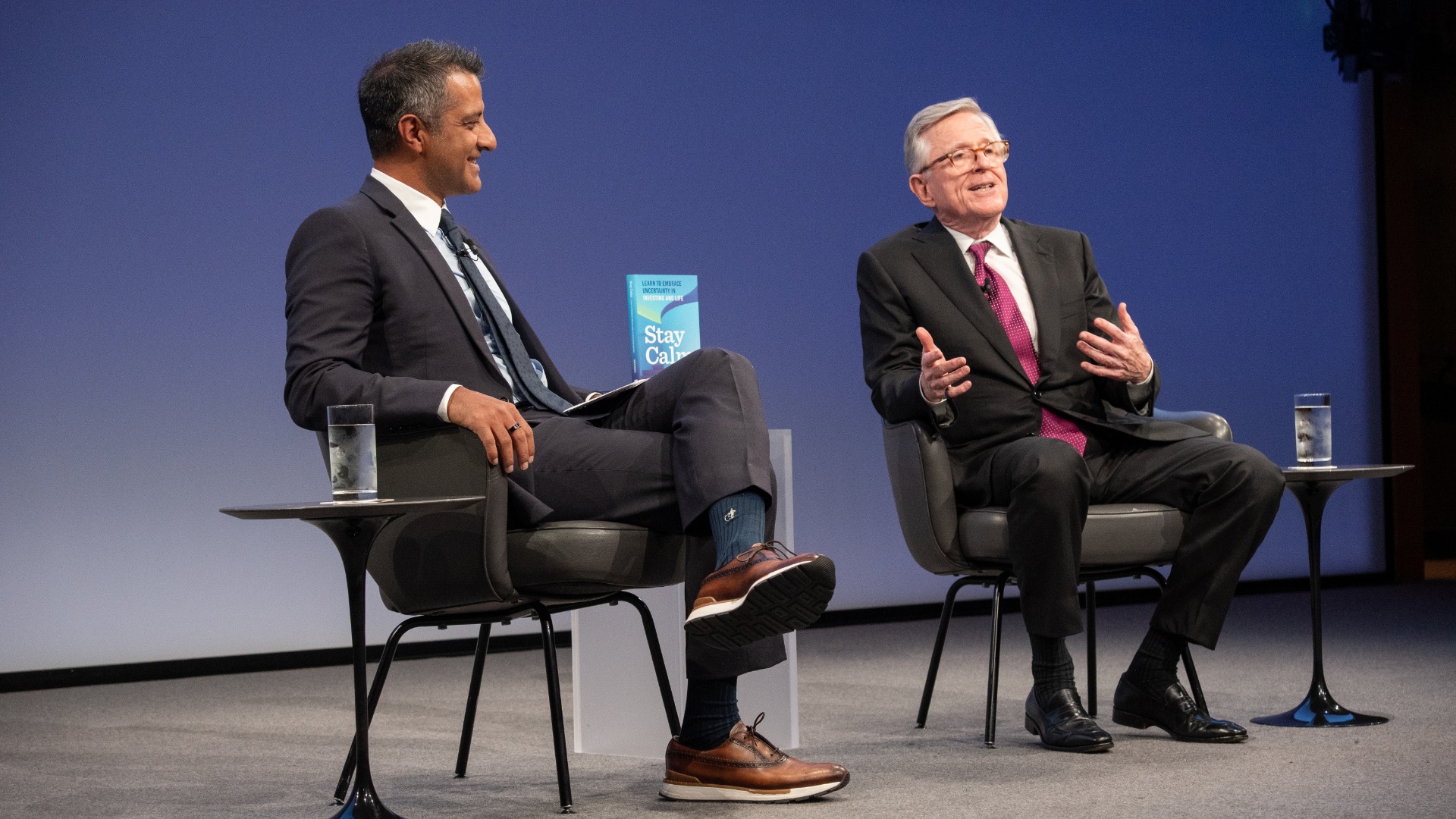
David Booth, the founder and chairman of Dimensional Fund Advisors, uses academic research and market evidence to manage more than $1 trillion in assets. Booth, the author of Stay Calm, joins Raj Mahajan, a senior partner in Goldman Sachs Global Banking & Markets, to discuss how to interpret risk and uncertainty, how outsiders can participate in the market as effectively as insiders, and the long-term magic of compounding.
Transcript:
David Booth: Where you end up in life, you know, it is the result of the compounding of many decisions you made over time. You won some of the time, you lost some of the time. There are no shortcuts, and maybe that's where wisdom comes from.
[MUSIC INTRO]
Raj Mahajan: I am thrilled to be joined by my friend David Booth, co-founder and chairman of Dimensional Fund Advisors. Welcome David.
David Booth: Well, thanks for having me.
Raj Mahajan: From selling shoes in Kansas to studying under Nobel Laureates at the University of Chicago, ultimately founding Dimensional, not too far from here in Brooklyn. And then it has now, over the last five decades, become this extraordinary institution that is educating investors on markets, risk, and evidence-based investing. And then you wrote a book, Stay Calm. And that's what I'd love to jump into today and talk about some of those insights.
Let's go back to the University of Chicago. Something galactic happened where you became galvanized by these big ideas that ultimately inspired you to start Dimensional. What were some of these big ideas?
David Booth: Well, first off, these ideas were really new. Before 1960, there really wasn't research-quality data where you could test out much of anything in investing. And that all changed in the 1960s with the CRSP data. Then all of a sudden, you have the development of investing as a science. You can't have a science without testable hypotheses. So, now they have data, and they could test a lot of things.
And one of the things, of course, they've been testing for the last 60 years is professional money management.
Raj Mahajan: Yeah, active management.
David Booth: Worth the cost? Yeah. And those were really exciting ideas. Because the conclusion was, we can't seem to find the value in professional management. I mean, there are undoubtedly people out there that can beat the market. There are just too few of them. When you have fewer than you would expect by chance, you can't separate out skill from luck.
And so, depending on your point of view, that was either exciting and innovating, or it was, you know, something that was threatening to you. And it was basically threatening at first to Wall Street before they realized how cool it was to trade with index funds.
Raj Mahajan: You tell this lovely story about finding $15,000 in your late father's lockbox that had not been invested. And it lost 80% of its purchasing power by the time you found it. And one of the reasons you cite is that your parents felt like outsiders, and as a result, didn't trust investing. So, tell us a little bit more about this ethos of being an outsider and how it's influenced you in your approach.
David Booth: My parents, they didn't trust markets because they thought as an outsider, if they invested, the insiders would take advantage of them and just take all their money. So, they never invested.
Now in 1985, when I opened the lockbox, it was 40 years later. If you'd gotten the market return over the last 40 years, what would it have grown to? It would have grown to over a million dollars. That's just an example of the magic of compounding. And one of the lessons that I wish I'd been able to convince my parents of, the magic of compounding.
The second part of the story, of course, is back when they were around, you know, market portfolios weren't readily and easily available. So, forget about this idea about being an outsider. You know? You can do apparently about as well as the insiders just by buying the market.
Raj Mahajan: I like this connection you drew in the book between being an outsider and uncertainty. And that actually uncertainty creates more optionality and opportunity for you. Can you talk more about uncertainty and why it's something to be embraced, in particular, if you're an outsider?
David Booth: Investing is uncertain and complex. So is life. If there is no uncertainty, I mean, if everything had been predetermined, you know, you wouldn't have been able to progress the way you have in life. And in investing, if there were no uncertainty, in other words, then everything would be riskless and all investments would have a riskless rate of return. So, it's the uncertainty creates the opportunity. And so, it's not about eliminating uncertainty. It's about managing uncertainty in life and investing.
And there are some kind of general themes that are in the book. How do people go about doing that? Well, you know, first thing is don't bet all your money on your ability to predict. You know? The market is inherently unpredictable. And so much of life is unpredictable. Very few people here could have said 20 years ago that they'd be sitting in this auditorium. You know?
So, what you want to do is plan rather than predict. You know? Observe outcomes, be flexible, adaptive. And over the long haul, you know, there's a good chance you'll be okay.
Raj Mahajan: Speaking of be okay, for those who have been investing in equity markets, over the last hundred years, the return has been 10.2%.
David Booth: Yeah.
Raj Mahajan: So, how do you interpret that risk premium and why it's persistent? And then if you extrapolate forward, we're also in another moment in time with artificial intelligence and the transformational effects it might have. Are the gains in the stock market going to accrue to 10 firms and not the balance? Do you think it'll persist? And if so, tell us why.
David Booth: I mean, there are two parts to the story. The first is 10% by itself is amazing. When you figure all the economic scenarios we've had over the last hundred years, somehow, and it's kind of one of my passions, you know, the market, the stock and bond markets in the US, they're really miracles. Anyway, as you pointed out, there's about a 6% risk premium. In other words, stock returns over riskless assets, it's been about 6% a year. And that's really the story that I like to talk about because academics have studied this like crazy.
And I think they're kind of missing one crucial factor here, which is human ingenuity. And by that, I mean, you know, we've had all kinds of economic scenarios. And when you get into a bad economic scenario, you know, people don't just give up and go, "Oh, gosh, that's boo-hoo." They figure out how to get back on track and figure out how to do things new and different. I mean, I think most of you remember in the pandemic, all of a sudden, you've got Peloton and DoorDash, and all the kinds of things spring up. I said, you know--
Raj Mahajan: Zoom.
David Booth: Zoom. In 2020 they're saying, "What's going to happen?" I go, "I don't know what's going to happen. But here's what I believe. I believe that you'll see this human spirit take shape and be entrepreneurial. And there'll be winners and losers. Yeah, I don't know who the winners and losers will be, but there'll be a lot of both. And what I do believe is this will cause us to get back on track faster than you might think."
And as you recall, that recession was one quarter long. I mean, that's a miracle given the magnitude of the problem.
Raj Mahajan: Utter mistake if you would have sold stock at the lows during, you know, the most fearful parts of COVID.
David Booth: So, people are pulling their hair out. Then they look at it, the market's down 20%. They go, "Oh, gosh, you know, holy cow, I've got to get out." And then, of course, the market ended up 20% for the year. So, if it's down 20% to begin with, you have to come back 40% to get up to that total of 20%.
Raj Mahajan: Exactly.
David Booth: And as we've talked about, you know, there are no mulligans in this business. I mean, if you missed out on that rise, there's no do-over. To get that 10.2% that you've talked about, you've got to be there to be assured of getting it. You know, our goal is if we can help more people better understand how markets work, the stock and bond markets, public markets, then they'll be able to make more sensible choices. And if they can make more sensible choices, they're going to feel calmer.
Raj Mahajan: And one of my favorite quotes in the book is, quote, "By owning a share of the market, we get to participate in the upside of human ingenuity."
David Booth: That's it. I mean, that's really what we're talking about here. We don't know individual stocks or which companies are going to really have a great time and when bad times hit. But the overall market, that's really what we're talking about.
And, you know, sometimes people say I'm an optimist, because that all sounds pretty. I don't think I'm an optimist, I think I'm a realist. I mean, it can't be any other way. People aren't going to invest unless they think they can have a positive expected outcome. It's where buyers and sellers come together. You know, they don't trade unless each side thinks they got a good deal.
Raj Mahajan: By the way, there's no shame of being an optimist. Maybe there's a strong connection between true wealth and optimism.
David Booth: Yeah, I don't know which one comes first. But I would say if you're lucky enough to be an optimist, you're really wealthy already. If you really know what your values are, and one of the keys to investing is figuring out, you know, what do I really care about? Where am I headed in life?
And that's why I said my parents, even though they didn't have much money, were wealthy. For them, it was all about family.
Raj Mahajan: Let's pivot to David Booth, the business builder at Dimensional. In 2003, you had $50 billion of assets under management. You tell a story in the book of, in 2004, you really challenged your leadership team to 10X and be a $500 billion asset manager.
You got there, spoiler alert. But tell us about what you learned about leadership on that journey and how some of that may be applicable to anyone in the room today.
David Booth: Well, I believe strongly in giving people a lot of autonomy and so forth. Nevertheless, you have to have some kind of collective vision.
Raj Mahajan: Aspiration.
David Booth: Aspiration or where are we headed? I didn't say, "Look, in 15 years, we're going to go 50 to 500 billion." I said, "Plan on being 500 billion."
Raj Mahajan: Basically, setting the aspirational goal accelerated those conversations internally.
David Booth: Yeah.
Raj Mahajan: Another aspect to Dimensional's extraordinary success is tapping into RIAs and investors via the RIA channel. Can you tell us about the story of how that came to be? Because it sounded like in the book, you may have been a little reluctant at first to embrace that.
David Booth: When we started, all of our clients were large institutional clients. In 1981, pension funds were huge and those were our clients. So, we had an advisor in Sacramento come up to us and say he'd like to have access to our funds. Now, what was unusual was that right from the get-go, even though our clients were institutional clients, we wanted to commingle for administrative ease and mutual funds.
So, the price of these funds are institutionally priced. You know, they're very low, which made them very attractive to RIAs. So, we're not so sure. You know, commingled funds are great as long as everybody behaves themselves. What you don't want to have are people getting in and out all the time and generating costs, you know, for the other shareholders.
So, he said, "No, no, I'm not that kind of person." So, we said, "Okay, we'll give you access, but we'll monitor what you're doing." And about a year later, he comes back and goes, "You know, I think there's a business in this."
At that time, the RIA market was teeny tiny. I go, "Okay, well, here's what we're going to do. First off, advisors, if they want access to our funds, they've got to go through a platform like a Schwab or Pershing or Fidelity. And secondly, before we give them access to the funds, they have to come meet with us at one of our seminars." I mean, to a casual observer, that doesn't sound like that's the best marketing strategy, forcing people to come to your offices and spend a couple of days learning about what you do.
Raj Mahajan: Dimensional boot camp?
David Booth: Dimensional boot camp. But funny, in a way, that turned out to be kind of clever marketing, because people, once they got accepted, they felt kind of pride in, hey, look, I've got access to these funds. And that took off. Now more than two thirds of our assets come from the RIA market. It's been amazing.
Raj Mahajan: Now, at a trillion. I'm sure there's a lot of lessons in leadership. And you've built this culture that prizes evidence over ego. And how do you hire and develop people who can allow you to scale from $500 billion to a trillion and where you're going next?
David Booth: One of the things we don't have difficulty doing, same with Goldman, is we don't have trouble finding really bright people that want to work hard. That's kind of a given. But what we're looking for, first off, is this person a team player. And the other thing is, you know, they kind of have to believe our story. I mean, we have a different point of view about markets and how they work. If you want to do a lot of trading, you probably won't last in our firm.
Raj Mahajan: We've seen a massive rise in retail. And their participation seems to be in equal parts active trading, you know, prediction markets. You know, you can't watch a sports game without sports betting. How do you help educate people on the distinction between whatever you want to call that and investing? Because they're coming into the market, which is a good thing. But how do you characterize the distinction?
David Booth: Well, let's talk about risk and return. In the prediction markets, you're taking a risk. You wonder, is there going to be a return there? Gambling is gambling. You know? As you start with the market, I call buying the market investing. And it's perfectly reasonable for people to take some of their money and say, "Look, I'd like to do something else with it. You know, private equity or pick a few stocks." It's irresistible. I wouldn't do it. It's okay for some people, but it's not right for me anyway. Anyway.
Raj Mahajan: There are a couple of stories in the book that I know had a profound impact on you. Do you mind sharing a little bit about your high school math teacher and what that lesson learned was? Because I'm seeing it as a through line in a lot of what you're talking about.
David Booth: Yeah, I think that-- actually her name was Mrs. McReynolds. What I've learned is almost everybody has a Mrs. McReynolds story. Well, mine was that my senior year in high school I was taking a calculus class. And this is where the University of Kansas is. And they had arranged with the university that at the end of the first semester if you took a test, you did well enough, they would give you college credit for it. And so, I took the test and I didn't do well enough to get college credit. And I was totally humiliated because I'd always taken great pride in my math. And so, I transferred out of calculus.
And in my new class, you know, the first day of class, I'm sitting there and Mrs. McReynolds walks into this new class. I'm trying to look inconspicuous and she's out there pointing, "see me in the hall." And so, I go out there and she just tells me how badly she feels. And she wants me back in the class.
She'd realized when I wasn't there in the class that, you know, she wondered where I was. She went down to the office, found out where my new class was, came out and found me. And that changed everything for me.
Raj Mahajan: She believed in you.
David Booth: Believed in me. And so, as you know, I mean, kind of my career from that point on, basically, was a heavy dose of math, econometrics, and stuff. But I wouldn't have done it without her.
Raj Mahajan: It's amazing how even someone as successful in this field needed somebody to say, "You can do this and, you know, don't quit at this, you know, I believe in you."
David Booth: Sometimes it's the little, seeming little things that you do can have a huge impact long-term for people that you work with. That's one of the points we try to stress with people. And sometimes I ask people, tell me a story about how you dealt with uncertainty. You had a big decision to make, what did you do? And often it comes down to, well, first off, I played for the long haul. I wasn't that concerned about, you know, next month, which gets into compounding. And where you end up in life, you know, it is the result of the compounding of many decisions you made over time.
Raj Mahajan: There's no shortcuts.
David Booth: There's no shortcuts. And maybe that's where wisdom comes from.
Raj Mahajan: David, you're an inspiration and a legend in our industry. Thank you for being here today. And everyone should read this book. Thank you very much.
David Booth: Thank you.
The opinions and views expressed herein are as of the date of publication, subject to change without notice, and may not necessarily reflect the institutional views of Goldman Sachs or its affiliates. The material provided is intended for informational purposes only, and does not constitute investment advice, a recommendation from any Goldman Sachs entity to take any particular action, or an offer or solicitation to purchase or sell any securities or financial products. This material may contain forward-looking statements. Past performance is not indicative of future results. Neither Goldman Sachs nor any of its affiliates make any representations or warranties, express or implied, as to the accuracy or completeness of the statements or information contained herein and disclaim any liability whatsoever for reliance on such information for any purpose. Each name of a third-party organization mentioned is the property of the company to which it relates, is used here strictly for informational and identification purposes only and is not used to imply any ownership or license rights between any such company and Goldman Sachs.
A transcript is provided for convenience and may differ from the original video or audio content. Goldman Sachs is not responsible for any errors in the transcript. This material should not be copied, distributed, published, or reproduced in whole or in part or disclosed by any recipient to any other person without the express written consent of Goldman Sachs.
Subscribe to Briefings
Our weekly newsletter delivers the latest insights on economic forces shaping markets—from Goldman Sachs leaders, economists, and investors around the world.
You can unsubscribe at any time. For information about how your personal data will be used, visit Privacy Information and Resources.