

Talks at GS
ESPN’s Jimmy Pitaro on the New Playbook for Sports Fans
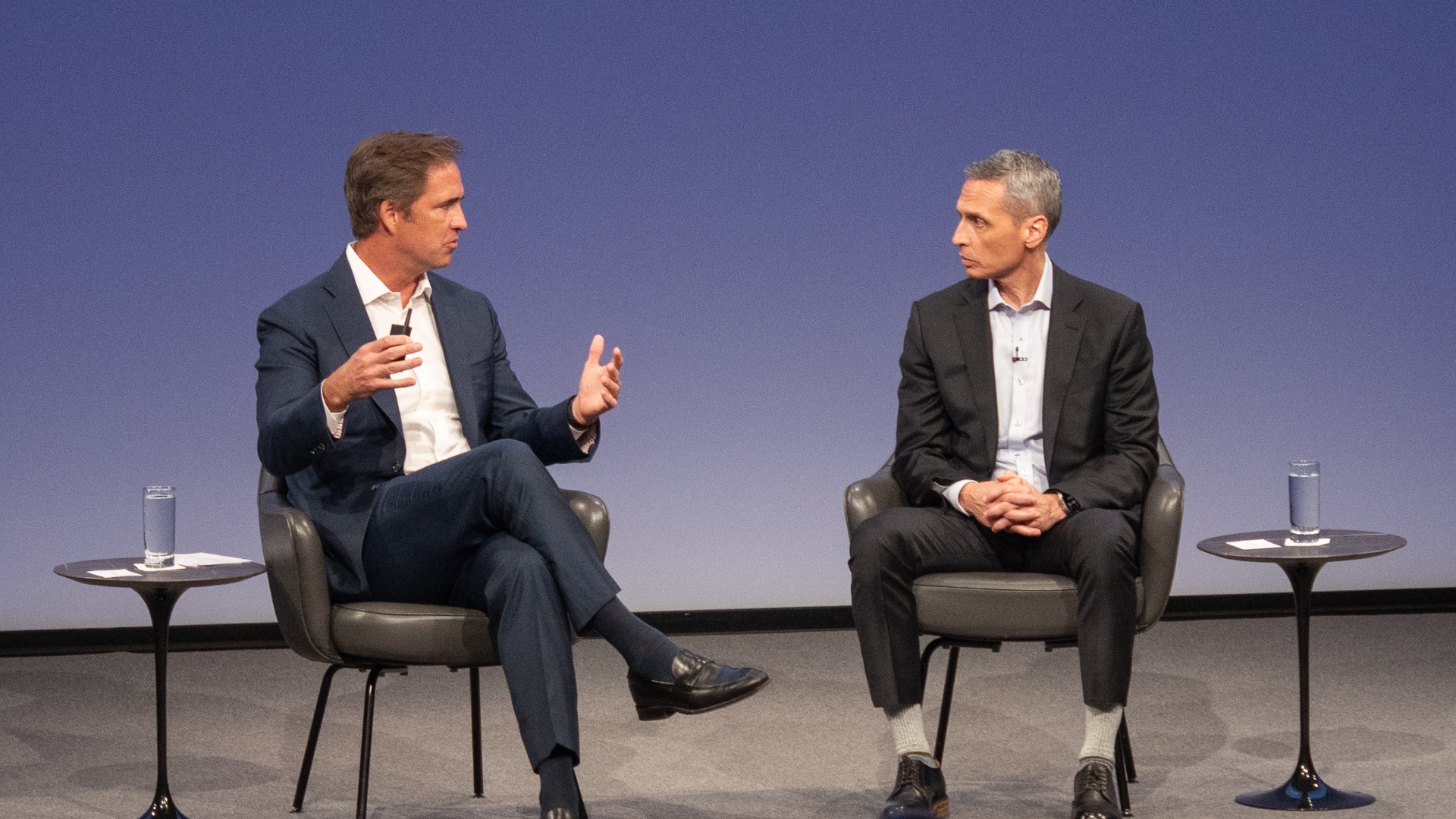
The launch of ESPN’s direct-to-consumer service a year ago was a marker of change in the sports media business—offering the full suite of ESPN networks without a pay-TV bundle for the first time. ESPN Chairman Jimmy Pitaro joins Dave Dase, global co-head of the Sports franchise in Investment Banking, and discusses how this challenging decision helps the company reach younger viewers and “serve the sports fan anytime, anywhere.” Pitaro also talks about the strength of ESPN’s current sports rights portfolio, why the company is sometimes willing to walk away from media rights negotiations, and explains how AI allows ESPN to create new offerings.
Transcript:
Jimmy Pitaro: The foundation of ESPN is live events. Everything that we do, original content, our 30 for 30, E60, SC Featured, our studio programming. It all is built off of that foundation of live games.
[MUSIC INTRO]
Dave Dase: Good afternoon. Welcome to Talks at GS. I'm Dave Dase. I head up our Southeast business and co-head our global sports business in investment banking. I'm joined today by Jimmy Pitaro, chairman of ESPN, who's led one of the most important transitions in sports media.
Under Jimmy's leadership, ESPN launched its full direct-to-consumer streaming service, expanded its partnership with the NFL, and continued reshaping how fans watch, follow, and engage with sports, all of which we will discuss today.
Jimmy, you signed and closed a deal with the NFL on Red Zone NFL Network earlier this year. Maybe just talk about the impact that's having, right, as you think about broadly NFL football.
Jimmy Pitaro: Well, let me first say thank you for the partnership on that. You were involved in that in that deal. We feel great about it.
For those of you that don't know really what we're talking about, we acquired the NFL Network. ESPN did. We also acquired their entire fantasy business. We acquired their Red Zone linear business, and we acquired the Red Zone brand. In exchange, the league took a 10% equity stake in ESPN.
Walt Disney Company owns the majority. We have another shareholder, Hearst. And now we have the NFL at 10%.
The relationship with the league, I think, has never been better. I think they're very pleased with the deal. We're very pleased with the deal. We've now ingested NFL Network into the ESPN app, which I'm sure you want to talk about. But now if you're a subscriber to our premium tier called ESPN Unlimited, you have access to all the programming of NFL Network.
We are, as I said before, the official game, the official fantasy game of the NFL. So, we've combined those two products.
Many of you probably saw this. We had a US Open Red Zone, which filled me with joy. It was exactly what I was envisioning when we were negotiating this deal with the league and looking to acquire that Red Zone brand. Not just the linear product, but the Red Zone brand. What else could we do with that brand?
We kicked it off with the US Open. We're looking at other opportunities. Potentially college football, although we haven't decided on that yet. That's something that's on the board. But we're in really good shape here with this deal. And we're excited about what it means for the future at ESPN.
Dave Dase: Maybe talk about a year ago you launched the direct-to-consumer platform and streaming platform. That was a tough decision. Something that was talked about in, you know, the ecosystem for many, many years, for you as well as other, certainly the other more traditional or legacy broadcast cable-oriented type businesses. But talk a little bit about that process, what your goals and objectives were, and just how it's performed thus far.
Jimmy Pitaro: You nailed it. It was a really tough decision. And the entire industry was focused on it. What is this going to mean? If ESPN goes direct-to-consumer over the top, what is that going to mean for cord cutting? Are all sports fans then going to cancel their paid TV subscription?
We knew that wouldn't happen. I mean, we have, call it high-level, maybe one-third of the market from a sports viewership perspective. We don't have everything. We can't have everything. It doesn't work for us.
From our perspective, knowing that it wasn't going to cause a total collapse of paid television, which has been very good to ESPN and the Walt Disney Company. It's a fantastic business model for us. We had to be very careful in terms of when we were going to actually go direct-to-consumer.
And I spent many, many hours in a conference room with Bob Iger on this topic. And so, ultimately, we made the call that we would go summer of 2025. And so, we did it in August of last year. So, we just celebrated our one-year anniversary.
Look, our strategy was what I often refer to as parallel paths. Meaning how do we make ourselves available to people who are not interested in paid television? Okay? Mostly the younger generation, but there are others my age that are just not interested in paid television anymore. We need to be there. Our mission is to serve the sports fan anytime, anywhere. And so, if you're not interested in paid television, we still need ESPN to be accessible to you.
Okay, so we're going to go direct-to-consumer. At the same time, as I said before, paid television has been really important to us in our bottom line. And so, how do we go direct-to-consumer and protect that legacy or traditional business?
And so, what we ended up doing, and this was a very challenging decision and somewhat of a polarizing topic early on in the discussions, we decided to make ESPN DTC available to all paid TV subscribers long-term. Ultimately, now we have to get the deals done with the distributors, but the vast majority of distributors today are now offering what we call entitlements. Meaning, if you're a subscriber to Charter, Comcast, YouTube TV, Hulu Live. You fire up the ESPN app. You enter your credentials and you get access to everything ESPN direct-to-consumer.
So, what does that mean? That was our way of adding value to paid TV. So, we went direct-to-consumer. We're available there as an option. But if you're a paid TV subscriber, that subscription is far more valuable to you than it was yesterday.
Two things. Timing. We knew we were going to go direct-to-consumer. It was a matter of when, not if. And do we offer these entitlements to paid TV subscribers? And the answer to that one was yes.
Dave Dase: Great. Let's talk a little bit about media rights. From my sense, the comprehensive best content out there, you probably have the strongest portfolio today as you've ever had. How do you think about the value proposition of what rights do you want? How do you think of return on investment?
Jimmy Pitaro: I get this question all the time. It's probably where I spend the most amount of time dealing with rights. The foundation of ESPN is live events.
Everything that we do, original content, our 30 for 30, E60, SC Featured, our studio programming. It all is built off of that foundation of live games. And so, thank you for acknowledging that. Yes, our rights portfolio today, we're 47 years old at ESPN. And it's the best it's ever been. It's the best that the industry has ever seen from any one enterprise. So, we feel really good about that.
At the same time, as I mentioned before, we cannot have everything. It just would not work for us financially. We spend just as much time analyzing things that we end up passing on as things that we end up acquiring. But we sit down, we do the analysis. We have a very sophisticated rights acquisitions team, a very sophisticated strategy team, finance team. We all get together. We look at value to pay television. Are the affiliates interested in this content? We look at projected ratings and corresponding ad sales. And then we look at value on the direct-to-consumer side. And then we make the best offer that we can.
But we're at peace. If the league or the conference is looking for something significantly more, we're at peace with walking away.
All that said, Dave, I still really like our hand. Historically, we're competing against NBC, CBS, and Fox. Today, we're still competing against the incumbents. And yet we're competing against Netflix, YouTube, Amazon, Apple, DAZN. And so, it's fiercely competitive. But I said I like our hand. And the reason why I said that is because we're the Walt Disney Company. And so, when we sit down at the table, we don't just bring ESPN linear. We bring everything that I mentioned before digitally. We bring broadcast through ABC. We bring Hulu. We bring Disney Plus. We bring the power of the theme parks for promotion.
And so, I'm not quite sure a league or a conference is going to get that kind of value. We also bring the megaphone that is ESPN. We're the only folks that are covering sports every day, all day long, 365.
We are in a really good place here because that portfolio that you mentioned, it's locked up. Like, for the next, I don't know, five to 10 years, we're in really good shape because those rights are spoken for now.
Dave Dase: Yeah. It seems like you have an interesting rights decision to make with respect to the college football playoff. Maybe talk about there's been an explosion in terms of sports valuations. We've certainly seen that. Women's sports, people are really talking about. There's real capital going into. And I often get asked the question by clients or investors or people who may want to buy a team, you know, what's going on? Why is this different now with women's sports?
I give you and ESPN a lot of credit for - women's sports needed oxygen. And you, in some ways, were the oxygen, which gave distribution platform both at the college level as well as at the professional level. But talking about that. Was that intentional? Was it part of the strategy? How did you think about women's sports and how are you thinking about it today? Because it's a fantastic moment for, you know, both of us have daughters. And many of you, right, you have daughters who are playing sports and everything else. It's a fantastic time.
Jimmy Pitaro: Thank you for recognizing that. I can take zero credit for ESPN's investment in women's sports. It long predates me. This has been a multi-decade priority at the company. I mean, we were the WNBA launch partner 30 years ago. We've had the NCAA women's tournament for decades, which is a crown jewel in our portfolio.
But I will tell you that, you know, over the past decade, we have significantly increased our investment in women's sports, both professional and college. You know, we now have a fantastic partnership with the NWSL. We have a partnership with Athletes Unlimited on the softball side, which we love. That's another sport that's on fire. Women's volleyball is on fire. Everything volleyball is up and to the right.
We're also, as an extension of the live games, we're investing in women's fantasy. Fantasy is a big part of our DNA at ESPN. We have significantly more women's studio programming today than we did a decade ago. We love the fact that the industry is kind of working with us here. It's not just ESPN. Others are clearly-- our competitors are clearly making investments as well. And what we're seeing is this rising tide.
And last thing I'd say on this is the dollars are following. Like advertisers, sponsors are very focused on women's sports. So, fandom is heading that way. And so are the dollars. So, it makes perfect sense for us on a variety of levels to be increasing our investments.
Dave Dase: Incredibly competitive, right, areas to be in, in and of themselves. What was your approach? For a sports fan out there, they would say, gosh, you have the dream job, right? Running ESPN. But what was your approach just from a career development kind of advice? Or how did you get to where you got to? Or, you know, what sort of skill set got you there?
Jimmy Pitaro: Well, I am, as you are, I'm a crazy sports fan. My wife thinks I need therapy on this. Like, I'm not exaggerating when I say my mood is completely dependent on how the Yankees do like the next day and how Notre Dame football does. My whole life has been team sports. Dave and I also played together. And so, I know you can relate to this, but my whole life, I've just loved team sports.
By the way, this started at Edgemont High School in Scarsdale, New York, which is where your CEO went. David's younger brother was my classmate at Edgemont High School. And he was a friend of mine.
But my fandom, my crazy fandom, I was surrounded by crazy sports fans. My mom does not watch it when the Yankees are in the field because she thinks nothing good can happen when the Yankees are in the field. Like that's how crazy-- My sister is the general counsel of Major League Baseball. Like I'm surrounded by crazy sports-- all of my friends, we used to leave Edgemont High School and go to the Bronx and sit in the bleachers. So, my crazy fandom started then.
You know, played in college. And you know, my fandom just continued to grow. I was a lawyer. I learned a ton. I went to law school and practiced. I was a litigator for several years. Learned a ton on the litigation side, really starting with like public speaking and the importance of brevity. But yes, then I made the transition to the business side at Yahoo and got immersed in technology.
That was a blessing for me. Everyone has breaks during their careers. And so, when I was asked to leave law and run a business, it was Yahoo Sports. I went from managing 12 people to managing over a thousand people overnight, most of whom were technicians, engineers, front end, back end engineers, designers. I'm this lawyer guy managing these folks. And that was quite daunting. But baptism by fire. I learned a ton.
By the way, I was competing with ESPN every day of my life. I woke up every day and challenged the team, how are we going to beat ESPN?
Anyway, I met Bob Iger, Steve Jobs, who I'd worked with, and Sheryl Sandberg, who I knew very well, were on the Disney board. They were looking to make a change. Bob was looking to make a change on the digital side. That's actually how I joined the Walt Disney Company, not to run ESPN, but to lead Disney Interactive, their digital horizontal business. It doesn't exist anymore today.
But because of my Yahoo days and being immersed in technology, I was able to take a lot of that learning and be effective at Disney Interactive. And then in 2017, the gentleman who was running ESPN resigned.
Working for Bob was such a blessing. Every year during my review with Bob, he would ask me, or we would have a conversation around what I wanted to do next and would always end with ESPN. So, fast forward to 2017, the ESPN job opens up and Bob calls me, "I'm assuming you want this?" I said, "Yes." And then I had to interview 16 times. I had an interview with the entire board and several people in corporate. Anyway, ended up getting the job. And it's been a dream.
Dave Dase: Talk a little bit about your management style today, sitting on top of this organization all over the world, 24-7, 365. You have massive personalities, right, in the media business. You have best-in-class innovative technology. What's your management style? How do you handle this?
Jimmy Pitaro: I just love being a part of a team. I really do. And so, the highlight of my week is my senior staff meeting. All of my direct reports and I get together, and we sit in our ESPN boardroom, and I say, "Discuss, debate, decide a line."
And so, our chief of staff puts together the agenda. And we have real tough debates. She'll tee up the discussion and we will debate. And my direct reports know that not only can they challenge me, but I'm still learning. Every single day, I'm trying to learn and be an effective leader, but I want to be, I need to be challenged. I don't just want yes people around me.
We have really healthy discussion and debate. And then we try to decide as a team. We don't get paralyzed by the analysis. We try to decide as a team. And more often than not, far more often than not, we do. But there are times where we can't agree. And so, then I make the decision. That's what I'm getting paid to do.
And then the most important part of that is alignment, right? Once the decision is made, and I feel really strongly about this, and I've had some roadblocks in my career on this last one, but as a leader at the Walt Disney Company and ESPN, you lose the luxury of questioning the decision after it's been made. Right? You want a forum to be heard. And you have that at ESPN. But once we make the decision, or I make the decision, then the expectation is alignment, even if you were in the minority, you didn't agree with the decision.
You asked me what my leadership philosophy is. There are several components to that. But at a macro level, I think that's the most important thing I would call out.
Dave Dase: We talked a little bit about artificial intelligence. As you sit here today, as we sit here today, what do you think it's like being a fan 10 years from now, 20 years from now? Where does this innovation go? I had this debate with some team owners around, is there ultimately a physical sporting world and, you know, a completely digital, in essence, sporting world that coexists, overlapped to some extent? But just with AI and everything else, where do you think this goes?
And I will say, right, most of the owners who are calling, or most people who want to deploy capital - institutions, individuals, billionaires who want to deploy capital into sports teams, are now, at least for the last 9 or 12 months, saying it's a hedge on AI. Right?
Jimmy Pitaro: I hear it all the time.
Dave Dase: People want to be there. It's a true hedge. It's an asset allocation play. And I think, in large part, I mean, we've seen some pretty significant uptick in sports valuations. And so, I think part of that, you know, is from that. But just how do you think about AI and where does this go and what's it like to be a fan?
Jimmy Pitaro: My old boss contributed to that increase.
Dave Dase: He did. He did, yes. Teams are being bought, not sold.
Jimmy Pitaro: Yeah. Everyone's talking about AI today, of course. We've been invested in AI for many, many years at ESPN. And so, the SportsCenter For You that I mentioned before would not exist without AI.
But for us, AI has been nothing but a blessing. And for the sports fan, from my perspective, it's been nothing but a blessing. It hasn't displaced jobs. Okay? If anything, it's helping our business grow so that we can hire more people. Like, that's how I look at it. But examples outside of SportsCenter For You? Highlights. Highlight generation. Like, a lot of that is being generated through AI. We can generate far more highlights at scale than we ever could before.
We talked about women's sports, but some of the smaller leagues, like the Premier Lacrosse League, NWSL, TGL, we can now do game recaps that are automatically generated.
Now, we can't go out and hire 5,000 people to create game recaps. It just would not be cost effective for us. We're running a business. But now, through AI, and it's not always perfect, but we can generate game recaps.
Investigative reporting. I talk about this all the time. My commute to Bristol, Connecticut, sometimes I'm in the car for an hour and a half. And so, our investigative reports oftentimes could take you 30, 45 minutes to read. They're very lengthy and in-depth. And I don't have the time to get through all of that. So, now, you can just tap on the Listen button and the narration is automatically generated. I expect to see a lot more of that.
In terms of your point on sports being somewhat AI-proof, I do agree with that for the most part. Again, full circle, I think AI is going to do nothing but-- not just for ESPN, but for the industry, is going to improve the experience. Whether it's in stadium - we all know what's happening now with places like Cosm. Like, that whole experience is off the charts great from my perspective. And I think that's just going to continue to improve.
Dave Dase: Well, thank you very much. Thanks for being a client. Thanks for being so generous with your time. Most importantly, thanks for providing all this content that makes everybody's lives so interesting.
Jimmy Pitaro: Thank you for having me, everybody. Appreciate it.
This episode was recorded on September 10, 2026.
The opinions and views expressed herein are as of the date of publication, subject to change without notice, and may not necessarily reflect the institutional views of Goldman Sachs or its affiliates. The material provided is intended for informational purposes only, and does not constitute investment advice, a recommendation from any Goldman Sachs entity to take any particular action, or an offer or solicitation to purchase or sell any securities or financial products. This material may contain forward-looking statements. Past performance is not indicative of future results. Neither Goldman Sachs nor any of its affiliates make any representations or warranties, express or implied, as to the accuracy or completeness of the statements or information contained herein and disclaim any liability whatsoever for reliance on such information for any purpose. Each name of a third-party organization mentioned is the property of the company to which it relates, is used here strictly for informational and identification purposes only and is not used to imply any ownership or license rights between any such company and Goldman Sachs.
A transcript is provided for convenience and may differ from the original video or audio content. Goldman Sachs is not responsible for any errors in the transcript. This material should not be copied, distributed, published, or reproduced in whole or in part or disclosed by any recipient to any other person without the express written consent of Goldman Sachs.
Subscribe to Briefings
Our weekly newsletter delivers the latest insights on economic forces shaping markets—from Goldman Sachs leaders, economists, and investors around the world.
You can unsubscribe at any time. For information about how your personal data will be used, visit Privacy Information and Resources.