

The Markets
The US Midterms: Reshaping the Stock Market
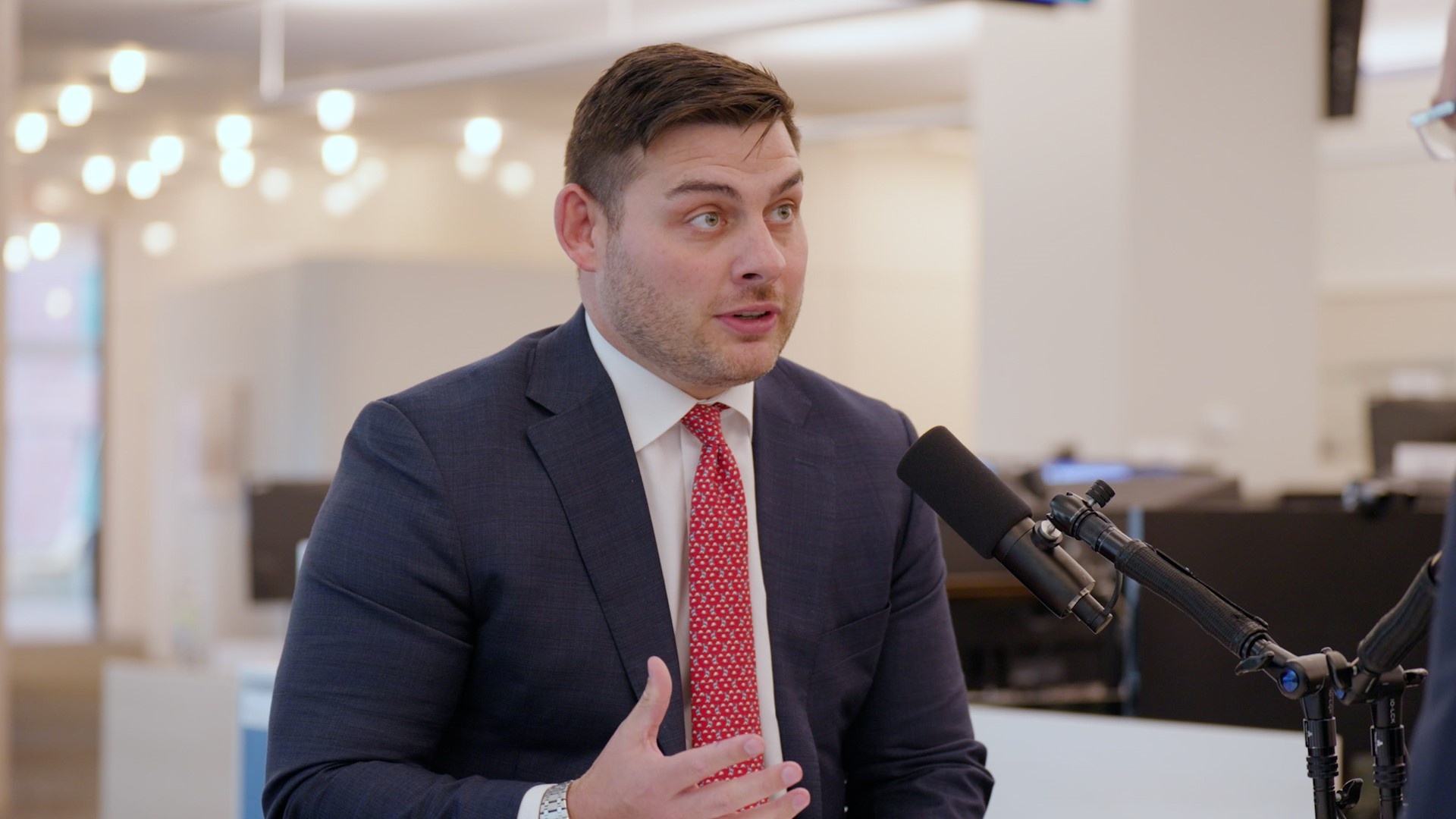
The US midterm elections could strengthen the stock market rotation that was already underway, says Lou Miller, global head of Custom Basket Trading in Goldman Sachs FICC and Equities. Traditional defensive sectors such as consumer staples are expensive right now, but healthcare stocks may provide defense along with earnings acceleration, Miller explains on The Markets podcast. He also says that stocks related to the data-center buildout have fallen sharply, resetting valuations and lowering the bar for positive surprises.
Transcript:
Chris Hussey: This is The Markets. I'm Chris Hussey, and today is Thursday, November 5th, and we're here on the Goldman Sachs trading floor with Lou Miller, who is our global head of our custom baskets business within FICC and Equities. And on the back of the midterm elections, we're going to explore the market reaction and where we go from here.
Lou, thanks so much for joining us.
Lou Miller: Thanks for having me.
Chris Hussey: Let's start with the rotation trade that you can see from your baskets group. In particular, that there was a rotation already happening before the midterms. How is that evolving post midterms? Where do you think it heads into the year end?
Lou Miller: Yeah, so we've seen, especially in the second half of the year, it's been a really challenging environment for active investors, and we've seen people get very defensive. If you look at beta-adjusted net exposure in our prime book, it's definitely at very low levels versus history.
Chris Hussey: Let me peel back the onion a little bit on the rotation. Let's talk about data centers if we can. How is that data center trade holding up in the post-election world?
Lou Miller: Worse than I would've thought. I think it's bigger picture concerns like ROI, open-source competition, limits on capital markets came into picture the last few months. The AI data center trade, the right tail of that trade has increasingly gotten removed, and multiples have dramatically dropped to much healthier levels.
We now see data center stocks down 36% from their highs earlier this year. And then some of the higher beta areas like memory down 42%, optical networking down 46%, even NeoCloud's down 57%. So the early reaction was way more extreme than I would've expected, but I think the silver lining is the bar is much, much lower for surprises and there are positive catalysts ahead.
Think about this: the multiple for the data center trade is about half of what it was in June. We're at liberation day lows in terms of multiples. So you can't argue valuation is a headwind anymore, and there are some positive catalysts ahead.
Chris Hussey: Okay. I want to dive now into a little bit of a comment you made about defensives, and I want to go back to the post-pandemic era where tech became the new defensives.
Let's explore the AI trade more broadly. You talked about a rotation. You talked about the data center trade. What about the AI trade more broadly? Is that a new defensive kind of trade, or is that really evolving?
Lou Miller: I think the next leg of the AI trade is actually healthcare, and I think that's also a very defensive sector that historically is very uncorrelated to AI.
Healthcare, we notice those companies are getting very involved at, like, the tools and diagnostics level and that there's now we're going from headwinds to tailwinds there. There's both cyclical and secular drivers there and it's really one of the few sectors that we're going to see accelerating growth next year.
AI touches a lot of different parts of the economy, a lot of different parts of the market everything from the application layer, like cybersecurity, but I think healthcare is an area that increasingly looks more and more credible.
Chris Hussey: All right. If the new defensives aren't the new defensive, what is the new defensive? What do you want to play defense?
Lou Miller: So yeah. So expensive defensives I don't think are defensive.
Chris Hussey: Oh my God, expensive defensive.
Lou Miller: In a slowing growth environment, not just for the AI CapEx complex, but the real economy it does make sense to be defensive, but you don't want to take it too far.
You don't want to bury your head in the sand. So you take staples, for example, the earnings yield of staples is half of the high yield bond yield. The dividend yield of staples is half of the 10-year treasury yield. To me, that's not a good deal for investors. I think people should look beyond the traditional defensive label and look for other characteristics, like quality or free cash flow yield or earnings yield in this higher nominal growth backdrop.
I think those dynamics are going to be a lot more defensive than a traditional defensive like staples.
Chris Hussey: All right, great. So, we've walked through it. We've walked through the AI trade, the data center trade, the expensive defensives. Let's put a bow on it. What's the trade?
Lou Miller: I think the S&P 500 excluding AI is the trade.
So rather than pay 25 times earnings for some, you know, boring consumer product, you can pay a high teen multiple for low teens earnings growth. These are some of the highest quality balance sheets in the market. You're buying quality compounders in a decelerating growth environment.
That seems like a safe play here over the next six months.
Chris Hussey: I'm just curious, if you buy the S&P ex AI, how many stocks is that?
Lou Miller: Well, you can, you can get about 500 if you- Just got to add a few extra.
Chris Hussey: I like that. I love that. All right. As we go deeper into the end of the year, what are you watching for?
Lou Miller: Employment, inflation, the geopolitical events that have passed, and then the rest of earnings season. Those are key. And then longer term, I'm watching the equity capital markets quite closely, debt capital markets closely, and then the FOMC decision on December 9th.
Chris Hussey: I know it's early yet, but I've already gotten some Hallmark ads in front of me.
Santa Rally or no Santa Rally this year?
Lou Miller: I think a relaxed Santa Rally, yes.
Chris Hussey: Oh, a relaxed Santa Rally. I like myself a relaxed Santa. Lou, thanks so much for joining us.
Lou Miller: Thanks for having me.
Chris Hussey: That does it for this week's episode of The Markets. I'm Chris Hussey. Thanks for listening.
This episode was recorded on November 5, 2026.
The opinions and views expressed herein are as of the date of publication, subject to change without notice, and may not necessarily reflect the institutional views of Goldman Sachs or its affiliates. The material provided is intended for informational purposes only, and does not constitute investment advice, a recommendation from any Goldman Sachs entity to take any particular action, or an offer or solicitation to purchase or sell any securities or financial products. This material may contain forward-looking statements. Past performance is not indicative of future results. Neither Goldman Sachs nor any of its affiliates make any representations or warranties, express or implied, as to the accuracy or completeness of the statements or information contained herein and disclaim any liability whatsoever for reliance on such information for any purpose. Each name of a third-party organization mentioned is the property of the company to which it relates, is used here strictly for informational and identification purposes only and is not used to imply any ownership or license rights between any such company and Goldman Sachs.
A transcript is provided for convenience and may differ from the original video or audio content. Goldman Sachs is not responsible for any errors in the transcript. This material should not be copied, distributed, published, or reproduced in whole or in part or disclosed by any recipient to any other person without the express written consent of Goldman Sachs.
Subscribe to Briefings
Our weekly newsletter delivers the latest insights on economic forces shaping markets—from Goldman Sachs leaders, economists, and investors around the world.
You can unsubscribe at any time. For information about how your personal data will be used, visit Privacy Information and Resources.