

The Markets
What a Fed Rate Hike Could Mean for US Stocks
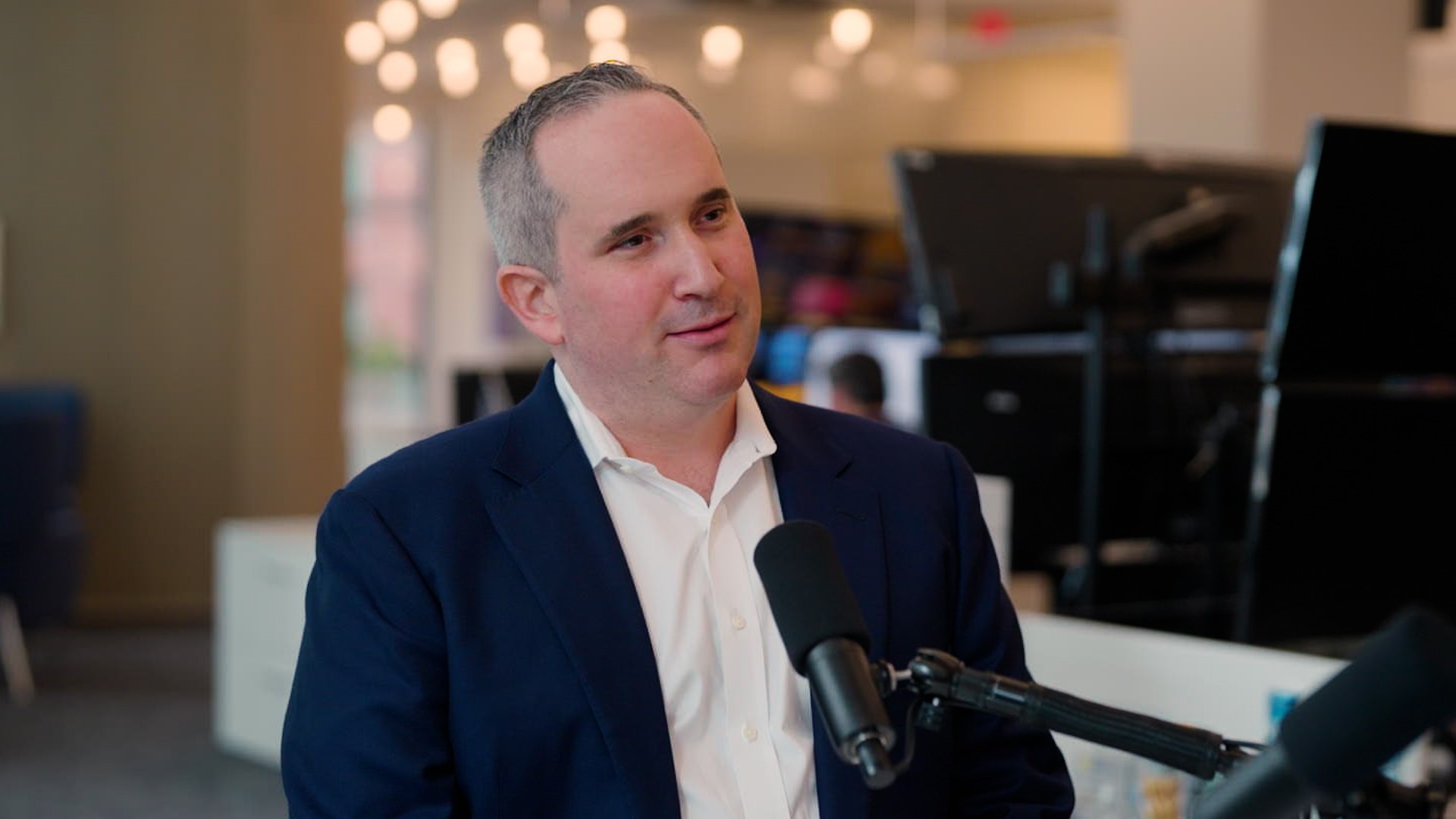
Investors are pricing in a higher likelihood that the Federal Reserve will hike rates after core CPI inflation rose in August more than economists had estimated. However, a rate hike may not keep the US stock market from climbing higher, says Jonathan Shugar, head of Cross Asset Sales in Goldman Sachs FICC and Equities, on The Markets podcast. Companies reported strong earnings growth in the second quarter, and valuations near the 10-year average are not stretched, he explains. Shugar also discusses why a Fed hike may not restrain investment in artificial intelligence, the risks in longer-term interest rates, and the potential opportunity for investors in consumer experience stocks.
Transcript:
Chris Hussey: This is The Markets. I'm Chris Hussey, and today is Friday, September 11th. Before we start, I want to acknowledge that it's 25 years since the 9/11 attacks. As our chairman and CEO, David Solomon, said in remarks, "Our firm joins the community in honoring the lives lost that day, as well as the first responders, recovery workers, and survivors, and everyone who suffered from 9/11 related illnesses."
I'm also joined today on the Goldman Sachs trading floor by John Shugar. John is head of cross-asset sales within FICC and Equities. John, thanks so much for joining us on The Markets.
Jonathan Shugar: Thank you for having me, Chris. Great to be here.
Chris Hussey: Well, first time, long time for you, I know. Tell us a little bit about cross-asset sales. That could encompass anything. What exactly is it?
Jonathan Shugar: What we like to do is be like our clients, which is ultra-flexible as to where the opportunity set is. That's really what drives it. The team is about 25 people, specialists across equities, derivatives, execution, credit, rates, and FX.
And so really what we're able to help people do is capture these inflection points in markets, whether that's going from a growth equity cycle to a credit cycle, or whether that is looking at asymmetric hedges.
And you've seen the utility of that ever since the subprime crisis to different rate hiking cycles or credit protection, where we look for asymmetric hedges. And we'll talk a little bit more about that later on.
Chris Hussey: Yeah. Well, it sounds like having the inflection guy here is perfect because we just got the CPI report.
The FOMC meets next week. Looks like we might be in for an inflection. What do you make of the CPI report and the reaction that the market's had so far?
Jonathan Shugar: So, I think that the market reaction is telling you that they're going to hike next week. We have something like 84% odds priced for that, and for 50 bps before year-end.
That's not to say that inflation has not followed some of what the people who want to hold say, which is you haven't seen shelter inflation continue to go and goods inflation moderated. It was really driven by things like communication services. That being said, with it being so hot and the Fed having said they're data-dependent, the market is telling them that in some ways it's actually more dangerous not to hike because you might lose control of the back end in that case, and that's one of the bigger risks to the market.
Chris Hussey: Yeah, it's a great point, cause the Fed controls the front end through their Fed funds rate, but the back end is controlled by the markets, and the markets can do anything they want there.
Let's talk a little bit about equities for a second here, because this also is back to school week, and we've had a series of things that always happens in the back to school, and people come back and they're trading heavily.
The market, though, has kind of flat-lined since early August. What do you make of the rally that we've had and where do you see it going from here?
Jonathan Shugar: So we've had some near-term challenges. Momentum has had an extraordinarily tough last two months. When you look at technical levels here, you have both CTA and systematic flows against you in the near term.
That being said, we just finished our Communacopia conference. One of the biggest themes in the market right now is AI. The companies coming out of there could not have been more bullish. And to the people who say the market is expensive, we're trading at a 19 PE. That's the 10-year average. We've had S&P earnings growth of something like 30% on the second quarter.
So, if you look at that, you basically have a market where all of the heavy lifting has actually been done on the earnings side. And when you think about the drivers going forward, there's terrific opportunities within various AI consumer sectors which are off highs, to really say that, well, over the next few weeks we may have a lot more speed bumps.
But if you and I are sitting here at year-end or we're sitting here next year, we're talking about an S&P that's probably well over 8,000.
Chris Hussey: Okay, John, let's examine de-globalization because your customers can invest anywhere in anything all at once, and there have been a lot of geopolitical risks. We're seeing it in the oil tape. What are your customers saying about those geopolitical risks today?
Jonathan Shugar: So, one of the most interesting things has been the things that really impacted the market negatively when you think about Liberation Day as the original tariff announcement. Those have become less relevant to price action as we go forward, and it's a trend that we've really seen since COVID, which is the duration of opportunity to take advantage of dislocations to the market is getting less and less, and the moves to correct to the upside are much more violent.
Now, when you think about geopolitical risk out there, there's certainly things which are near term. You mentioned oil. If you look at Brent right now, you're trading around 104, but you look out one year, you're buying Brent at, with a seven handle on it. So, this is still viewed as a more near-term problem.
That doesn't mean you can't have local disruptions. On the product side, whether it's gasoline, diesel, heating oil, probably looks incrementally worse for Europe than the US, but that can certainly be something that comes up. All of that should be relatively short duration in terms of impact but can certainly drive local price action.
When we think more broadly, there are geopolitical impacts on both the positive and negative side. Obviously there's a good reason why you might want to look at a country like Brazil, and we've seen investors increasingly look to buy upside there as they're going into an election in October.
Chris Hussey: Brazil. When the market zigs, you zag. I love it. Okay. You're a risk guy. Let's talk a little bit more broadly about risks here because I know you have a view. What are the risks out there that you're watching and how do you wanna hedge them?
Jonathan Shugar: So, as we think about what the largest risk on the board is, it really, outside of some of the true tells, which are global geopolitical risk exploding is really in the back end of the rate curve.
And that is because, one, there's natural impulse for this to be higher. You have global fiscal deficits. This is not just a US problem. This is everywhere. You have a ton of AI issuance, so hyperscalers doing about $800 billion of CapEx this year. Our analysts estimate something around $1.2 trillion next year.
So, there's a lot of natural supply which is competing for money. Now, if you get a really sharp move in rates, cause equities can tolerate higher rates. It's really just the pace of change that has the biggest impact. So, the way we like to hedge that is really in two ways: either buying outright payers or payer spreads on the back end, the 30-year part of the swap curve, or looking out and doing something like a CMS cap, which is the shape of the curve between front and back end, and we think that there's good returns out there.
Now, we always love 10 X-type trades. On reasonable strikes, you can probably still make five to six X your premium. And so that's what we're talking to investors about now.
Chris Hussey: Five to six X. I thought everything was 10X, but okay. You say equities can tolerate higher rates, but do they tolerate higher rates because as long as the rates are going higher because of inflation, equities are indexed to inflation, so they're a nominal asset, so they go up?
What happens if the higher rates are tied to something more like a debasement trade?
Jonathan Shugar: So, if they're tied to a true tail risk debasement trade, that would obviously be negative in the short term for equities. If you get true hyperinflation, and you can go back to Zimbabwe or anything you want, that could be really good for equities because they are a nominal asset.
That being said, I think the reason people are thinking about all of this is, one, economic growth remains good. The fact is that hiking25 or 50 basis points doesn't change the need for the strongest balance sheet companies in the world to be investing heavily in CapEx, given how transformative a technology AI is going to be, and the consumer outside of the low end still is okay.
And so, you compare that to the fact that most consumer stocks are trading 30% plus off their 52-week highs. There just seems a real disconnect here. And so, as you think about equities going forward, people got very surprised by things like biotech performing so well. And biotech, another thing that typically has a lot of correlation negatively to higher end rates being higher.
Well, I think consumer and there are pockets of that we like, there are pockets of that we don't like, could be the thing that surprises into your end. By the way, another plug for our conferences, we've got our consumer conference next week. So, we're going to know a lot more after that.
Chris Hussey: Okay, you gave us a great hedge trade, but give us one more. What's the trade?
Jonathan Shugar: So, I think that there's a lot that can be done here. Number one, within consumer, there's both longs and things that we're more cautious on. On the long side, the experiential type names, whether it's cruise, whether it's events, things that people really want to do and spend money on, especially at the high end, that continues to see a lot of growth.
On the flip side, there have been companies releasing agents for consumers. Well, guess what? If you don't have to spend two hours to switch your phone plan to a cheaper plan that's probably something that could be really impactful, and so we're a little bit more cautious on some of the impacts there.
We mentioned AI briefly. A lot of the CapEx picks and shovels are trading well below market multiples. A lot of the semis type names trading well below market multiples. You're seeing capital return in some of those places and other interesting things. We think this is a temporary air pocket and those have good runway ahead of them.
Chris Hussey: Terrific. Sum us up for this here. What are you watching for next week and the weeks ahead that we should be keeping our eyes on?
Jonathan Shugar: So clearly watching the Fed next week, I think that's something where the press conference is going to be a lot more impactful than the actual if they do hike, hike. If they don't hike, that's actually very interesting and may have impact of its own.
Outside of that, I think that any clarification on kind of the big picture questions from corporates as you go through the rest of the year on the efficacy of AI in terms of increasing revenue will get people really, really excited again. Outside of that, watching the Giants on Sunday. Hoping that's not another tough season to be a Giants fan.
Chris Hussey: J-E-T-S, Jets, Jets, Jets. John Shugar, you're a wealth of information. Thanks so much for joining us.
Jonathan Shugar: Thanks, Chris.
Chris Hussey: That does it for this week's episode of The Markets. I'm Chris Hussey. Thanks for listening.
The opinions and views expressed herein are as of the date of publication, subject to change without notice, and may not necessarily reflect the institutional views of Goldman Sachs or its affiliates. The material provided is intended for informational purposes only, and does not constitute investment advice, a recommendation from any Goldman Sachs entity to take any particular action, or an offer or solicitation to purchase or sell any securities or financial products. This material may contain forward-looking statements. Past performance is not indicative of future results. Neither Goldman Sachs nor any of its affiliates make any representations or warranties, express or implied, as to the accuracy or completeness of the statements or information contained herein and disclaim any liability whatsoever for reliance on such information for any purpose. Each name of a third-party organization mentioned is the property of the company to which it relates, is used here strictly for informational and identification purposes only and is not used to imply any ownership or license rights between any such company and Goldman Sachs.
A transcript is provided for convenience and may differ from the original video or audio content. Goldman Sachs is not responsible for any errors in the transcript. This material should not be copied, distributed, published, or reproduced in whole or in part or disclosed by any recipient to any other person without the express written consent of Goldman Sachs.
Date of recording: September 11, 2026
© 2026 Goldman Sachs. All rights reserved.
Subscribe to Briefings
Our weekly newsletter delivers the latest insights on economic forces shaping markets—from Goldman Sachs leaders, economists, and investors around the world.
You can unsubscribe at any time. For information about how your personal data will be used, visit Privacy Information and Resources.