

The Markets
Why the Bond Market May Be the Stock Market's Biggest Risk
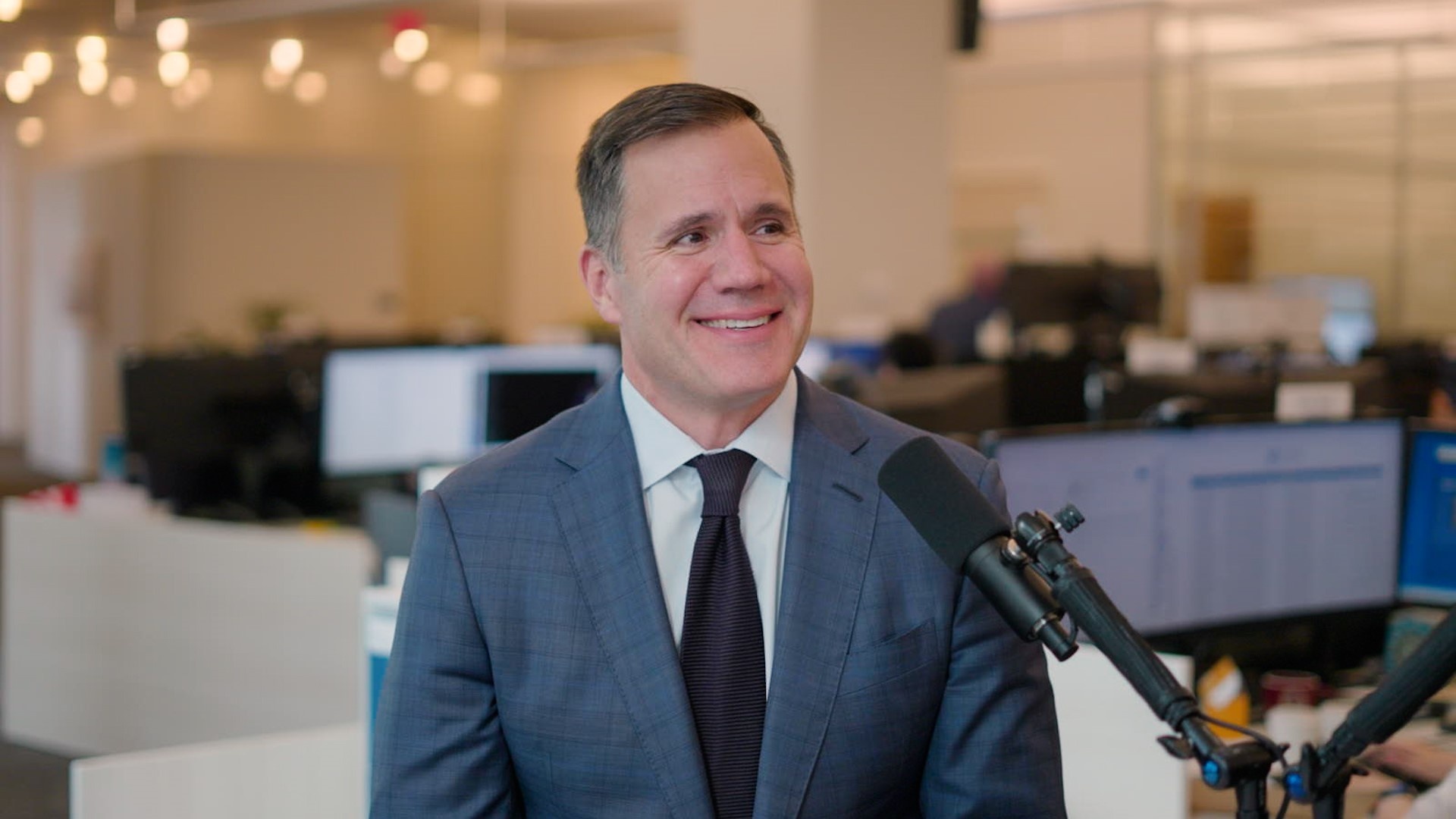
With US 10-Year Treasury yields climbing this week to the highest level since 2007, the bond market may be the biggest risk to further equity gains, says Tony Pasquariello, global head of hedge fund coverage in Goldman Sachs FICC and Equities. Shorting bonds could be a useful hedge for stock investments, he says on The Markets podcast.
S&P 500 earnings growth, meanwhile, has been “mind-bending,” helping to keep valuations from becoming stretched, Pasquariello says. However, the increase in earnings may begin to taper off, and US stock returns may slow from their double-digit annual pace. He also sees opportunities in Japan’s TOPIX, as the country’s equity market gets a boost from shareholder reforms and government spending on defense and industrialization.
Transcript:
Chris Hussey: This is The Markets. I'm Chris Hussey, and today is Wednesday, September 23rd. And I'm here on the Goldman Sachs trading floor with Tony Pasquariello, who is global head of hedge fund coverage within FICC and Equities. Tony, thanks so much for joining us.
Tony Pasquariello: Great to be here.
Chris Hussey: Okay. You were with us almost exactly a year ago, and at the time, the Fed was actually cutting rates.
Oh, what a difference a year makes. Walk us through what you make of both the Fed and the market's reaction, and how hedge funds were positioned going in and coming out.
Tony Pasquariello: Well, it's interesting. We started the year, and the market, the interest rate market expected there'd be a couple of cuts this year. Looks like there may be certainly a couple of hikes this year. We are one, one hike into that. The strip's telling you there'll probably be about four hikes, maybe a touch more when all is said and done. So, we've ended up in a very different place. You know, why is that? 66 months above target on inflation. Of course, what's going on in the Middle East has contributed to a rise in oil prices and refined products.
But also nominal growth has been very strong, so I don't think it's necessarily all bad in that context. Look, I thought the Chair reasserted kind of command of the narrative last week. Ultimately, he hiked. It was a hawkish hike, and in the doing, the back end was kind of anchored in, inflation break-evens were anchored in, and I think it kind of became a clearing event for the stock market.
And so up until Monday's close, it felt like that was, generally speaking viewed as a win by the stock market. As we sit here today, bond yields are pushing higher again, 10-year notes kind of making higher highs in yield terms relative to where they've been. So a bit more pressure returning to the equation.
Chris Hussey: Yeah. You would've expected, though, the 10-year not to make higher highs, right? I mean, if they're going to be hiking, you got to think that that's going to slow the economy down, and so people are going to think, "Okay, they got everything under control." Are you worried that the 10-year making higher highs has got people worrying that they don't have things under control?
Tony Pasquariello: If you were to ask me what's the number one kind of clear and present danger for the stock market, I'd say it is the bond market. I would've said that a month or two ago, so this is not new. I do think the debt and deficit narrative, which kind of comes in and out of market focus, is kind of in Marcus- market focus right now.
Of course, we're talking about a lot of bonds coming off the assembly line, not just from sovereigns like the US Treasury, but also, of course, the fund, the AI CapEx build-out. And growth continues to look stronger than expected. And so we're now talking about Q3 GDP growth 3% or better.
Remember, the second half was supposed to be a slowdown post the tax stimulus. So I'm not saying it is all bad, but you can certainly feel on a day like today, again, that kind of pinch coming into the stock market from the bond market.
Chris Hussey: Tony, that's a great point on growth. Our economists are forecasting 3.3% GDP growth for the third quarter. This is a very strong growth environment still.
All right. You've taught me a lot over the years. You're a deep thinker on the markets. But one of your mantras has always been "don't fight the Fed". So where do you think equities go from here? Because if I don't want to fight the Fed, don't I sell equities?
Tony Pasquariello: I'm a student of market history, respect the market history book for sure.
I feel like in the, you know, section on first principles, rule number one is probably don't fight the Fed. I've been doing this for 27 years. If I look back at what has ended bull markets along that path, it usually does involve a tightening of Fed liquidity alongside other factors. And again, if you, if you look at market history, generally speaking, the early innings of a tightening cycle do see S&P trade lower.
Now, I think you have to ask the question, is this kind of a mini tightening cycle or something bigger? I think the stock market is acutely aware of what the bond market discounts. So, as we sit here today, again, even with appreciation for a little bit of the pressure that you feel in stocks, I think the stock market knows the strip is telling you they're probably going to go about four times.
So, like if that is what is delivered or less than that, I don't think this is necessarily a traumatic dynamic for the stock market. But again, you have to watch it carefully. And where it leads me is if one needs to be looking for hedges, looking for bedfellows for the equity risk, then I do think contemplating shorts in the bond market is the right way to go.
Chris Hussey: Okay. So one of the elements of that, of course, is that, you know, four hikes will contain inflation. One of the other differences in the markets today, though, is that we have this AI structural trade underway. How does that change the dynamic of maybe don't fight the Fed or just what the Fed is doing in general?
is this AI trade going to just continue to drive up inflation because there's so many resources going to this?
Tony Pasquariello: I think there's two dynamics in the context of countervailing forces to the worry about a Fed tightening cycle. One is exactly that, which is the AI CapEx cycle. And so if you just look at the hyperscalers, I think in 2023, I'm going to round, hyperscaler CapEx was like $150 billion.
Next year, that's probably $1.3 trillion. So it is an enormous cyclical impulse that is working its way through the global economy, particularly within the US. Look, the second is we have a $2 trillion budget deficit at full employment when we're not really fully at war, if you will.
And so I think when you stack those two impulses next to each other, trillions of dollars of AI CapEx spend, trillions of dollars of fiscal deficit per annum simultaneously, then I do think you have a very pro-cyclical offset to some of the other things we're worrying about. Not uncomplicated.
Chris Hussey: No, it's not uncomplicated.
And are your hedge fund customers positioned correctly for that, you feel? Or do you feel the hedge fund guys are having to get themselves right way here?
Tony Pasquariello: I'd say as a general statement, I think deployment of risk, deployment of leverage is relatively low right now versus various other turns in the year.
And again, I've used this word choice every week, certainly every month has been its own little distinct adventure this year. On net, hedge funds have performed very well. That could be fundamental long-short clients, that could be systematic long-short clients, that could be macro hedge funds. And so they've done quite well amidst all these twists and turns in the volatility.
But I think as we sit here today with a nice P&L reservoir, folks are lower on the risk-taking scale. Generally speaking, I think set up for what we're talking about though, so paid rates, positions in the bond market, bias towards flatter curves in the bond markets, on the margin long dollars. And I think are people on net long equities?
For sure. Again, though, I think it's kind of on a lower risk setting than where it's been most of the year.
Chris Hussey: Yeah, it makes sense. What other risks are you and they looking at here beyond AI, beyond the Fed?
Tony Pasquariello: Well, as a client who's been there and done that said, you know, the surprise always comes from the place you're not looking.
I suppose COVID was probably the best example of that. I think the biggest question is we've enjoyed this incredible earnings boom. So, when you take out these one-time PE marks, you're talking about 25%, 30% earnings growth for the S&P 500 coming off great denominators. So just, kind of mind-bending earnings growth.
And so the open question is can that be sustained? On our view, it will slow, but you're slowing from 25%, 30% to more like 10% to 12%, so still generating double-digit earnings growth, but a meaningful slowdown. So, trying to calibrate how the market's going to treat that second derivative slowdown is, I think, one of the big open questions.
Chris Hussey: Yeah, it is. And, I guess if it's a slowdown and not a decline in earnings, though, it- you're going to get, you know, a pretty good market you would expect, though, no?
Tony Pasquariello: That's where I come out. So we've enjoyed what is tracking to be four years of double-digit returns in S&P 500. That's only happened one other time in modern history, and of course, that was the very end of the 1990s.
So the market has enjoyed this, and it's very much been an earnings-driven rally. We're sitting here today, PE's 18, 19. A year ago, when we last spoke, it would've been 23. So very much driven by the earnings growth we're talking about. And so, I think the market has enjoyed that. My guess is where that leads is just a lower gradient of return from here, i.e. as earnings growth slows, uh, the extent to which the market appreciates slows, but on the net is still positive.
Chris Hussey: You said it, so I got to ask you, the tail end of the 1990s led to the 2001 tech bubble. Does that concern you that what we're seeing is rhyming?
Tony Pasquariello: I think where I come out and where Peter Oppenheimer and our colleagues have come out is there's no doubt the market is highly valued relative to market history, so I think even, like, that 18, 19, you're probably still in the 90th percentile of historical range.
But if you do a direct compare to say we were coming out of 1999 into 2000, the market today is less highly valued. These companies are more profitable, and they have better balance sheets.
Chris Hussey: Yeah. No, it's so true. All right, let's put a bow on it. What's the trade?
Tony Pasquariello: I always have a soft spot for the trading rallies in Japan.
This has been more than a trading rally. This has been a heck of a post-COVID rally in Japan. I still think there's this bottom-up shareholder reform story that's coming through brick by brick, day by day. I think if you're a believer in the AI trade, if you're a believer in the re-industrialization and the re-militarization trade, the Japanese stock market offers a lot of these properties that you're seeking.
It has AI stocks, it has advanced manufacturing, it has defense contractors. And you have, long may it run, a very pro-cyclical government policy, federal policy right now. I think that trade is cleaner than it was three or four months ago. We've seen actually a pretty consistent deleveraging of that trade through our prime brokerage franchise.
So, if I had to pick one horse to ride for the next phase of the game, I'm going Japanese equities with a bias towards the domestic. So more of a TOPIX like trade than a Nikkei ike trade.
Chris Hussey: Yeah, of course, you have corporate governance monetization taking place there as well. So, cool trade. What are you looking out for next week and the week after?
Tony Pasquariello: So when I started in this business, I started in interest rates, and one of the guys I worked for said, "You know, rule number one is you can never miss a payrolls Friday. You can never take that day off." So next Friday brings a payroll number. The labor markets looked pretty solid of late, so jobless claims are very low.
Job creation not outsized,but healthy enough. And so I think both the bond market and then in turn the stock market will take their cue from the payroll number next Friday.
Chris Hussey: Tony, thanks so much for sitting down with us. That does it for this week's episode of The Markets. I'm Chris Hussey. Thanks for listening.
The opinions and views expressed herein are as of the date of publication, subject to change without notice, and may not necessarily reflect the institutional views of Goldman Sachs or its affiliates. The material provided is intended for informational purposes only, and does not constitute investment advice, a recommendation from any Goldman Sachs entity to take any particular action, or an offer or solicitation to purchase or sell any securities or financial products. This material may contain forward-looking statements. Past performance is not indicative of future results. Neither Goldman Sachs nor any of its affiliates make any representations or warranties, express or implied, as to the accuracy or completeness of the statements or information contained herein and disclaim any liability whatsoever for reliance on such information for any purpose. Each name of a third-party organization mentioned is the property of the company to which it relates, is used here strictly for informational and identification purposes only and is not used to imply any ownership or license rights between any such company and Goldman Sachs.
A transcript is provided for convenience and may differ from the original video or audio content. Goldman Sachs is not responsible for any errors in the transcript. This material should not be copied, distributed, published, or reproduced in whole or in part or disclosed by any recipient to any other person without the express written consent of Goldman Sachs.
Date of recording: September 23, 2026
© 2026 Goldman Sachs. All rights reserved.
Subscribe to Briefings
Our weekly newsletter delivers the latest insights on economic forces shaping markets—from Goldman Sachs leaders, economists, and investors around the world.
You can unsubscribe at any time. For information about how your personal data will be used, visit Privacy Information and Resources.