

The Markets
Why US Equity Returns Are Broadening Beyond AI Stocks
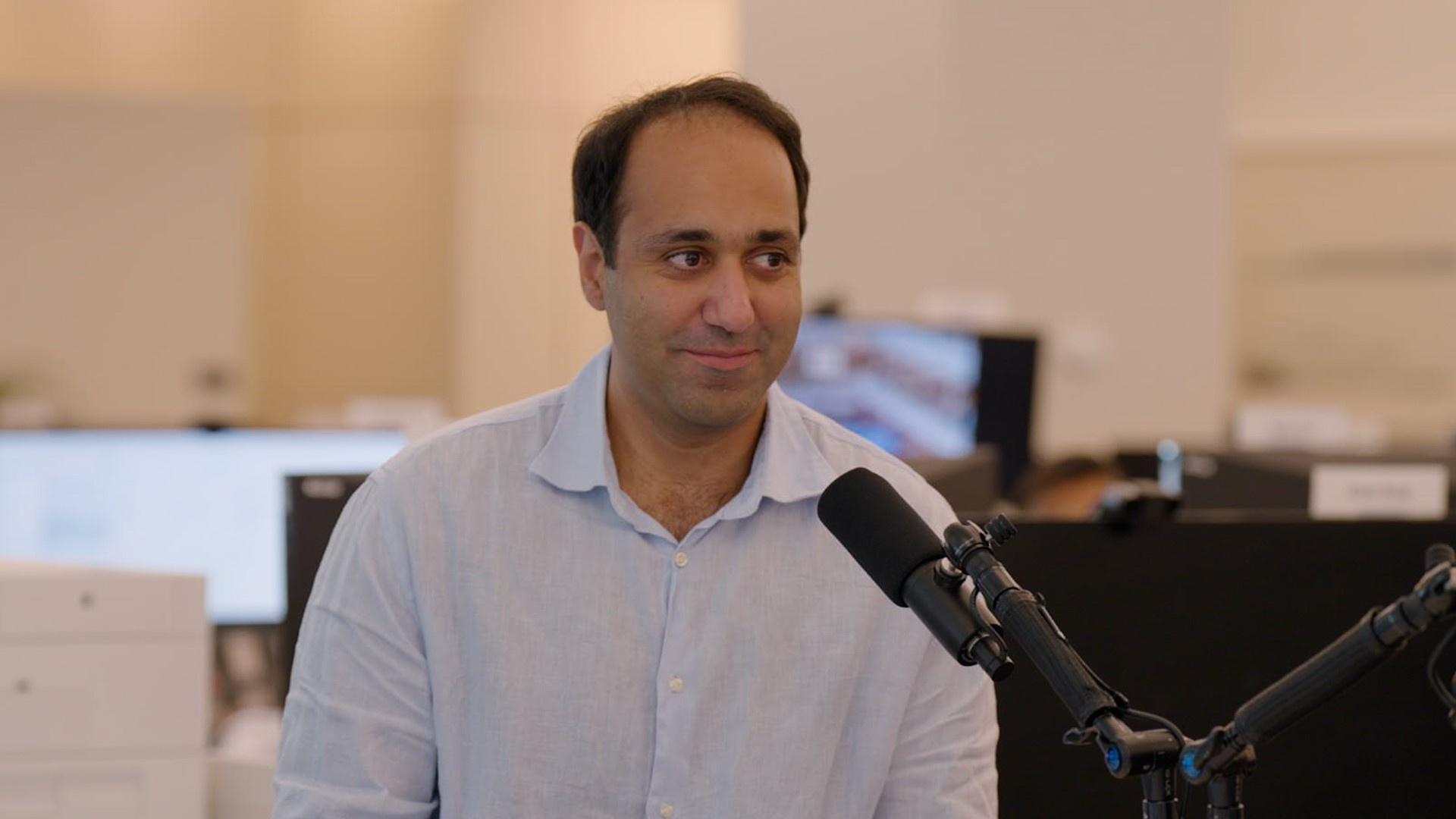
While artificial intelligence (AI) has been a key driver of US stocks, a wider range of sectors is starting to power the S&P 500, says Shawn Tuteja, head of ETF and Custom Basket Volatility Trading in Goldman Sachs Global Banking & Markets, on The Markets podcast. Tuteja also discusses the robust strength in earnings across 9 of 11 sectors in the S&P 500, elevated volatility among AI-related themes, and the interplay between oil prices, longer-maturity bond yields, and Federal Reserve policy.
Transcript:
Chris Hussey: This is The Markets. I'm Chris Hussey, and today is Wednesday, August 19th, and I'm here on the Goldman Sachs trading floor with Shawn Tuteja, who oversees our ETF and custom baskets vol trading businesses within global banking and markets. Shawn, thanks so much for joining us.
Shawn Tuteja: Thanks for having me again.
Chris Hussey: Well, it's great to have you, and it's been a heck of a period since we last saw you, and particularly a heck of a summer because we worked through some July volatility, and now we've got ourselves back at an all-time high. Not coincidentally, second quarter results were unbelievably strong. Is this just a case of earnings driving stocks?
Shawn Tuteja: It's interesting because you look at the market, and at a top level, the S&P is sitting at or near the all-time highs, and it's very easy to see that and say, "This must have been a quiet summer or a smooth summer," and it's been anything but that.
Clearly, there's been a lot of under the surface volatility. And I think going forward, the key thing amidst all of this uncertainty in the markets and which theme to rotate into has been the certainty of the earnings story.
We're about 92% of the way through earnings season for Q2. And of the 92% of companies that have reported, 64% of them have beat their estimate by more than one standard deviation, which is one of the highest beat rates on record. But what's interesting is, because of these high beat rates, we've started to see 2027 consensus earnings lift by about 2%.
So the market's implying around 390 to 400 consensus EPS for 2027, which is extraordinary earnings growth. 9 of the 11 S&P sectors have seen double-digit earnings growth year over year, which is pretty remarkable. And so I think that what's interesting under the surface though is if you look at the tech sector in particular, the names that are beating this last quarter have actually underperformed the S&P by 130 basis points the day after they beat.
And so I think what the market is slowly doing is expressing some skepticism about when the peak earnings is going to happen, especially in a lot of these AI trades, like memory. Which I actually think is healthy. And what we saw in July was all of the subcomponents of the AI trade, AI power, memory, optical networking, liquid cooling, semis, they all went down roughly on the same vol-adjusted basis. But what's been super interesting is that even though they've started to bounce in the month of August, there has been discernment and different levels of bounces in each of the different themes, which shows that investors aren't just buying AI blindly. They're actually saying, "Okay, I like memory over this," And so I think that the more discernment there is in the AI trade, the more sustainable the rally is in the entire complex.”
Chris Hussey: The other thing I want to sort of unpack though a little bit is what you're sort of implying by that 2/3 of stocks having beaten by more than a standard deviation. It suggests that the market is broadening out. We're getting a, maybe a rotation within that. What are you seeing investors doing as they think about more than just the big mega cap tech stocks outperforming?
Shawn Tuteja: Yeah, so it's not just earnings being driven by the AI story. The median stock has grown its earnings 14% year over year, which is the largest increase since coming out of COVID in terms of earnings projections going higher, earnings growth going higher. And the story of the last decade or so has been mega cap tech, the Magnificent Seven.
And what we're starting to see this year, especially in the last month or so, is a real broadening out where other sectors are starting to become more investable. The equal weight S&P has outperformed the regular S&P by almost 300 basis points year to date this year. And I think there's a few reasons why the market is starting to broaden out.
The first I would say is markets tend to broaden out during times of more certainty, and so far this year, for a lot of the year, we've had a lot of uncertainty. You started the year with uncertainty around private credit, around AI disruption, AI leading to the unemployment rate. Then you had peak geopolitical uncertainty, peak oil prices.
Then you started to have macro uncertainty with the Fed. Are they gonna hike? Are they not? And we're starting to tame some of that uncertainty, and it's making other sectors more investable. I think the second thing is a lot of sectors were kind of written off at the beginning of the year, even though they had strong fundamental stories, and the earnings are allowing those sectors to show how strong the fundamentals are.
You look at sectors like software that had just been grouped into this AI disrupting category at the beginning of the year, but the earnings are super strong. You look at healthcare, which continues to be underowned and cheap from a valuation perspective. That's been a really strong fundamental trend.
And then I think the third thing is the AI trade itself, as we saw in July, has been extremely volatile. And if you're an investor and you have a dollar to allocate to a position, but every day that position is moving double or triple what it normally was moving, you sort of have to de-risk
And so, I think that a lot of these forces have led to this broadening out, and the question is: is the overall economy good enough to sustain this broadening out for a longer period of time?
Chris Hussey: You know, and as you point out, all of this is sort of coming down to volatility and people's comfort with volatility. We have seen volatility come down, as you said, with uncertainty coming down. As you talk to investors out there, do you feel like they are in a position where they feel volatilities come down enough where they can start engaging in more trades?
Shawn Tuteja: So from the end of July to now, overall market volatility, or the VIX, has gone from about 21 to 15, and even in July, the story of volatility wasn't so much at the broad index level. It was more on the sector level, especially in the AI trade, and we're seeing a lot of reasons why volatility across the board in AI might start to come down.
For example, some of the high-octane sectors within AI, like memory, those companies have started to sign long-term agreements, which makes the cash flows a bit more transparent and a bit more steady. They've also started to focus on things like share buybacks and capital return, which sort of puts a floor and a ceiling and is a bit vol dampening for these names.
I think the more interesting thing now from volatility is shifting back to the broad index level because we've seen over the past three weeks the most amount of net buying on our prime book since COVID. And so, what it means is that people aren't exactly sure where to allocate their chips, i.e., their gross risk is starting to go lower because there are less longs versus shorts, but they're just buying a lot of different sectors.
And when that's the case, especially in an environment where the macro is a bit uncertain, we don't know exactly what the Fed is going to do, we don't know how Jackson Hole's gonna sound, et cetera, it means that buying options at the index level looks very, very cheap to us. Implied correlation is essentially at the all-time lows in the index, meaning that it's very cheap to hedge your book or express directional views at the S&P level, which is something that we feel really strongly about and like a lot.
Chris Hussey: All right. In this type of market, we've been ignoring a lot of those macroeconomic variables, as you pointed to. You pointed to a litany of things from oil prices, to the Fed, to the rates are actually at an all-time high almost now.
All-time high. Guy as old as me, nothing's ever at an all-time high, but 25-year high, let's call it. So, what do you think about what's happening in rates markets, for example? Is that getting so distracting now that at some point that creates the pressure on this everybody's long trade?
Shawn Tuteja: I think that the biggest thing in the macro right now is, one, the price of oil because, you know, when oil was going lower, it clearly created a lot more broadening in the market, and now we're starting to see oil prices tick up.
And oil prices ticking up generally creates concerns for the back end of bond curves. But I think the core story of it is in the US, there's a lot of supply from hyperscalers needing to fund CapEx.
In Europe, there's supply from needing to fund defense. In Japan, they're doing a lot of fiscal, and so that puts pressure on the back-end. So globally, you have a lot of supply of back-end bonds that needs to get met with demand. And so this morning, we got headlines from the US Treasury talking about increasing the size of buyback programs.
And even if in size that's not as material, in signal it could be quite meaningful for the market, and back-end bonds sort of stabilized over the past two days, and especially this morning took that move in stride. So, I think that what I'm really watching for on the macro is, one, back-end bond yields, two, oil, and then three, the path of the Fed in the near term, and they're all sort of related.
GS Research just released a piece talking about H2 and the economic outlook, saying that we might see a slowing in the economy versus what we saw in H1 of this year.
So, it's really important to see these data releases, the unemployment rate, claims data, et cetera, and to see how the economy's evolving there. And so what we're starting to see is clients who really like their equity books, they really like the micro because of all the strong fundamental earnings, but they're afraid of the geopolitical risk in the macro.
They're using ETF products to hedge that risk. They're buying oil via ETF products as a hedge to their book, and that's something that I think will continue throughout the year.
Chris Hussey: So, you know, when you had to put this all together though, what is the trade?
Shawn Tuteja: A trade that we really like and a theme that's started to work in the market is consumer experiences.
So, think theaters, think live sports, theme parks, concerts, et cetera. And I think that if you look at that subset of the economy, consumers going out and doing physical experiences, that's a segment of the market that we think is under-owned and undervalued. If you look at the actual fundamental story behind it, spending to those parts of the economy was at around 1% in Q1 of 2025, versus the equivalent of 2% in broader services category at the beginning of 2025.
That number is now 6% as of Q1 of 2026, versus still the 2% to the broader services. So, we're clearly seeing an uptick in spending in these areas. And from a valuation standpoint, they sit at around a 17 PE, which is well below their six-year median average, and we expect earnings revisions to continue to go higher in these names going forward.
So, I think that's a segment of the market that has started to perform really well, that's also immune to a lot of these AI disruption risks that the market is so worried about.
Chris Hussey: Yeah, coming off vacation, I can't help but thinking- ... that that's gonna be a heck of a trade. Consumer experiences has been what it's all about this summer.
All right. As we look forward over the next week or two, what are you watching for most closely?
Shawn Tuteja: I think the biggest thing is you have Jackson Hole next week, it's a chance that we're gonna have for the new Fed chair, Chairman Warsh, to sort of set his framework for policy.
And it's really important because one of the things that he said very openly is that he doesn't really believe in forward guidance, and he thinks the markets should trade how they wanna trade. So, any time he speaks and we can glean any information on how he's thinking, how he's evaluating the incoming data, is really valuable to markets, especially at a time where there's uncertainty about Fed policy.
Going into the July Fed meeting, it was priced at a 33% chance that they might hike a minute into the meeting, which was the most uncertainty since 1990 going into a Fed meeting about whether they would hike or not. So, this new uncertainty aspect of the Fed, it's really important to monitor then all the data releases and every time that the Fed speaks.
And so I think Jackson Hole is a real important moment to see, is this broadening trade real? Because if the Fed starts hiking, it may just be back to the AI trade for the market.
Chris Hussey: Such a great point. Shawn, thanks for taking the time with us today.
Shawn Tuteja: Thanks for having me.
Chris Hussey: That does it for this week's episode of The Markets. I'm Chris Hussey. Thanks for listening.
The opinions and views expressed herein are as of the date of publication, subject to change without notice, and may not necessarily reflect the institutional views of Goldman Sachs or its affiliates. The material provided is intended for informational purposes only, and does not constitute investment, legal, or tax advice, a recommendation from any Goldman Sachs entity to take any particular action or be used as a basis for any other investment decision, or an offer or solicitation to purchase or sell any securities or financial products. Any forward-looking statements, case studies, computations or examples set forth herein are for illustrative purposes only. Past performance is not indicative of future results. Neither Goldman Sachs nor any of its affiliates make any representations or warranties, express or implied, as to the accuracy or completeness of the statements or information contained herein and disclaim any liability whatsoever for reliance on such information for any purpose. Each name of a third-party organization mentioned is the property of the company to which it relates, is used here strictly for informational and identification purposes only and is not used to imply any sponsorship, affiliation, endorsement, ownership or license rights between any such company and Goldman Sachs. This material should not be copied, distributed, published, or reproduced in whole or in part or disclosed by any recipient to any other person without the express written consent of Goldman Sachs. A transcript is provided for convenience and may differ from the original video or audio content. Goldman Sachs is not responsible for any errors in the transcript.
Disclosures applicable to information relating to Goldman Sachs Global Banking & Markets, if any, mentioned herein, are available here: https://www.goldmansachs.com/disclaimer/salesandtrading
Filmed on August 19, 2026
© 2026 Goldman Sachs.
All rights reserved.
Subscribe to Briefings
Our weekly newsletter delivers the latest insights on economic forces shaping markets—from Goldman Sachs leaders, economists, and investors around the world.
You can unsubscribe at any time. For information about how your personal data will be used, visit Privacy Information and Resources.