

Goldman Sachs Chief Economist Jan Hatzius Joins CNBC to Discuss the US Jobs Report and the Economic Outlook
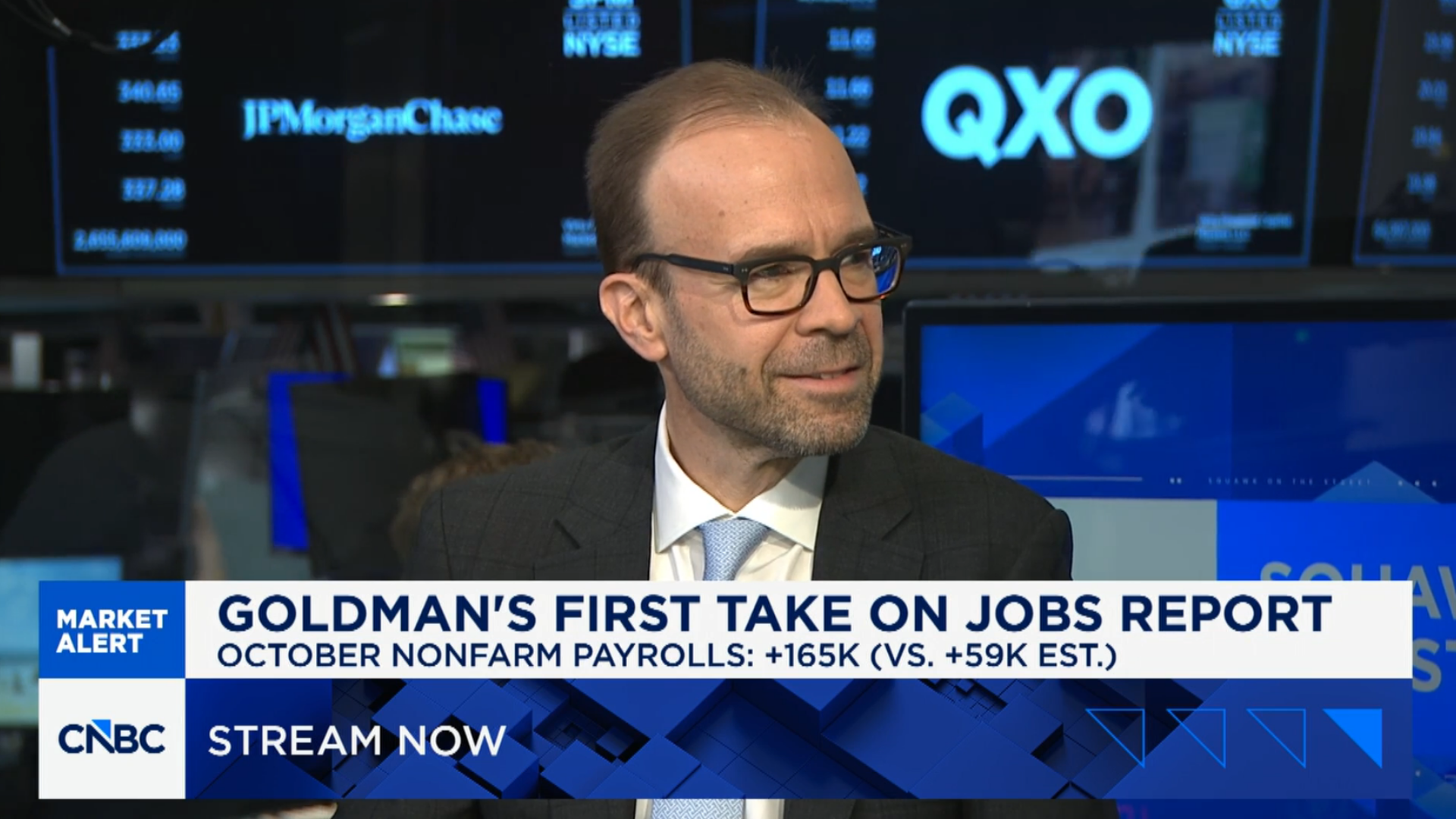
The recent stronger-than-expected employment report indicates a stable labor market, according to Goldman Sachs Chief Economist Jan Hatzius. He joined CNBC to discuss his views on the data and his outlook for the year ahead.
Transcript:
Host: Welcome back. The October jobs number came in hotter than expected: nonfarm payrolls rose by 165,000, above nearly every forecast. Joining us is Jan Hatzius, Goldman Sachs Chief Economist, to discuss the report, the midterms, markets, data centers, and more. Jan, it is great to have you.
Jan Hatzius: It is great to be here.
Host: There is nothing wrong with this number, I assume you agree. Do you think it marks the beginning of something new?
Jan Hatzius: Definitely nothing wrong with it. It is a very solid report, certainly as far as payrolls are concerned. There is some month-to-month volatility, but we think the underlying trend in job growth is probably back above 100,000. That is more solid than it was earlier in the year.
What we are not seeing is sustained downward pressure on the unemployment rate. It edged down a little, but it has remained in the 4.1% to 4.2% range. To me, this still looks like a labor market that is stable at about full employment. We think it will probably stay roughly in that range over time, which remains consistent with relatively subdued wage growth and low inflation.
Host: How low can claims get? Are we scraping the bottom of that historic range?
Jan Hatzius: It is the lowest we have seen in a series that goes back more than five decades. Layoffs are at extremely low levels, which is consistent with what we see in other indicators.
Hiring continues to be relatively subdued as well, so we have not really seen a major pickup in hiring. It is still a more stagnant environment, but at a very solid level.
Host: The markets this week have been rethinking the possibility of a more elongated buildout cycle. Does that lead you to lower your nominal GDP estimates for next year?
Jan Hatzius: We are growing at a very rapid pace right now. GDP numbers fluctuate, but we are talking about growth with a three-handle in the second and third quarters, and likely in the fourth quarter as well.
I do think growth will be softer next year. We have thought that before, but we have not made a change to our underlying growth estimate. We think it is probably in the 2% to 2.5% range, which should keep the unemployment rate roughly stable.
There are some downside risks to that growth outlook. We have seen tightening in financial conditions of about 50 basis points according to our index. There are also questions around energy prices, the war with Iran and its implications for real income growth, as well as the AI buildout and its effects on both GDP and the labor market.
But our baseline remains relatively stable growth.
Host: Goldman also closely monitors increases in enterprise efficiency from AI use, or at least expected productivity gains. Where are we now, and what are your expectations for 2027?
Jan Hatzius: We have seen some effects on the labor market, mainly in the technology sector. That has been worth roughly 10,000 to 15,000 fewer jobs per month in employment growth.
There are some indications that this is broadening into the service sector. For example, we have begun to see a correlation across service-sector industries between employment growth and unemployment rates on one hand, and AI adoption on the other.
But the relationship is still not particularly strong, and you would not expect it to be if you looked at overall labor-market outcomes. Over the next year or two, I think that relationship will probably strengthen. By 2028, it is likely to become somewhat more of a headwind for employment growth.
I have a fair amount of conviction that AI will be more of a macroeconomic story by 2027, though the timing remains one of the open questions.
Host: That could also affect profit margins.
Jan Hatzius: Yes, although at the moment it is clearly still a tailwind.
Once we get into 2028, you would expect the volume of investment to flatten out, and eventually investment spending will come down. That is what tends to happen in historical investment booms: infrastructure is built out, the necessary capital stock is achieved, and investment then begins to decline.
That is probably still some way off, but there is, of course, substantial uncertainty around the path.
Host: We are glad we will have you around for 2027 and 2028. I hope we will speak many times.
The opinions and views expressed herein are as of the date of publication, subject to change without notice, and may not necessarily reflect the institutional views of Goldman Sachs or its affiliates. The material provided is intended for informational purposes only, and does not constitute investment advice, a recommendation from any Goldman Sachs entity to take any particular action, or an offer or solicitation to purchase or sell any securities or financial products. This material may contain forward-looking statements. Past performance is not indicative of future results. Neither Goldman Sachs nor any of its affiliates make any representations or warranties, express or implied, as to the accuracy or completeness of the statements or information contained herein and disclaim any liability whatsoever for reliance on such information for any purpose. Each name of a third-party organization mentioned is the property of the company to which it relates, is used here strictly for informational and identification purposes only and is not used to imply any ownership or license rights between any such company and Goldman Sachs.
A transcript is provided for convenience and may differ from the original video or audio content. Goldman Sachs is not responsible for any errors in the transcript. This material should not be copied, distributed, published, or reproduced in whole or in part or disclosed by any recipient to any other person without the express written consent of Goldman Sachs.
Subscribe to Briefings
Our weekly newsletter delivers the latest insights on economic forces shaping markets—from Goldman Sachs leaders, economists, and investors around the world.
You can unsubscribe at any time. For information about how your personal data will be used, visit Privacy Information and Resources.