

Global Institute Dialogues
Jason Bordoff on the Geopolitics of Energy
Jason Bordoff is the Founding Director, Center on Global Energy Policy at Columbia University’s School of International and Public Affairs.
In this edition of Global Institute Dialogues, Jason Bordoff discusses how the Iran crisis, China’s electrification strategy, and the US shale revolution have changed energy geopolitics.
The views stated herein are those of the interviewee and do not necessarily reflect the views of Goldman Sachs or its affiliates. Goldman Sachs is not responsible for any statements made by the interviewee.

- Global Institute DialogueJason Bordoff on the Geopolitics of Energy
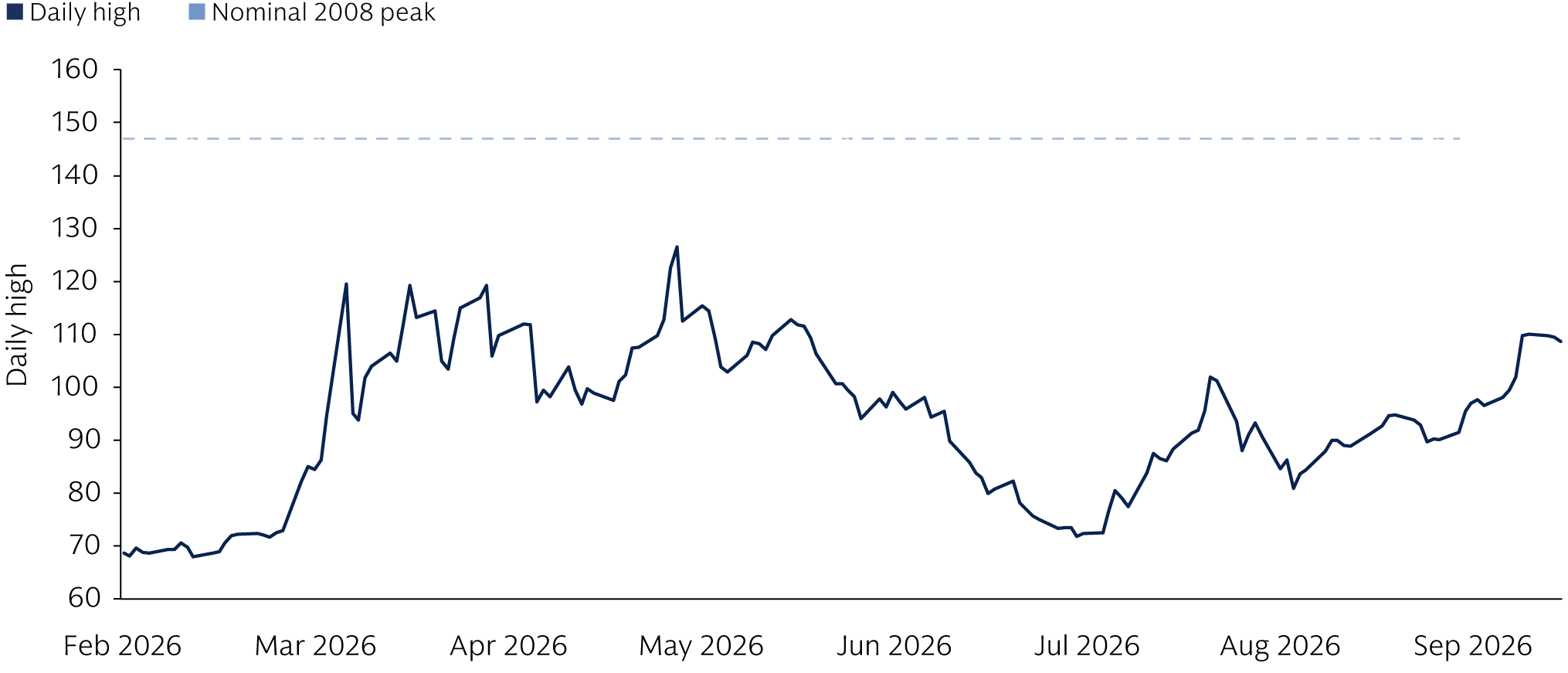
The closure of the Strait of Hormuz has been called the worst oil shock in history. During the Iran conflict, however, oil futures have not yet surpassed their 2008 peak. What does that tell us about the risks that Hormuz poses to the global economy, as well as the sources of market resilience?
It is too early to say with certainty what the full oil market effects will be, since the crisis is far from over. But a few things are already clear. Closing the Strait of Hormuz— through which roughly one-fifth of global oil and LNG supplies flowed before the crisis—has long been the nightmare scenario of energy security planning; the head of the International Energy Agency (IEA) called it the largest supply disruption in the history of the global oil market. Yet with the strait almost entirely closed for nearly four months, Brent averaged just over $100 a barrel, up from around $70 when the war began, and peaked at $126 in April—far below the $200 that veteran analysts had warned was possible.
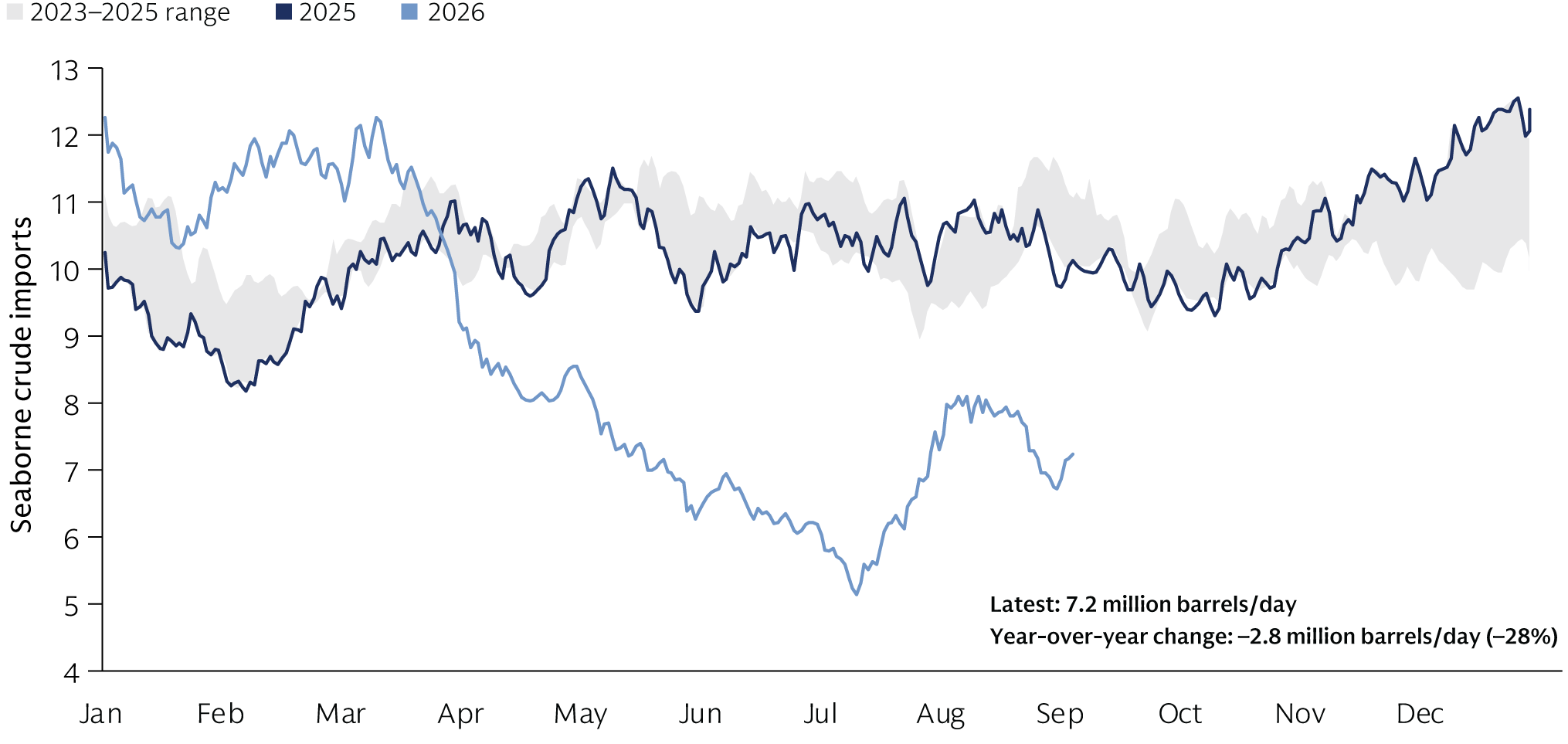
Several factors explain the muted response, and most were neither automatic nor guaranteed. Markets were oversupplied and inventories relatively flush when the war began. Saudi and Emirati pipelines, built years ago as insurance, moved over five million additional barrels a day around the strait, cutting the shortfall in Gulf exports to roughly 13 million barrels a day rather than the full 20 million. The IEA coordinated the largest emergency stock release in its history, which, together with commercial draws, offset five million to six million barrels a day. US production and exports surged, and refiners proved remarkably flexible in responding to price signals. Perhaps the biggest surprise was China, which cut imports by roughly five million barrels a day between February and June by halting strategic purchases, drawing down inventories, restricting refined product exports, and reducing domestic demand.
The lesson is not that Hormuz no longer matters. It is that resilience was purchased—through years of investment— and that those buffers are now considerably more threadbare and should not be taken for granted.
Major energy crises often lead to structural shifts in energy markets. What lasting transformations do you expect the closure of the Strait of Hormuz to create in the global energy landscape?
Lasting transformations in the global energy system are hard to predict with confidence. But the energy world had already changed dramatically before this shock: The United States is now the world’s largest oil and gas producer; renewables and electric vehicles have become genuine alternatives in some sectors; a cooperative global order has given way to geopolitical fragmentation; and China, India, and other emerging economies now drive demand growth.
The most consequential shift this crisis has revealed is a new geography of energy power. The countries best able to absorb disruption and those forced to bear its costs are no longer the same. The United States weathered this shock far better than it would have a decade ago, given both lower oil use as a share of GDP and much higher production. China, as the largest importer and by far the largest holder of inventories, has come to play an important balancing role in the global market. Meanwhile, the burden of demand adjustment has shifted toward poorer importing countries with thinner fiscal buffers: Jet fuel spot prices briefly approached $200 a barrel in some markets, and dozens of developing economies adopted nearly 200 emergency measures, from rationing and conservation mandates to fuel tax suspensions.
Expect a durable turn toward redundancy as countries invest to make the oil and gas system more resilient, not just to move away from it. Infrastructure once considered surplus, such as Saudi Arabia’s East-West Crude Oil Pipeline, proved vital; both Saudi Arabia and the UAE plan to increase their bypass capacity; and Iraq and Kuwait are exploring new export routes. Governments are rebuilding or expanding buffers; the United States should appropriate funds to refill and modernize a strategic petroleum reserve (SPR), now at its lowest level in nearly five decades, while India, South Africa, and Southeast Asian countries are seeking to build reserves and refining capacity. Electrification will accelerate too, but not automatically, and not necessarily in a low-carbon direction without policy direction.
China has undergone one of the largest electrification and clean-energy build-outs in history. How is China’s energy strategy evolving, and what does it mean for global energy markets and strategic competition?
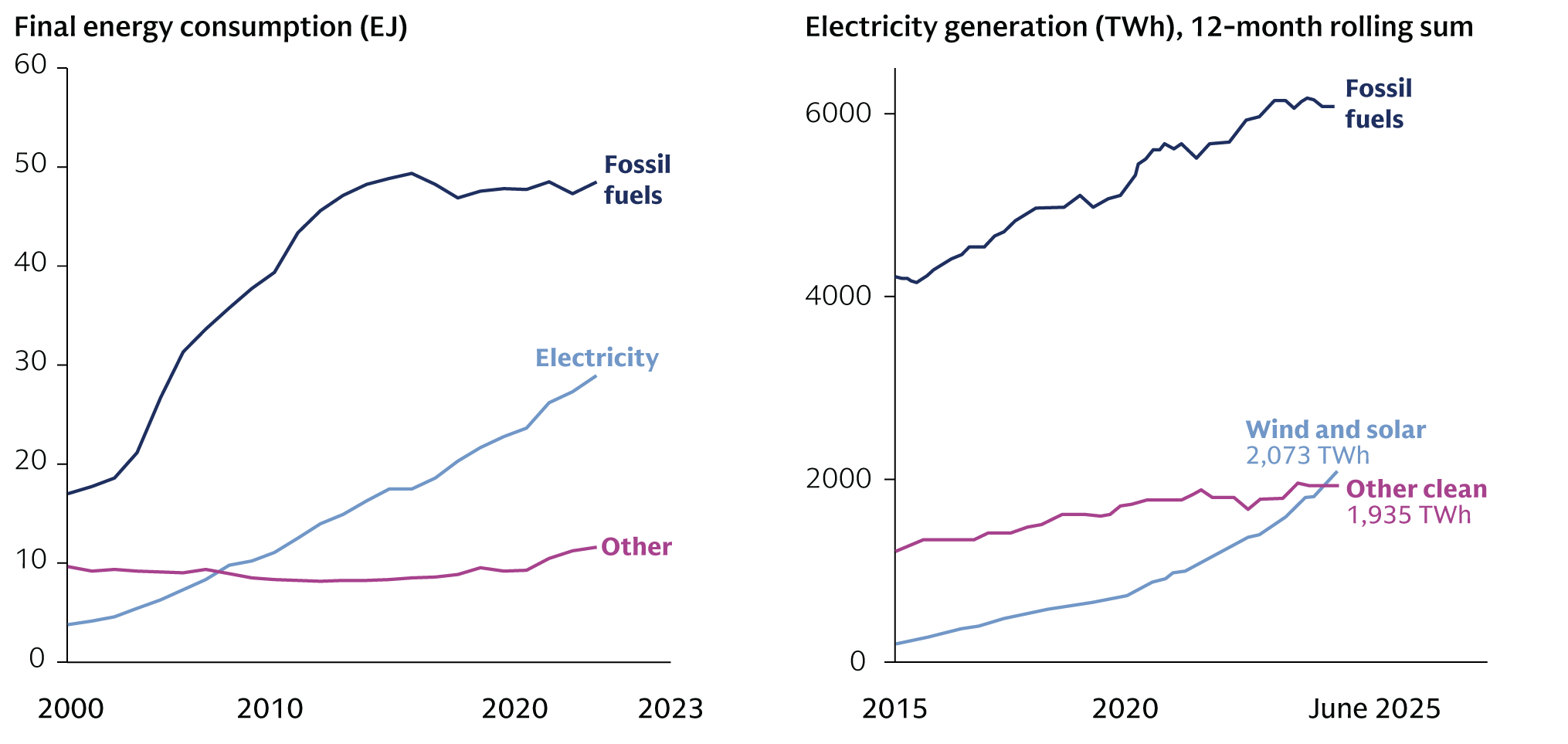
For more than two decades, China has pursued an energy security strategy built for precisely this kind of disruption. At the core of this strategy is electrification: Shifting the economy away from directly consuming oil and gas reduces exposure to markets prone to geopolitical shocks. The transformation has been historic. More than 32 percent of China’s final energy consumption is now electricity, against 22 percent in the United States and 21 percent in Europe. More than half of new cars sold are electric. China invested $625 billion in clean energy in 2024, nearly one-third of the global total, and clean-energy sectors contributed over 10 percent of GDP in 2025.
The Hormuz crisis showed the benefits of that strategy. It was part of the reason China reduced oil imports by roughly five million barrels a day, easing pressure on global markets; China also restricted refined product exports (imposing significant costs on its Asian neighbors), drew inventories, and ceased filling its stocks. If the crisis continues and worsens, with OECD inventories depleted, China’s estimated 1.4 billion barrels of strategic reserves, drawn down only modestly so far, are now among the last lines of defense against a sharper price spike. For decades, US presidents called Riyadh during oil crises to ask for spare capacity; Beijing may come to occupy a comparable position, with comparable influence.
The 15th Five-Year Plan calls for China to become an “energy powerhouse,” and Beijing recently raised its 2030 renewable consumption target by 53 percent—which will mean both more renewables and more coal. Paired with China’s dominance of clean energy supply chains—over 80 percent of solar, wind, and battery manufacturing capacity, plus most critical minerals processing—this leaves other countries choosing not whether to depend on imports but which dependence is least dangerous. China’s behavior in this crisis to look out for itself by moving quickly to restrict refined products exports, viewed by some as prioritizing domestic energy security at the expense of neighboring Asian countries, may make that trade-off look less attractive.
The shale revolution made the United States the world’s top oil and gas producer. To what extent has that changed the United States’ geopolitical position, and what does the country need to do to maintain it?
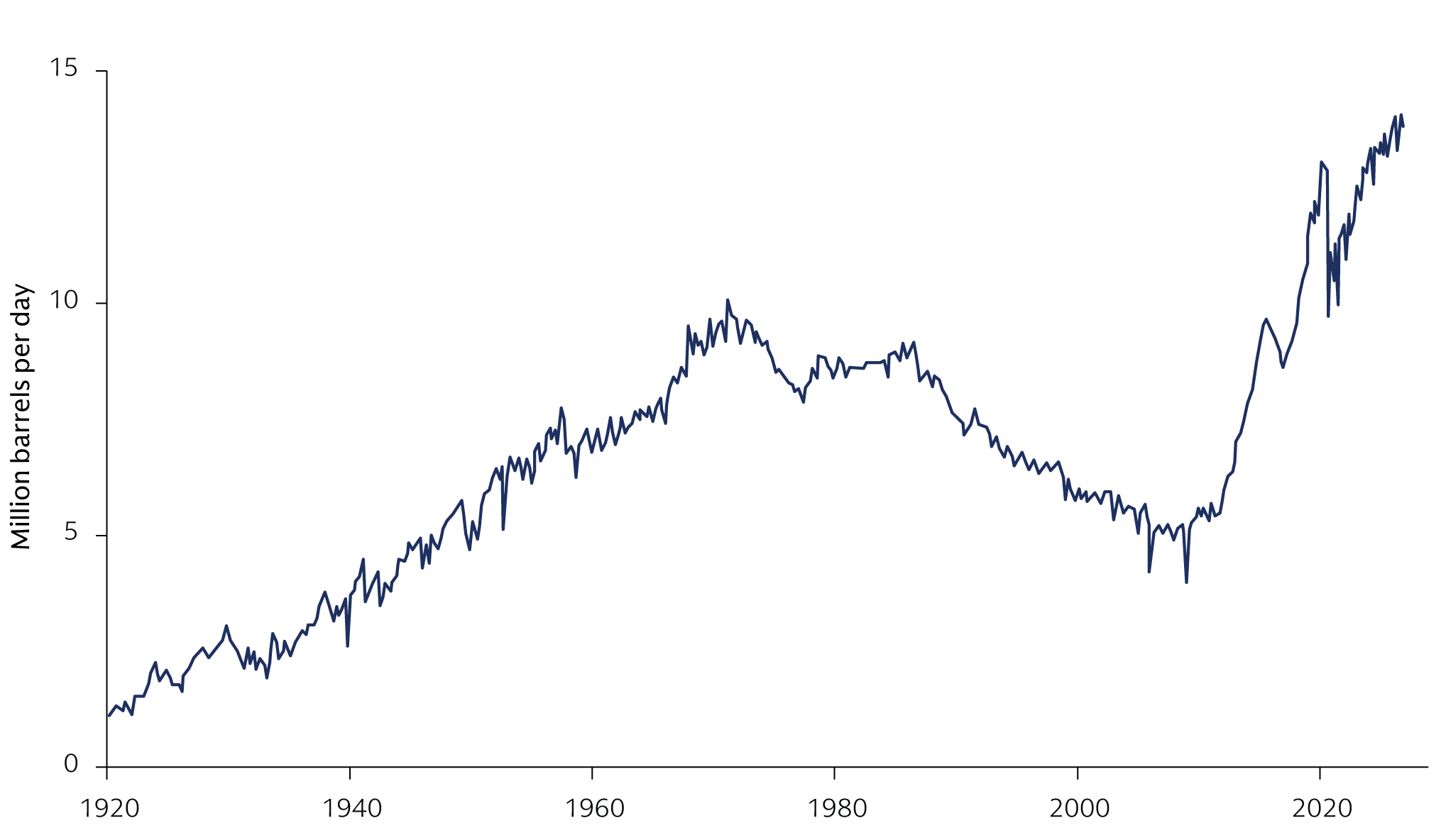
Combined with lower oil intensity, the shale revolution has fundamentally strengthened America’s geopolitical position, and this crisis demonstrated it. The US economy is nearly four times larger than in 1973, while domestic oil demand is only slightly higher. Two decades ago, the country imported 60 percent of the oil it used; this spring, it became the world’s largest oil exporter and briefly a net crude exporter for the first time since World War II.
Oil is globally priced, so Americans still feel higher pump prices. But the broader damage has been far smaller than it once was: Economists at the Dallas Fed estimate a shock comparable to this year’s would have cut US real GDP growth by 5.6 percentage points in 1980, versus roughly 0.3 points today. As a net exporter, the United States saw higher prices transfer income to domestic producers, workers, and shareholders rather than abroad. In an acute disruption, physical barrels can price far above futures benchmarks, forcing import-dependent economies in Europe and Asia to pay steep premiums for immediate delivery; abundant domestic production gave the United States a valuable window of insulation from these dislocations. The contrast was even starker in natural gas, where European and Asian prices moved toward $20 per million BTUs while US benchmarks stayed below $3 per million BTUs—an example of a divergence the economist Lucas Davis estimates has saved American consumers roughly $5 trillion over two decades.
Maintaining this position means resisting the temptation to squander it: Refill and modernize the SPR; keep export markets open rather than yielding to calls for restrictions that could damage US credibility and undermine domestic production and refining capacity; and preserve the efficiency, mass transit, and EV policies that reduce oil exposure. America’s newfound position as a dominant producer also means recognizing an uncomfortable corollary—a superpower insulated from the consequences of the turmoil in which it’s involved has fewer reasons for restraint.
For investors, what are the most important trends in the energy transition? Where is the market overestimating change, and where is it underestimating it?
The most important trend for investors is that the energy transition is no longer driven by climate policy alone. Energy security, industrial strategy, and national security have become equally important and increasingly inseparable.
Markets may be overestimating the speed and linearity of the move away from fossil fuels. Every oil and gas shock strengthens the case for electrification, but wanting secure and affordable energy does not necessarily mean moving quickly off all fossil fuels. This crisis, for example, pushed several Asian countries toward coal—Japan allowed greater use of older plants, South Korea lifted limits on coal-fired generation, and India accelerated a $4 billion coal-to-chemicals plan—and the IEA expects record global coal consumption this year. Some governments may also conclude that if the nightmare scenario proved manageable, the practical course is to invest in the resilience of the oil and gas system rather than to move beyond it.
Investors should understand both today’s headwinds and its tailwinds for the energy transition. On one hand, clean energy is more capital-intensive, which is especially challenging in an era of higher interest rates. Moreover, in a world of geopolitical fragmentation, governments are shifting from “just in time” to “just in case”: storage, redundant pipelines and ports, strategic reserves, domestic refining, and trusted supply chains. The desire to de-risk from global supply chains dominated by China will lead many governments to feel a growing pull toward energy autarky—the ability to meet one’s own energy needs. The problem is that prioritizing redundancy and domestic manufacturing and extraction is inflationary for clean energy.
On the other hand, the drive to reduce exposure to geopolitically risky oil and gas markets will lead many governments to try to reduce imports, giving a push to electrification and domestic sources of electricity, including clean-energy technologies such as solar, wind, geothermal, storage, and nuclear. Electrification, such as EVs and heat pumps, and clean sources of electricity are themselves tools of geopolitical resilience; indeed, energy security, which has returned to the forefront as a policy concern, can be a more powerful driver of clean energy than climate change alone.
About the Interviewee
Jason Bordoff is Founding Director of the Center on Global Energy Policy, and Professor of Professional Practice in International and Public Relations at Columbia University SIPA. Bordoff is also Cofounding Dean Emeritus of the Columbia Climate School.
Bordoff joined the Columbia University faculty after serving until January 2013 as Special Assistant to President Barack Obama and Senior Director for Energy and Climate Change on the staff of the National Security Council, and, prior to that, holding senior policy positions on the White House’s National Economic Council and Council on Environmental Quality. One of the world’s leading energy and climate policy experts, Bordoff places research and policy interests at the intersection of economics, energy, environment, and national security.
He has written prolifically about how to address our greatest energy and climate change challenges and has developed innovative programs and tools to train future leaders to bridge the gap between academic research and policy, focused on delivering research insights in formats and time frames that are accessible and useful to decision-makers outside of academia.
The responses above draw from “The Long Shadow of the Iran Shock: Hormuz and the New Geography of Energy Power,” an essay coauthored by Jason Bordoff and Meghan O’Sullivan, Director of the Belfer Center for Science and International Affairs and Jeane Kirkpatrick Professor of the Practice of International Affairs at the Harvard Kennedy School, published in Foreign Affairs on August 14, 2026.
This document has been prepared by the Goldman Sachs Global Institute and is not a product of Goldman Sachs Global Investment Research. The opinions and views expressed herein are as of the date of publication, subject to change without notice, and may not necessarily reflect the institutional views of Goldman Sachs or its affiliates. The material provided is intended for informational purposes only, and does not constitute investment, legal, or tax advice, a recommendation from any Goldman Sachs entity to take any particular action or be used as a basis for any other investment decision, or an offer or solicitation to purchase or sell any securities or financial products. Any forward-looking statements, case studies, computations or examples set forth herein are for illustrative purposes only. Past performance is not indicative of future results. Neither Goldman Sachs nor any of its affiliates make any representations or warranties, express or implied, as to the accuracy or completeness of the statements or information contained herein and disclaim any liability whatsoever for reliance on such information for any purpose. Each name of a third-party organization mentioned is the property of the company to which it relates, is used here strictly for informational and identification purposes only and is not used to imply any sponsorship, affiliation, endorsement, ownership or license rights between any such company and Goldman Sachs. This material should not be copied, distributed, published, or reproduced in whole or in part or disclosed by any recipient to any other person without the express written consent of Goldman Sachs.
© 2026 Goldman Sachs. All rights reserved.
Subscribe to Briefings
Our weekly newsletter delivers the latest insights on economic forces shaping markets—from Goldman Sachs leaders, economists, and investors around the world.
You can unsubscribe at any time. For information about how your personal data will be used, visit Privacy Information and Resources.