

Outlooks
Global Stocks Are Expected to Rally in 2027 Even as Earnings Growth Slows

- Growth rates for corporate earnings are likely to at least halve in nearly all markets next year.
- Recent declines in equities mean stock valuations have come down substantially, particularly for technology companies.
- Our strategists are focused on three key investment themes: growth equities, defensive stocks, and companies that will benefit from lower oil prices and bond yields.
Stock markets from New York to Tokyo are expected to extend their rally in 2027, even as earnings growth and investment in artificial intelligence (AI) slow in most regions, according to Goldman Sachs Research.
What is the forecast for global stock market gains in 2027?
The S&P 500 index of US stocks is predicted to produce a total return of 16% in the next 12 months (as of November 12). Europe’s STOXX 600 is expected to generate a total return of 13% in US dollar terms during that span, while Japan’s TOPIX is forecast to return 24%. In emerging markets, the MSCI EM index is projected to have a 21% total return.
“We expect equities to generate positive returns, albeit with higher volatility than in recent years,” Peter Oppenheimer, chief global equity strategist and head of Macro Research in Europe, writes in a report. “We expect investors to seek companies that can sustain growth as it becomes more scarce.”
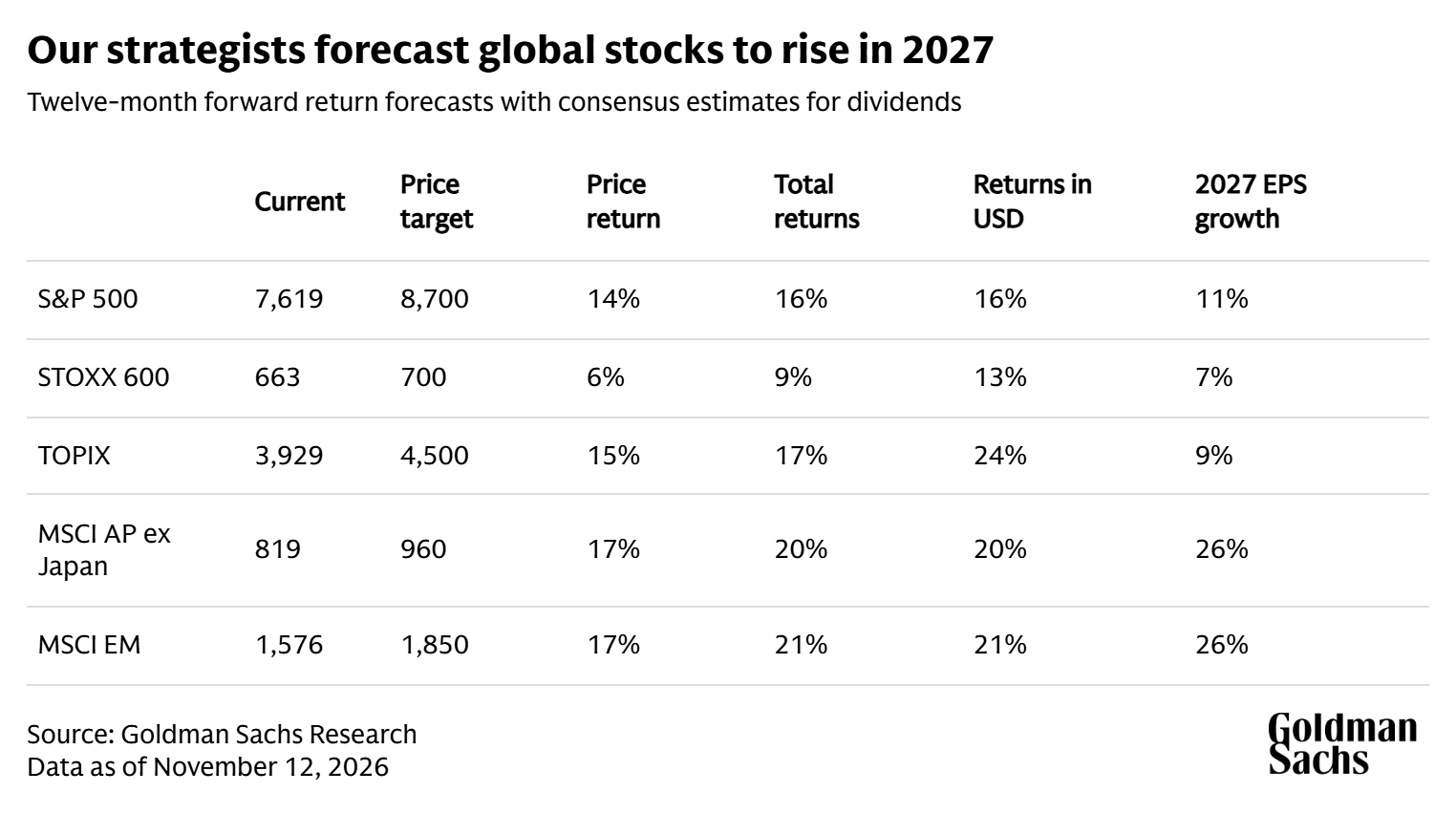
Recent declines in equities mean stock valuations have come down substantially, particularly for technology companies, he writes.
While nominal economic activity and earnings are predicted to grow at a slower pace in 2027, Goldman Sachs Research also projects inflation, bond yields, and oil prices will moderate. “We expect the equity bull market to continue,” writes Oppenheimer.
On a risk-adjusted basis, Goldman Sachs Research favors overweighting US and Japanese stocks relative to a typical global benchmark and underweighting European stocks.
What is the outlook for stock earnings in 2027?
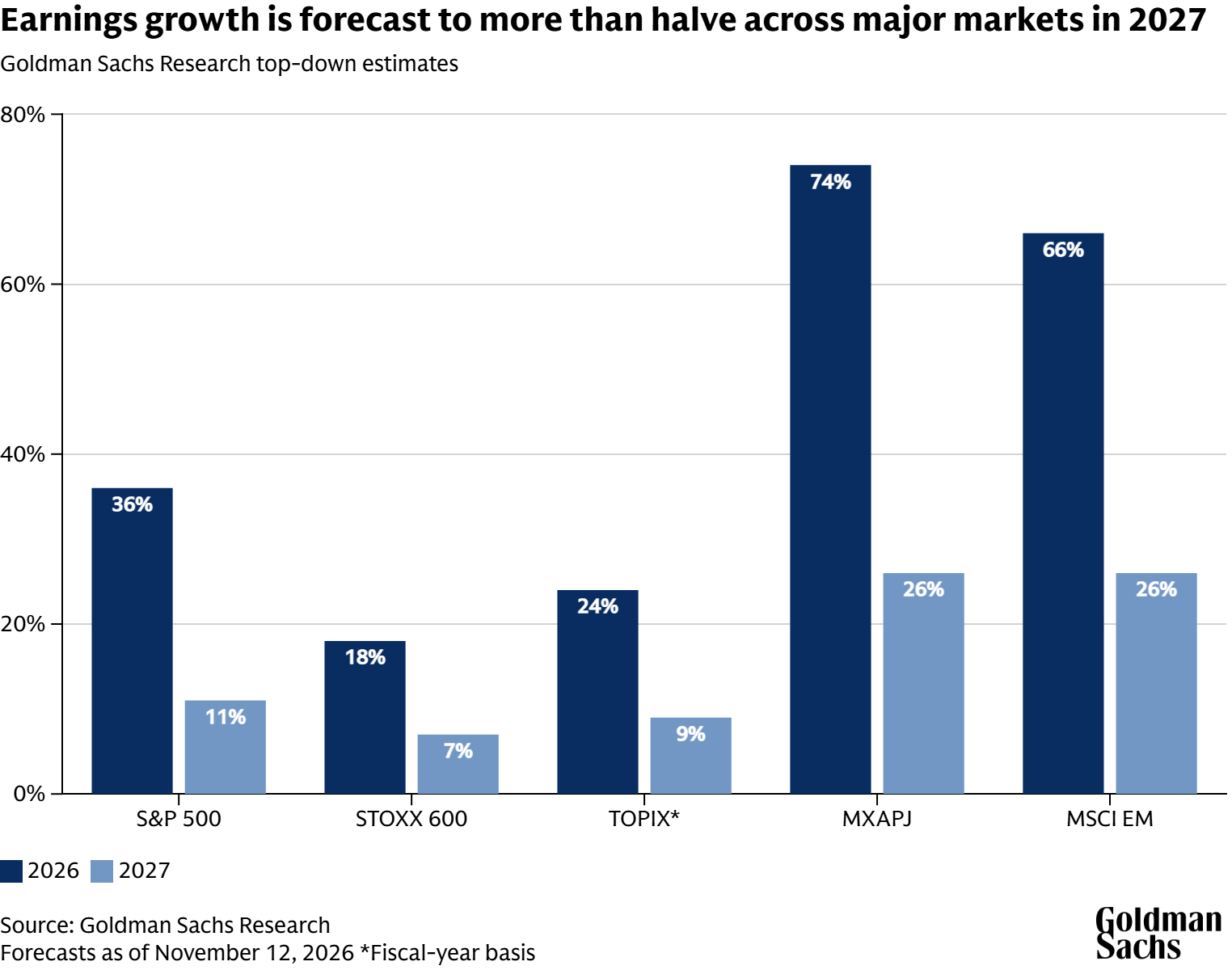
Earnings growth rates are likely to at least halve in nearly all markets next year: US earnings growth is estimated to slow from 36% to 11%, Europe from just around 18% to 7%, Japan from 24% to 9%, and Asia from close to 80% down to less than 30%.
One reason for the deceleration is slower growth in capex by hyperscalers, which is expected to result in a decline in earnings growth for AI infrastructure companies. In addition, energy prices are forecast to moderate, which will put pressure on that sector.
How should investors allocate to their global stock portfolios in 2027?
Goldman Sachs Research is focused on three key investment themes for global stocks in 2027: growth equities, selective defensive stocks, and companies that will benefit from lower oil prices and bond yields.
“The expressions that best fit these themes vary somewhat across regions, and there is some overlap, particularly between defensive areas and bond beneficiaries,” Oppenheimer writes.
The opportunities in growth stocks
Value companies that trade at a low price relative to fundamentals have outperformed faster-growing companies in recent months. But sharp rotations in performance have opened up value opportunities for investors in some technology companies, Oppenheimer writes.
The price-to-earnings (P/E) ratio for technology stocks globally has fallen sharply both relative to its own history (it is now in the 20th percentile of its historical band over the past 20 years) and relative to other sectors. The information technology sector is now one of the cheapest on a P/E basis, and hyperscalers are cheaper than defensive areas of the market.
Meanwhile the value factor, while cheaper in absolute terms, is close to the 90th percentile of its 20-year range and more expensive than growth relative to history.
Oppenheimer says investors may find opportunities in US hyperscalers, power companies, and growth stocks. In Asia, he sees potential in Korean memory chipmakers as well as companies involved in optical networking, physical AI, and power. In Europe, opportunities may include technology, defense, and renewable energy stocks.
The outlook for defensive stocks
There could be opportunities for defensive stocks, whose products are in demand even when economic growth slows. While Goldman Sachs Research expects resilient economic growth in 2027, the risks to that forecast are “skewed to the downside,” Oppenheimer writes.
Slower growth in earnings per share, tighter financial conditions, elevated borrowing costs, and the risk of an earlier turn in the AI cycle indicate the potential need for portfolios with greater resilience.
However, many of the traditional defensive stocks are no longer cheap. Goldman Sachs Research suggests a focus on defensive sectors that would also benefit from lower bond yields. Examples of companies that fit this criterion are utilities and telecoms in Europe; healthcare and companies consistently buying back their stock in the US; and Asian power companies.
Financially strong “quality” companies should benefit from slower growth and tighter financial conditions, but it will remain important to be disciplined when it comes to valuations, Oppenheimer writes. High dispersion should create a better environment for stock-picking, with a focus on stable earnings, structural growth, strong balance sheets, and shareholder returns.
Some stocks may benefit from lower energy prices and bond yields
A recovery in energy supplies from the Persian Gulf should bring down commodity prices, including European gas prices, according to Goldman Sachs Research.
Combined with fading US tariff effects and easing AI-related supply pressures, this should lower inflation and help central banks bring it back towards target, Oppenheimer writes. The US Federal Reserve and European Central Bank are expected to move towards rate cuts in late 2027, supporting modestly lower bond yields. Goldman Sachs Research’s rates forecasts remain more dovish than market pricing.
Europe should be the clearest beneficiary of lower energy prices because of its greater exposure to imported energy and natural gas, according to Oppenheimer. He also sees opportunities in select US consumer companies, including consumer discretionary stocks and long-duration growth companies, whose profits are expected mostly in the distant future.
This document has been prepared by the Goldman Sachs Executive Office and is not a product of Goldman Sachs Global Investment Research. The opinions and views expressed herein are as of the date of publication, subject to change without notice, and may not necessarily reflect the institutional views of Goldman Sachs or its affiliates. The material provided is intended for informational purposes only, and does not constitute investment, legal, or tax advice, a recommendation from any Goldman Sachs entity to take any particular action or be used as a basis for any other investment decision, or an offer or solicitation to purchase or sell any securities or financial products. Any forward-looking statements, case studies, computations or examples set forth herein are for illustrative purposes only. Past performance is not indicative of future results. Neither Goldman Sachs nor any of its affiliates make any representations or warranties, express or implied, as to the accuracy or completeness of the statements or information contained herein and disclaim any liability whatsoever for reliance on such information for any purpose. Each name of a third-party organization mentioned is the property of the company to which it relates, is used here strictly for informational and identification purposes only and is not used to imply any sponsorship, affiliation, endorsement, ownership or license rights between any such company and Goldman Sachs. This material should not be copied, distributed, published, or reproduced in whole or in part or disclosed by any recipient to any other person without the express written consent of Goldman Sachs.




Subscribe to Briefings
Our weekly newsletter delivers the latest insights on economic forces shaping markets—from Goldman Sachs leaders, economists, and investors around the world.
You can unsubscribe at any time. For information about how your personal data will be used, visit Privacy Information and Resources.