

Outlooks
The Global Economy Is Forecast to Grow 2.8% in 2027 as Oil Prices Decline

- Goldman Sachs Research forecasts steady global economic growth in 2027: The US, Japan, and the UK are projected to grow faster than the consensus of economist estimates.
- Energy prices are expected to flip from an economic headwind to a modest boost next year.
- AI spending is projected to keep boosting global economic growth in 2027. Our analysts expect nominal global AI investment to rise to $1.8 trillion next year.
- The risks to Goldman Sachs Research’s forecast “are tilted to the downside”: Tensions in Iran, fiscal deficits, and lower-than-expected AI capex could result in slower global GDP growth.
Goldman Sachs Research expects steady global economic growth in 2027, as lower energy prices and still-strong capital expenditures in artificial intelligence (AI) outweigh tighter financial conditions and more neutral fiscal policy.
What is the outlook for global GDP growth in 2027?
Global GDP is predicted to increase 2.8% in 2027, up from 2.7% this year, Jan Hatzius, chief economist and head of Goldman Sachs Research, writes in a report. The economies of the US, Japan, and the UK are among those projected to grow faster than the consensus of economist estimates.
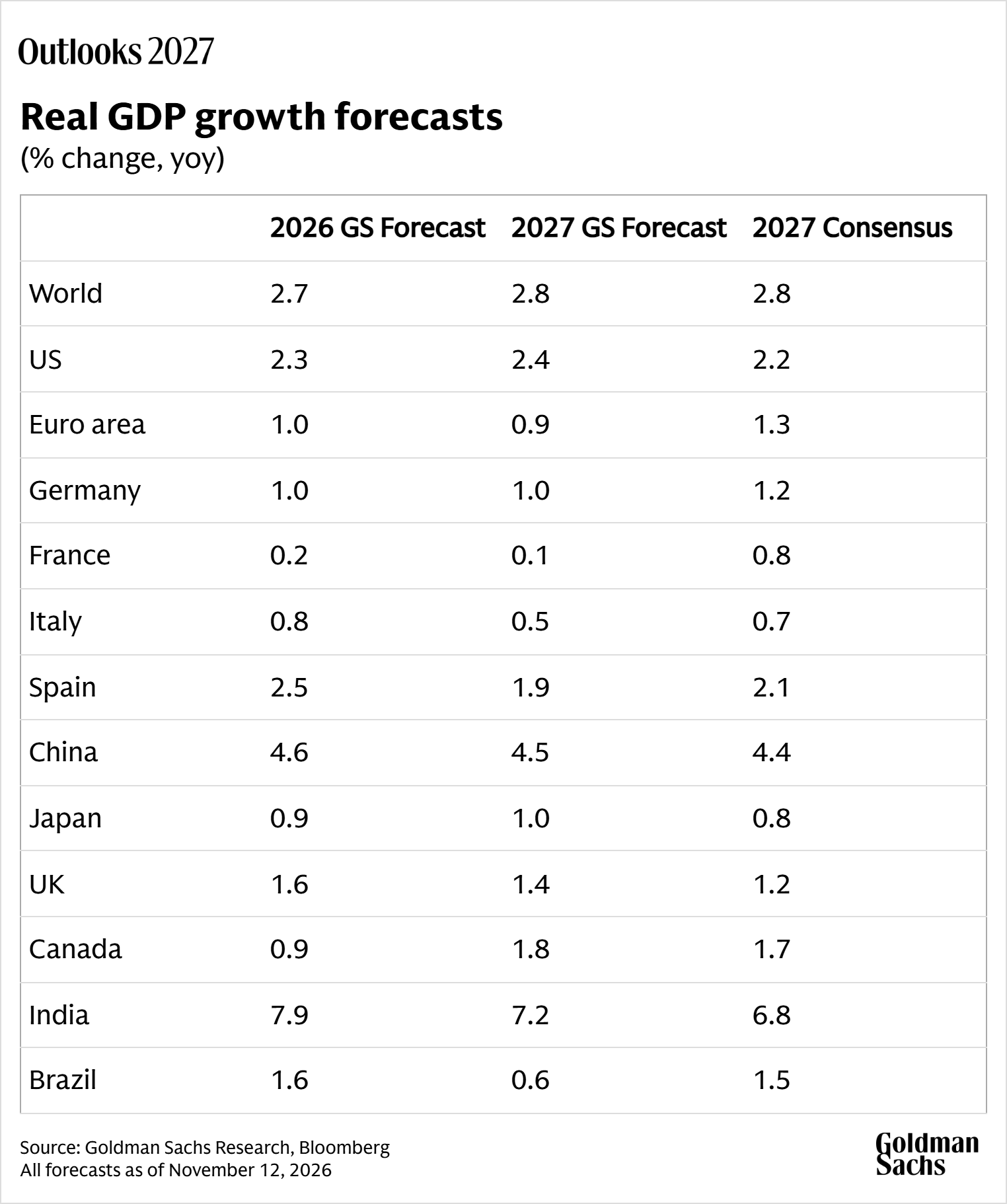
As has been the case for the last several years, our economists are more optimistic than consensus on US economic expansion owing to resilient investment. They are more downbeat on the European growth outlook amid tighter financial conditions and their expectation that higher energy prices will start to bite this winter. Goldman Sachs Research also forecasts continued robust economic expansion in South Korea and Taiwan, reflecting another year of strong AI exports.
While growth is expected to be solid, the risks to Goldman Sachs Research’s forecast for global GDP growth “are tilted to the downside,” Hatzius writes. Renewed escalation in the Iran war could result in another energy price surge. Large fiscal deficits could push up long-term yields more sharply, especially in France. AI capex could be lower than expected because of capacity constraints, regulation, credit market stress, or weaker demand, and Hatzius also sees early signs that AI adoption is weighing on the job market.
“We expect another year of solid but unremarkable GDP growth in 2027, but several of the impulses that shaped global growth in 2026 will look different,” Hatzius writes.
How will oil and energy prices affect GDP growth in 2027?
The headwind from the energy supply shock will likely flip next year as energy prices normalize. The baseline forecast from Goldman Sachs Research’s commodity strategists is that continued Middle East supply adaptation will lower Brent prices to $78 per barrel by the end of 2027, with a similar normalization in global prices for liquefied natural gas.
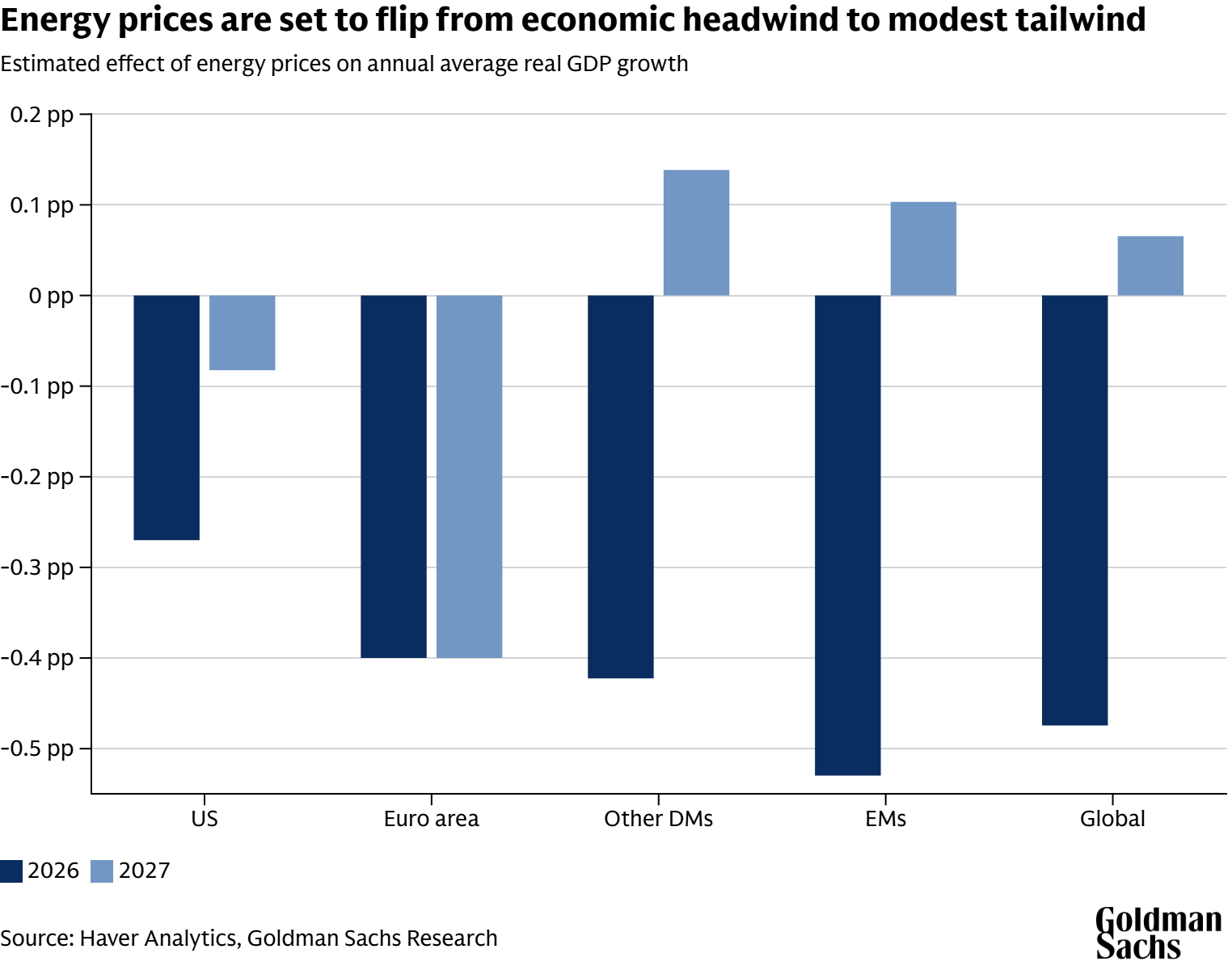
At the same time, Goldman Sachs Research sees an ongoing drag from energy prices in Europe from delayed energy cost pass-through to consumers.
How financial conditions and the fiscal outlook will affect GDP growth
Lower energy prices should outweigh the effect of tighter financial conditions and a smaller fiscal impulse to GDP expansion in 2027, Hatzius writes. Goldman Sachs Research’s Financial Conditions Index implies a moderate drag on growth over the next few quarters.
While our economists do not “expect meaningful fiscal consolidation” in 2027, the large fiscal expansions of the last few years are fading. The main exception is in Japan, where consumption tax cuts, increased defense spending, and the government’s investment plans are forecast to boost GDP growth by 0.7 percentage point.
“We also expect modestly positive impulses in Germany and the US—where the Democratic victory in November’s US election suggests some of the spending cuts from the 2025 One Big Beautiful Bill Act will be reversed,” Hatzius writes. Our economists project a continued fiscal drag in the UK that leaves the fiscal impulse in developed markets “only slightly positive.”
Will AI boost the global economy in 2027?
Goldman Sachs Research expects AI capex to boost global economic growth again next year. Our analysts forecast that nominal global AI investment will rise to $1.8 trillion in 2027 from $1.1 trillion this year, mostly driven by an increase of over $500 billion in hardware spending in the US. The investment surge is projected to be frontloaded, with the year-over-year change in investment as a share of GDP peaking in the first half of 2027.
“Even with the expected slowdown, the impact on GDP growth will be sizable,” Hatzius writes. Our economists estimate that AI investment will boost GDP growth by 0.4 percentage point globally. In the US, Goldman Sachs Research estimates AI investment will give a 0.6-percentage-point boost to "true" GDP growth after accounting for continued undercounting of semiconductor investment and chip-related intellectual property exports.
The transition to an AI-enabled economy, meanwhile, is occurring in two phases, according to Goldman Sachs Research. The first phase involves an investment boom that raises both corporate profits and global GDP growth but features only limited productivity gains. The second phase involves less hardware investment but more business reorganization, as well as more substantial productivity gains and labor market disruption.
Goldman Sachs Research has argued that AI is likely to displace some jobs and cause a temporary increase in the unemployment rate. Our economists’ baseline expectation is that AI adoption will only have a small effect on the labor market in 2027 and there will be more notable effects in 2028-2029.
What is the outlook for China’s economic growth in 2027?
Goldman Sachs Research forecasts China’s GDP to grow 4.5% in 2027, compared with the consensus estimate of 4.4%. This “reflects very robust expectations for Chinese exports and a further increase in China’s trade surplus,” Hatzius writes.
By contrast, domestic demand growth is predicted to remain weak next year owing to a drag from the property sector and weak underlying consumer spending.
This is expected to result in a modest headwind of 0.1 percentage point to the rest of the world’s GDP growth, with larger drags on growth in manufacturing-heavy economies such as Germany (headwind of 0.3 percentage point) and Central Europe (headwind of 0.2 percentage point).
What is the forecast for inflation in 2027?
Under Goldman Sachs Research’s baseline commodity forecasts for a steady decline in energy prices next year, inflation should slow in 2027, Hatzius writes.
The case for disinflation is particularly strong in the US because the price boosts from tariffs should fully drop out of the year-over-year inflation statistics next spring, he writes. With tariff effects fading and a much smaller inflation boost from the war in Iran, our economists expect core PCE inflation to slow to 2.4% at the end of 2027 from 3.2% at the end of 2026.
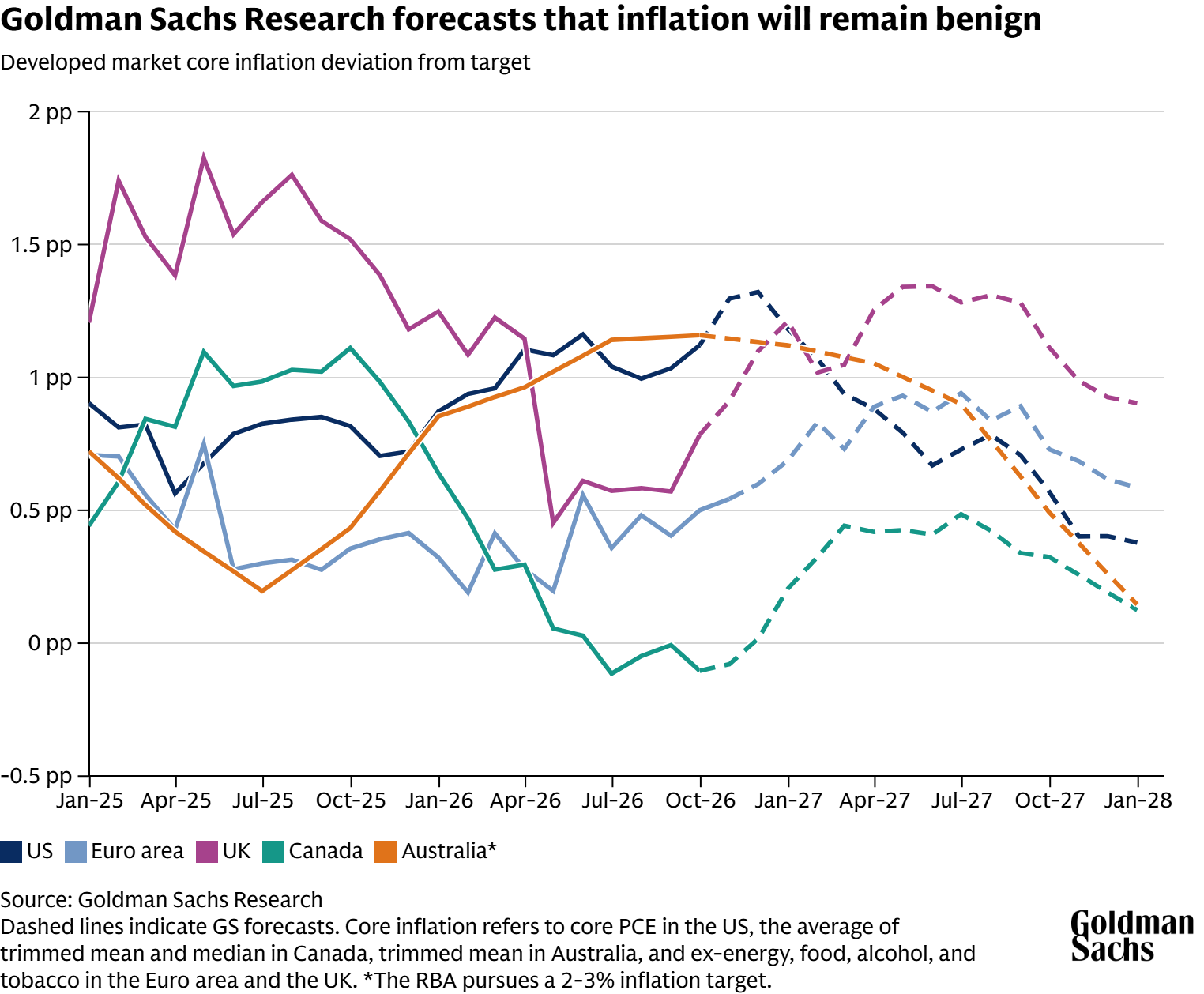
“We forecast a steady decline in year-over-year core inflation in the US and a more delayed decline in other major economies once the energy price shock is fully digested,” Hatzius writes.
What is the outlook for the Fed and other central banks in 2027?
Goldman Sachs Research expects “incremental policy tightening” through early 2027 in most major economies, but its economic forecasts support a dovish view on rates next year. Central banks could either deliver gradual normalization cuts later in 2027 as inflation comes down, or they could pivot to cuts sooner if economic growth is slower than projected.
The US Federal Reserve is expected to hike rates in December and March in response to lingering inflation pressures. But our economists say softer inflation data should allow the Fed to cut once in December 2027, followed by three more cuts in 2028 to a terminal rate of 3.25-3.5%.
“Furthermore, we see more dovish rate risks in the US than in most other economies, both because US inflation drivers look more clearly temporary and because the US is most exposed to a downturn in the AI cycle,” Hatzius writes.
Our economists’ views on other major developed markets also skew dovish. The European Central Bank is forecast to deliver its final hike in December, before starting to normalize back toward a 2.25% terminal rate in the fourth quarter of 2027.
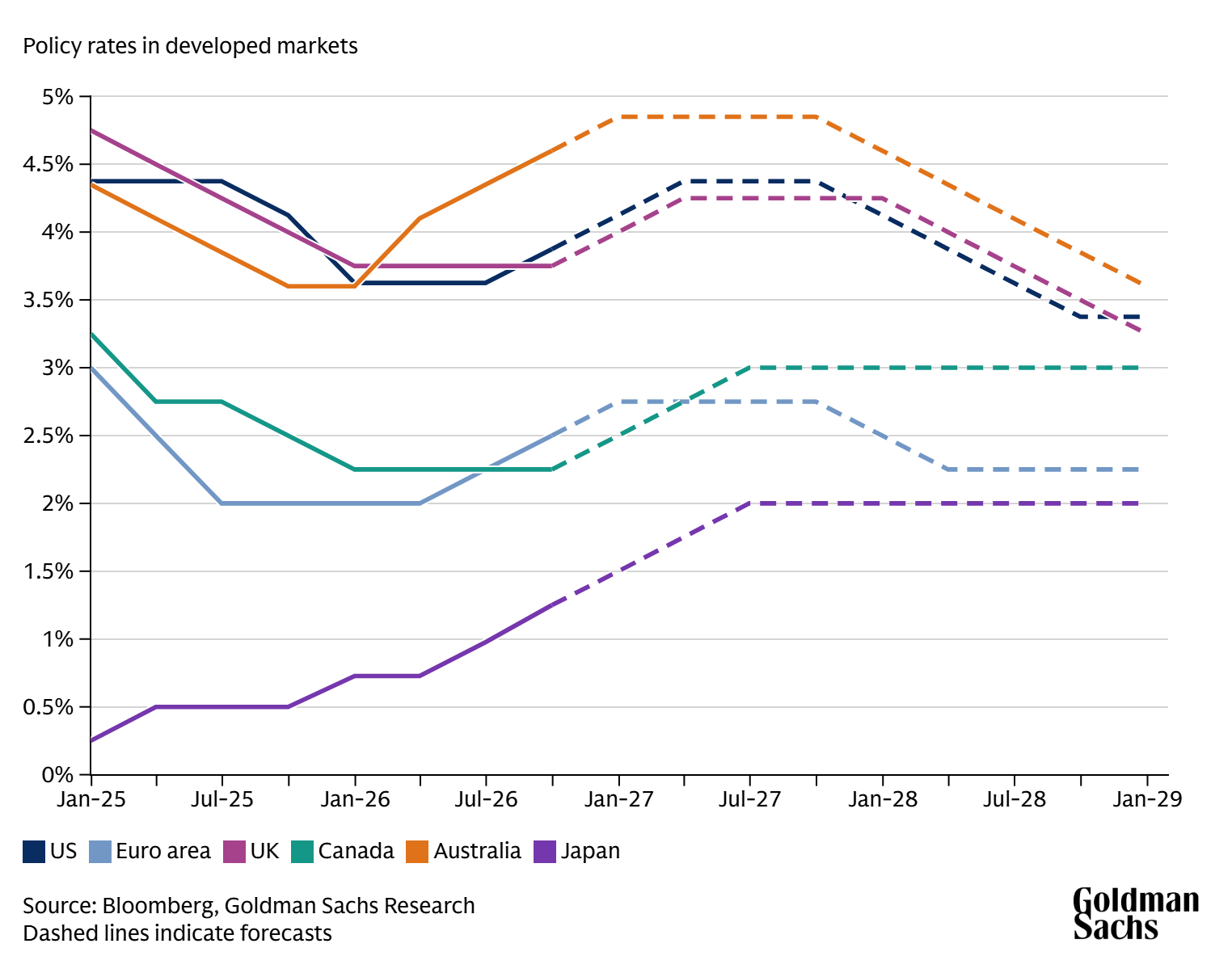
Goldman Sachs Research expects a final hike from the Bank of England to 4.25% in February before a hold for the remainder of 2027. Our economists forecast normalization cuts from the BoE to a 3.25% terminal rate, but not until 2028.
“The main outlier to our forecast of only modest further policy tightening is Japan,” Hatzius writes.
Goldman Sachs Research expects the Bank of Japan to hike rates by 25 basis points in December, reflecting recent communication from the central bank highlighting both upside inflation risks and the impact of higher global interest rates on the Japanese yen. With core CPI (excluding fresh food but including energy) likely to rise above 3.5% through next summer, our economists now expect that the BoJ will follow through with additional hikes in March and June for a terminal rate of 2%.
This document has been prepared by the Goldman Sachs Executive Office and is not a product of Goldman Sachs Global Investment Research. The opinions and views expressed herein are as of the date of publication, subject to change without notice, and may not necessarily reflect the institutional views of Goldman Sachs or its affiliates. The material provided is intended for informational purposes only, and does not constitute investment, legal, or tax advice, a recommendation from any Goldman Sachs entity to take any particular action or be used as a basis for any other investment decision, or an offer or solicitation to purchase or sell any securities or financial products. Any forward-looking statements, case studies, computations or examples set forth herein are for illustrative purposes only. Past performance is not indicative of future results. Neither Goldman Sachs nor any of its affiliates make any representations or warranties, express or implied, as to the accuracy or completeness of the statements or information contained herein and disclaim any liability whatsoever for reliance on such information for any purpose. Each name of a third-party organization mentioned is the property of the company to which it relates, is used here strictly for informational and identification purposes only and is not used to imply any sponsorship, affiliation, endorsement, ownership or license rights between any such company and Goldman Sachs. This material should not be copied, distributed, published, or reproduced in whole or in part or disclosed by any recipient to any other person without the express written consent of Goldman Sachs.




Subscribe to Briefings
Our weekly newsletter delivers the latest insights on economic forces shaping markets—from Goldman Sachs leaders, economists, and investors around the world.
You can unsubscribe at any time. For information about how your personal data will be used, visit Privacy Information and Resources.