

How Employers Are Thinking About Employee Stock Purchase Plans in 2026

- A slight majority of employers in the analysis offer an ESPP.Whether companies adopt these plans depends on many internal factors, including employee demand, cost, workforce ownership culture, industry norms, and broader compensation priorities.
- Qualified Section 423 plans continue to be the dominant approach but complexity creates challenges for both employers and employees.These plans account for most ESPPs reviewed and can provide favorable tax treatment for eligible US employees, though they also come with regulatory, approval, and purchase-limit requirements.
- Plan design should align with and support overall workforce and business goals.Employers adjust their eligibility rules, offering period cadence, contribution caps, discounts, matching features, and pricing methods to help align the benefit with their total rewards strategy.
For employers considering an ESPP or thinking about restructuring, there are a number of regulatory, financial, and employee attraction and retention considerations. This article shares insights into how employers are responding to these pressures and the trends shaping the broader market.

- Employee Stock Purchase PlansExplore how employers are evaluating Employee Stock Purchase Plans, including adoption trends, common plan structures, eligibility rules, and more.
The Current ESPP Landscape
From an employer’s perspective, an employee stock purchase plan can be a strategic compensation benefit helping to directly align employees’ financial incentives with those of shareholders and the business. At the time of this report, a slight majority of employers offer an ESPP (52%).1
This decision often hinges on several considerations, including the strength of ownership culture across the workforce, how closely participation tracks market-standard rates, the expense borne by the company, and the cash flow available to employees.
Variance by industry
The data shows meaningful differences in ESPP adoption by industry. Employers in the Technology, Media, & Telecommunications industry had the highest rate of ESPP availability (68%), while employers in the Real Estate sector were least likely to offer ESPPs (17%). This range suggests that employers weigh factors such as industry-specific talent dynamics, capital structure, and compensation philosophy when deciding whether to offer the benefit.
Determining ESPP eligibility
While employers use a number of metrics to define eligible participants for ESPPs, the most common is hours worked per week (36%). This can effectively remove part-time workers from eligibility pools. Tenure (32%) is also frequently used to limit participation eligibility. This can help encourage loyalty and support employee retention efforts.
Exactly half of the plans reviewed apply a single metric to limit employee eligibility, indicating a preference for administrative simplicity. 32% of employers take a two-metric approach, while the remaining 18% utilize three limitations.
Most common ESPP structures
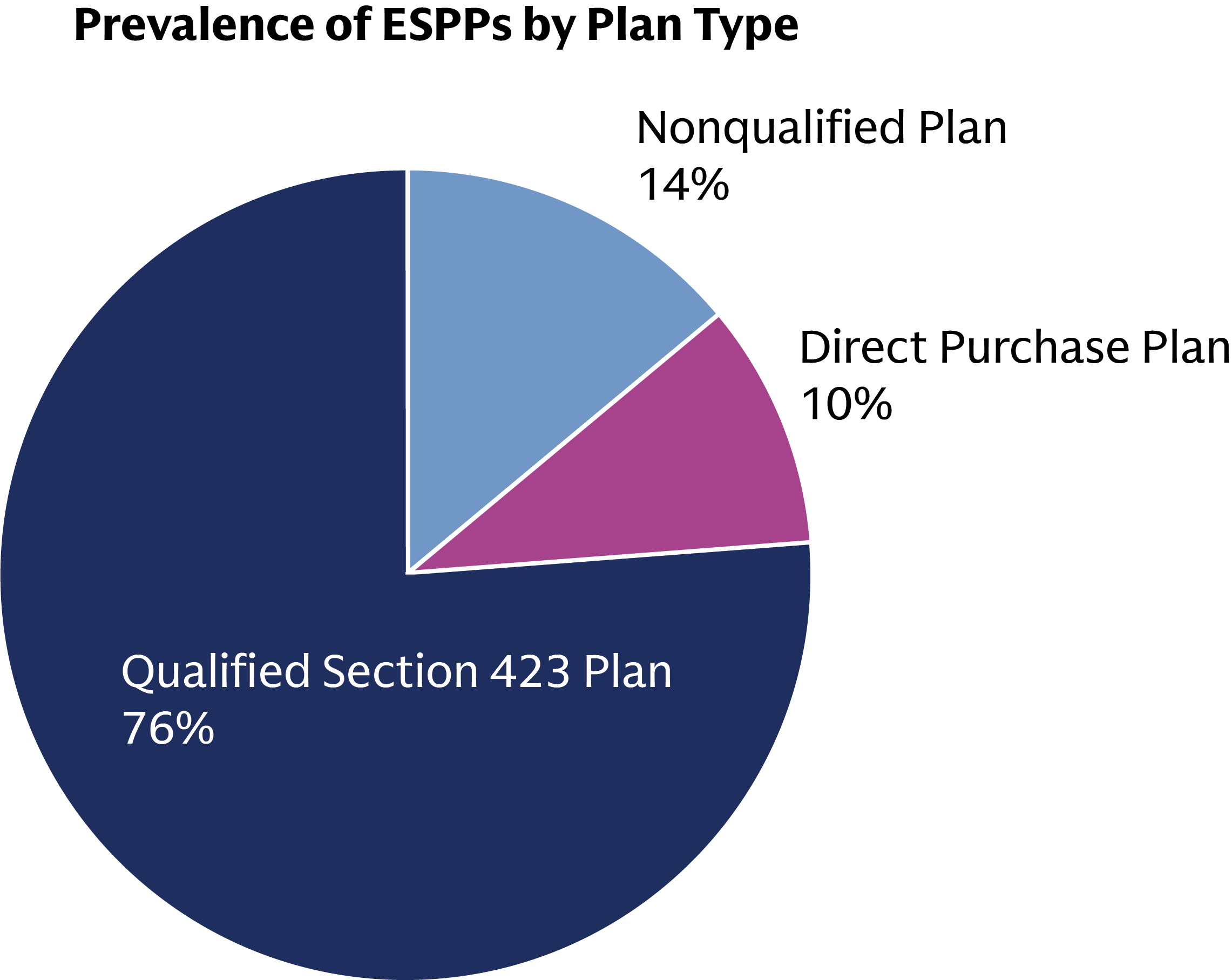
Employers that offer ESPPs fall into one of three broad plan structures: Qualified Section 423 plans, nonqualified plans, and direct purchase plans.
Qualified plans made up the largest share of plans reviewed (76%), while nonqualified (14%) and direct purchase plans (10%) appeared less frequently but may offer practical advantages for certain employer objectives.
Qualified Section 423 Plans
Qualified Section 423 plans (76%) may be particularly appealing to employers because of the potential tax benefits they can provide to eligible US employees. At the same time, they require strict regulatory compliance, shareholder approval, nondiscrimination rules, and the annual statutory purchase limit ($25,000 per participant).
| Structural Component | Most Common Method | |
|---|---|---|
|
Offering Period Frequency |
Semi-annually (54%) |
|
Maximum Contribution Limit |
10% of eligible compensation (39%) |
|
Purchase Price Discount |
15% discount (65%) |
|
Price Determination Method |
Lookback feature (54%) |
This table represents the most common methods of designing each individual structural component in the 121 plans reviewed. This is not meant to be representative of the most common holistic Qualified Section 423 plan structure.
Nonqualified Plans
Nonqualified plans represent a smaller share of ESPPs reviewed (14%) but employers are looking at the design as an option that introduces more flexibility, eases administrative needs, and simplifies tax treatment. Because these plans are not subject to the same Section 423 framework, they can support a broader range of eligibility rules and incentive structures. This may be particularly relevant for multinational employers looking for a more consistent employee experience across jurisdictions.
| Structural Component | Most Common Method | |
|---|---|---|
|
Offering Period Frequency |
Monthly (46%) |
|
Maximum Contribution Limit |
10% of eligible compensation (44%) |
|
Incentive Structure* |
Matching contribution (78%) |
|
Match Timing |
Annual (40%) |
|
Match Percentage |
10% match (31%) |
|
Price Determination Method |
Ending period value (62%) |
* Purchase Discounts are offered by the remaining 22% of employers. 40% of those employers that offer purchase discounts set the discount at 5%.
This table represents the most common methods of designing each individual structural component in the 121 plans reviewed. This is not meant to be representative of the most common holistic nonqualified plan structure.
Direct Purchase Plans
Direct purchase plans were the least common structure offered by employers (10%). These plans can provide a simpler way for employees to buy company stock, but they generally offer fewer plan-design levers and potential tax planning opportunities than qualified or nonqualified ESPPs.
| Structural Component | Most Common Method | |
|---|---|---|
|
Maximum Contribution Limit |
No maximum (25%) |
|
Price Determination Method |
Average price (73%) |
This table represents the most common methods of designing each individual structural component in the 121 plans reviewed. This is not meant to be representative of the most common holistic direct purchase plan structure.
Next Steps
For employers, the right ESPP design will depend on how the benefit fits into the broader total rewards strategy. Eligibility rules, offering frequency, contribution limits, incentive structure, and pricing methodology can all affect how employees interact with the plan and how the employer manages cost, administration, and alignment with business priorities.
To discuss how ESPPs and other benefits could impact your organization, connect with your Goldman Sachs Ayco team or start a conversation today.
1 Data is based on a review performed July–August 2026 of the employee stock purchase plans at 121 companies.
Disclosures
Advisory services offered by Goldman Sachs Wealth Services, L.P. (“Goldman Sachs Wealth Services”), a registered investment adviser, affiliate of Goldman Sachs & Co. LLC (“GS&Co.”), and a subsidiary of The Goldman Sachs Group, Inc., a worldwide, full-service investment banking, broker-dealer, asset management, and financial services organization. Goldman Sachs Ayco is a brand of Goldman Sachs Wealth Services. Brokerage services are offered through GS&Co. and Mercer Allied Company, L.P. (a limited purpose broker-dealer), both affiliates of Goldman Sachs Wealth Services and members FINRA/SIPC. For more information about Goldman Sachs Wealth Services offerings, visit our Full Disclosures.
No part of this material may be i) copied, photocopied or duplicated in any form, by any means, or ii) redistributed without Goldman Sachs Wealth Services’ prior consent. This does not constitute an offer or solicitation with respect to the purchase or sale of any security in any jurisdiction in which such an offer or solicitation is not authorized or to any person to whom it would be unlawful to make such offer or solicitation.
Goldman Sachs Wealth Services may provide tax advice to clients in accordance with its client agreement. GS&Co. does not provide accounting or tax advice to its clients, unless explicitly agreed between the client and GS&Co. All clients should be aware that tax treatment is subject to change by law, in the future or retroactively, and clients should consult with their tax advisors regarding any potential strategy, investment, or transaction.
This material is for informational and educational purposes only and is provided solely on the basis that it will not constitute investment or other advice or a recommendation relating to any person’s or plan’s investment or other decisions, and Goldman Sachs Wealth Services is not a fiduciary or Wealth Advisor with respect to any person or plan by reason of providing the material or content herein, including under the Employee Retirement Income Security Act of 1974, the Internal Revenue Code, or Department of Labor Regulations.
Articles were commissioned and approved by Goldman Sachs Wealth Services, but may not reflect the institutional opinions of The Goldman Sachs Group, Inc., Goldman Sachs Bank USA or any of their affiliates, subsidiaries or divisions. Goldman Sachs Wealth Services has no obligation to provide any updates or changes to this data. Information is subject to change without notice.
Certain information contained herein is based upon materials provided by third parties. We do not represent that such information is accurate and complete and it should not be relied upon as such. Information related to amounts and rates set forth under U.S. tax laws are drawn from current public sources, including the Internal Revenue Code of 1986, as amended, as well as regulations and other public pronouncements of the U.S. Treasury Department and Internal Revenue Service. Tax results may differ depending on a client’s individual positions, elections or other circumstances. Such information may be subject to change without notice. In some cases, rates may be estimated and may vary based on your particular circumstances.
Any discussions of pending legislation, or hypothetical projections based on same, are educational and should not be construed as or relied upon as investment, tax or legal advice. Where materials and/or analyses are provided to you, they are based on the assumptions stated therein. In the event any of the assumptions used do not prove to be true, results are likely to vary substantially from the examples shown herein. Illustrations or projections are based on certain assumptions that we believe are reasonable. If any of these assumptions do not prove to be true, results are likely to vary substantially from the examples shown herein. These examples are for illustrative purposes only, do not purport to show actual results, and no representation is being made that any client will or is likely to achieve the results shown.
Prepared by Wealth Advisory Services of Goldman Sachs Wealth Services, L.P.
©2026 Goldman Sachs Wealth Services, L.P. All Rights Reserved.
Insights from Goldman Sachs Ayco



Subscribe to Briefings
Our weekly newsletter delivers the latest insights on economic forces shaping markets—from Goldman Sachs leaders, economists, and investors around the world.
You can unsubscribe at any time. For information about how your personal data will be used, visit Privacy Information and Resources.