

Global Institute Dialogues
Clayton Swope on The Future of the Space Economy

Clayton Swope is the Deputy Director of the Aerospace Security Project and Senior Fellow at Center for Strategic and International Studies.
In this edition of Global Institute Dialogues, Clayton Swope discusses the future of the space economy.
The views stated herein are those of the interviewee and do not necessarily reflect the views of Goldman Sachs or its affiliates. Goldman Sachs is not responsible for any statements made by the interviewee.

- Global Institute DialogueGlobal Institute Dialogue
The government is the primary customer for the space economy. However, the private sector is playing a more important role, both in terms of providing new capabilities and with a growing customer base and set of end users. What are the current and potential future opportunities in the space economy as private sector customers shape more of the market?
Last year, researchers estimated the value of the global space economy at $626billion and projected that figure could approach $1.8 trillion by 2035. The space economy of today and the future will be shaped by the spending decisions of both government and non-government, including consumers and enterprise business customers. While the number of rocket launches, satellite giga-factories, and satellite production rates are easily measured they are also physical reminders about the economic impacts of outer space. Because these components are upstream elements of the space economy, they are also lagging indicators of the downstream drivers (i.e., the end customers) of space-derived products. To a large degree, the categories of downstream customers paying for products, including services, provided by spacecraft and satellites has remained static for decades.
Two categories of paying customers dominate downstream markets for space products and underpin the foundations of the space economy today: communications services, which is an approximately $125 billion market, and satellite imagery data, which is around a $6 billion market. The growth trajectory of the space economy will be largely shaped by the answer to one question: Can space companies develop products that tap into new downstream markets? Space companies selling downstream products need to figure out how to expand their markets by selling their wares to more people than they do now or selling higher value products to existing customers. There are multiple ways to accomplish those objectives.
First, increasing downstream markets for the space economy can involve developing entirely new types of space-derived products, such as space-based pharmaceutical and semiconductor manufacturing. While these are new markets for space companies, they are large, established markets on Earth, with the global pharmaceutical and semiconductor markets today each estimated at over $1.5 trillion. Space-based data centers also present an opportunity for space to capture business from an existing market—computing, in this case.
Second, space companies may grow their downstream customer market share at the expense of products provided by non-space companies. Leading public space company’s plans to provide “5G-quality” cellphone service using low Earth orbit satellite constellations foreshadow the potential for space operators to tap into a massive market for mobile communications services. In the United States alone, as of 2024, there are over 250 million mobile phone subscriptions. Space resource mining and extraction may present another opportunity to grow the downstream space economy.
Finally, rather than seeking out entirely new customers for their space products, companies can offer products with greater value, which demand a higher price than the ones currently on offer, to existing customers. Remote sensing companies, for example, are increasingly offering higher value products that offer analytical insights rather than just data, and companies in other sectors could pivot in similar ways.
In all three cases, space companies are increasing the size of the downstream pie—their success will reverberate across the space economic ecosystem.
The US government is also changing its role as a customer, including new priorities and models of procurement. How have these governmental changes reshaped the market and incentives for space companies?
To improve access to new ideas, produce innovative products at scale, and reduce taxpayer costs, the U.S. government has increasingly sought to incorporate commercial business practices and flexibility into its procurement processes. Rather than relying on cost-based contracts, government agencies have turned extensively to fixed-price contracts, which are commonly used for business-to-business transactions. To escape the rigid constraints of typical government contracting frameworks, agencies are also turning to non-traditional procurement agreements, using what are called other transaction authorities, which offer risk-sharing opportunities to enable unique government and private sector collaboration. Instead of buying a device, piece of equipment, or system from a company, which the government then owns and operates using government personnel, the government is increasingly turning to “as-a-service” models for acquiring certain capabilities from the private sector.
All of these trends are manifest in how NASA, the Department of Defense (DOD), intelligence community, and other government agencies buy space capabilities and seek to incorporate innovation and new ideas into their government missions. In fact, NASA has turned to commercial and non-traditional acquisition approaches for decades, going back to the early 2000s and the Commercial Orbital Transportation Services program, which sought to lower the costs of space access and played a significant role in the maturation of private sector reusable rockets. The Pentagon is also emphasizing modernizing procurement processes, announcing new measures to accelerate the fielding of new technology and advanced capabilities—an development that complements other plans to transform the military requirements process.
Acquisition approaches aligned with commercial best practices have already created and will continue to create opportunities for more space companies to win government contracts. The emphasis on fixed-price contracts gives space companies oriented around selling commercial products—business not designed around adherence to onerous reporting rules required for cost-style contracts—a chance to win government business. The use of other transaction authorities allows the government to fund developments even when the government has not yet concretely defined all its requirements—and essentially lets industry innovate and come up with the best ideas to meet a general need.
Finally, by emphasizing space-derived services, the government is aligning its procurement methodology around acquiring outcomes. This approach allows companies to iterate and refine technological solutions, which can evolve over time, without locking themselves into specific hardware.
The space economy is growing rapidly, but there are several unresolved debates about how it will develop, especially around governance. What are the most consequential unresolved questions for the space economy, and how do you foresee those questions being resolved?
In his seminal work, Capitalism and Freedom, published in 1962, economist Milton Friedman argued that capitalism only thrived in a rules-based environment. For the free market to work, the government must serve as “a forum for determining 'the rules of the game' and as an umpire to interpret and enforce the rules decided on."
The United States and other nations have established strong national laws and regulations for space commerce and economic activity. There is also a core foundation of international space law that dates back to the Cold War and the Outer Space Treaty of 1967. But there are not sufficiently detailed, internationally agreed-to basic norms governing spacecraft operations, nor are there international organizations dedicated to the maintenance of those norms. It would be incorrect to characterize outer space as the Wild West, but the international agreements covering space activities were not written with today’s realities of space in mind and do not offer a clear roadmap to space companies or spacefaring governments for ensuring safe and sustained operations in orbit.
The idea of a shared set of rules is not unique to space. Air, maritime travel, and commerce across international boundaries and the high seas work well and facilitate economic activities around the globe because of agreed-upon rules and standards. What is needed for space is the equivalent to the Chicago Convention, which laid the foundations for international air travel and commerce in the 1940s, or the United Nations Convention on the Law of the Sea, which established rules covering the high seas and other international bodies of water. The main sticking point for establishing such a comprehensive international approach to global space governance is geopolitics. To maximize the effectiveness of rules of the road for space, the world’s two most important space powers—the United States and China—would have to come to the table and negotiate a framework on which both nations agree. Given ongoing tensions and mistrust, as well as the recognition that negotiating a new space agreement is likely not the highest priority for either country, it is hard to envision an agreement coming together soon.
But ultimately the success of the United States and China in space are bound together by this shared interest in developing a more robust space governance framework—both nations’ commercial space enterprises have much to gain from the establishment of a shared understanding of the rules of the road for space. Companies themselves see the need and are moving out on their own to establish best practices and norms. Additionally, standards-making bodies like the Consultative Committee on Space Data Standards and International Organization for Standardization are making incremental progress bringing together space stakeholders, including from the United States, China, Russia, and others, to make progress on technical standards for space operations. Ultimately, industry- and nongovernment-led efforts may prove the most productive avenues, at least in the short term, to make critical progress on negotiating agreed-to approaches to managing and coordinating activities in orbit.
What risks or potential losses or degradations of space capabilities would create the greatest spillovers for US national security? For the civilian economy and financial markets?
In recognition of the threats faced by satellites in orbit and the critical role space-derived services play in modern life, policy and decisionmakers are often faced with a question: Are we too dependent on space? Many economic and business activities, as well as conveniences easily taken for granted, like mobile phone mapping and navigation apps, are enabled by satellite-provided services, from navigation and clock-setting signals enabled by GPS satellites, to broadband and connectivity, and satellite imagery from Planet, Vantor, Blacksky, and others. Modern all-domain military operations also rely on the same or similar space-based capabilities provided by government owned-and-operated and commercial satellites. The issue is not whether society or the military can function without space—thousands of years of human history are testimony to the fact that wars can be fought and life can go on without access to a single satellite. Rather, the issue is that the architecture of modern society, economic activities, and national defense currently rest on access to space services.
Disruptions or losses of access to space would change how we live and work, and they would alter the foundations of the technological systems and assumptions that underpin the global economy, and forcing cascading changes to how the United States and many other nations, including its geopolitical competitors, fight and win wars. For national security and defense, it would cause a cascading effect that would result in a rethinking of all aspects of joint warfighting because space services enable the projection of military power across all domains, including cyberspace. Disrupting space would change not only how warfighters operate but also the generation of direct effects on the battlefield, as modern weapon systems rely on space to identify, locate, track, and find their targets. The most economically consequential impacts of disruptions would likely be our reliance on GPS as a timing source for technologies supporting finance, energy, and transportation and the challenges to businesses, as well as individuals, who rely on GPS for navigation services.
The space economy is often discussed in terms of what is in orbit, but nearly every space-based service depends on critical infrastructure or supply chains on the ground. What are the most important capacity constraints or chokepoints in that terrestrial layer, and which parts of it are most likely to be in focus for policymakers and executives over the next decade?
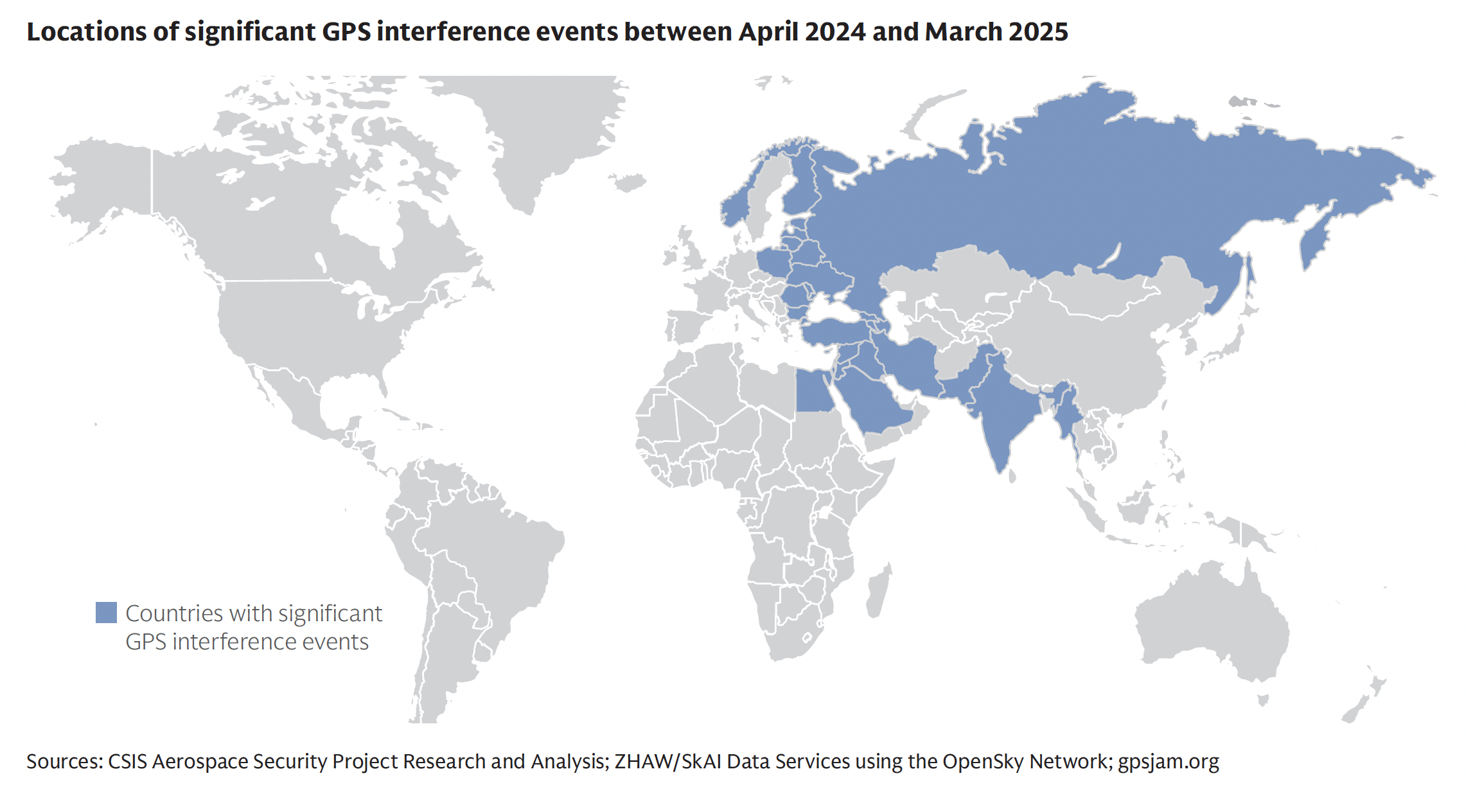
An obvious fact but worth clearly stating: All satellites communicate with controllers on Earth and send information to and from Earth using radio signals. The use of satellites and any space-derived service requires frequency bandwidth—necessitating access to and use of spectrum resources—and physical equipment on the ground to receive and transmit radio signals going to and coming from space. For over a century, international processes and national spectrum authorities, like the Federal Communications Commission, have developed and managed rules for using spectrum aimed at minimizing harmful interference between different types of radio users. But radio communications can be disrupted unintentionally, such as by natural phenomena or accidental human-made interferers, or through intentional interference with signals. Both the exponential increase in the use of spectrum resources for a vast number of devices and technologies and the rise in cases of endemic signal jamming and spoofing around the world means that policymakers and executives should pay attention to the fragility of spectrum “superiority” and its critical role in space operations and the delivery of space-derived services.
Physical infrastructure is needed to use spectrum—in the case of space, that means equipment on satellites and on the Earth at satellite ground stations. These ground stations are analogous to maritime ports, serving as entry and exit points for information and communications travelling between terrestrial networks and space. Like maritime ports, there are only so many satellite ground stations supporting certain satellites and satellite constellations, although inter-satellite links improve the resilience of constellations to individual or regional ground station disruptions.
As in the first space age, governments globally are now competing in space. What are the most important metrics of space leadership for countries like the US, China, and Russia? And what strategies are smaller countries pursuing to secure their own advantages?
On May 8, 1961, less than a month after the Soviets sent the first human into orbit, NASA Administrator James Webb and Secretary of Defense Robert McNamara sent a report to the White House aiming to make the case for an American effort to land humans on the Moon. They argued that the United States should pursue a crewed lunar landing because of what such a mission symbolized, even though it could not be justified by any “scientific, commercial or military value.” To Webb and McNamara, outer space was an important stage on which the United States competed with the Soviet Union—beating the Soviets to the Moon was a matter of national prestige.
Now, over fifty years after the Apollo 11 lunar landing, a new Moon race is playing out between the United States and China. But the Moon race is only one facet of a broader space competition, which includes not only the United States and China, but others, including India and European nations, and involving not only matters of national prestige, but also economic and security considerations.
Nations of all sizes seek to harness space to provide direct, tangible economic and national defense benefits, while also turning to space endeavors to foster national pride. In some cases, countries are looking to collaborate on space missions, including European efforts to strengthen partnerships with Japan and South Korea, the U.S. Artemis program, which involves many international partners, and Sino-Russian lunar plans. Many nations also seek to encourage the development of domestic space companies, with an eye toward capturing a greater share of the space economy. China has placed a significant emphasis on maturing and expanding its domestic commercial launch and satellite manufacturing capabilities and launching new broadband satellite constellations. Because of the increasing recognition of the critical role played by space in defense and military operations, nations seek to harness national space power to enhance their national security.
Rather than being assessed and measured individually, these various activities—with overlapping and complementary goals related to security, the economy, science, and prestige—are best assessed comprehensively in the context of their role in enhancing overall national power.
Today, the United States is the world’s most important space power. Space is a foundational pillar of U.S. national strength. China is motivated to close the gap and has demonstrated through its actions, measured over decades, that it understands the value of space in the same way. Winning in space matters because it is part of the broader geopolitical competition and, ultimately, one integrated component of national power.
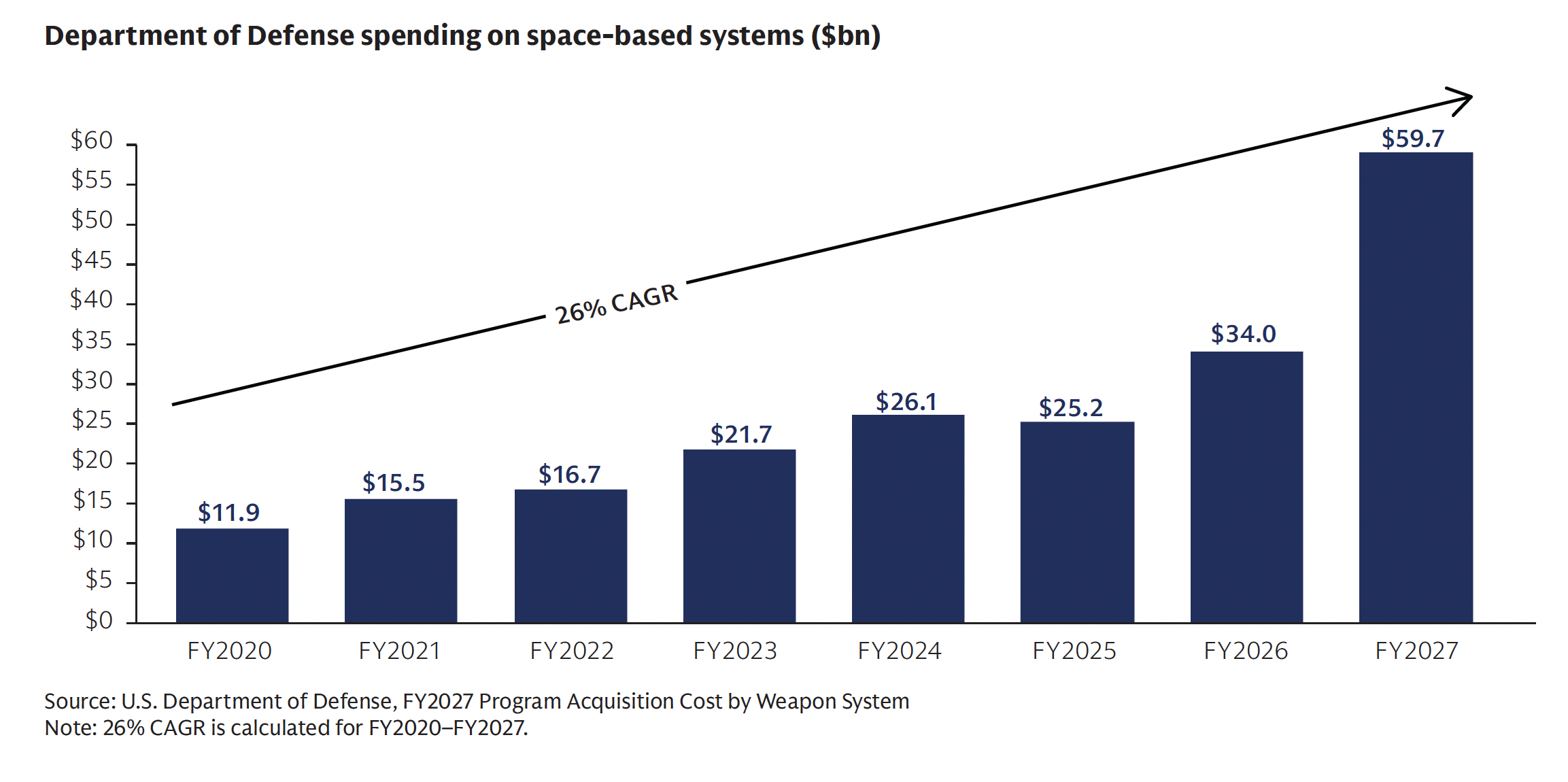
What have the wars in Ukraine and Iran taught us about how space capabilities are used and contested by modern militaries? How should those lessons inform thinking about the connection between the space domain and potential future conflicts?
Modern militaries use space to identify, characterize, and track targets, to communicate with warfighters and weapons, such as unmanned systems like airborne and maritime drones, and to ensure units and forces can navigate across the battlefield. Many satellites providing these capabilities are owned and operated by militaries or other government entities, but others are commercially operated, using as-a-service models to sell important data and services to militaries and national security agencies. In some cases, commercial satellites from third countries provide services used by militaries of other countries involved in wars. Iran has reportedly acquired a satellite and satellite imagery from companies in China. Russia too has acquired much the same from China. Ukraine relies on commercial satellites operated by companies in other countries for its defense.
A lesson from the ongoing wars in the Middle East and Ukraine is that civilian-oriented infrastructure, including facilities and equipment supporting satellite operations, will be targeted. In March 2026, Iran struck a commercially-operated teleport facility in Israel supporting a satellite in geostationary orbit. According to Polish officials, Russia is responsible for a September 2026 arson attack against a Starlink ground station in Poland. Satellite ground stations, like all Earth-based critical infrastructure, are also susceptible to damage from natural disasters, like storms and earthquakes.
Because of the critical role space plays in modern warfare, satellites and their supporting infrastructure, including commercially operated systems in space and on the ground, will likely continue to be targets. Satellites and networks and systems that support their operations on Earth face growing threats, including physical threats and threats in both cyberspace and across the electromagnetic spectrum. These threats also extend into gray-zone, hybrid warfare actions, as demonstrated by the recent maneuvers of a Russian satellite near a commercially-operated radar satellite in October 2026.
The United States and its allies cannot ignore the importance of space superiority: ensuring U.S. and friendly access to and use of space, while denying adversaries the same. The September 2026 disclosure by the United States that it possesses on-orbit space control weapons speaks to the need to establish a framework to deter aggressive actions against U.S. and friendly satellites and importance of space control, which are actions taken to obtain space superiority.
The dramatic reduction in the cost of launching objects into space has fundamentally reshaped the space economy. What other trends or innovations should investors watch as the space economy progresses over the next ten years?
While there is no shortage of public discourse on the need to grow the commercial space economy, often lost is that fact that the main customer for many U.S. space companies today is still the U.S. government. Government-dominated markets have different incentives around efficiencies and price dynamics than standard commercial markets. So, over the next decade, a key question will be if space markets can break free of their general dependence on government budgets.
Few space-derived products and services are the end customers, rather than customers of a downstream input or components in a supply chain, not predominantly affiliated with governmental entities. One answer includes space launch. But launch services should not be assessed independently of the end customers for the launched spacecraft and the services those spacecraft provide. They are a downstream input. That leaves only one type of commercial space activity today that is not dependent on government customers: satellite communications.
So, what part of the space economy might look like satellite communications in the coming years, free from a dependence on government budgets, and thus with more unconstrained growth? It is probable that the end customers for several other emerging space businesses—on-orbit computing and manufacturing and resource extraction—may be mainly private sector, non-government customers. There are more possibly even further on the horizon, like space-based solar power. And right now, semiconductors and pharmaceutical products seem to be the most promising use cases for on-orbit manufacturing. To unlock the potential of space resources, one company is aiming to mine asteroids from precious metals that carry a high price today in Earth-based markets, hopefully justifying the cost and trouble of mining them in space. In addition to their potential to tap into non-government-dominated markets on Earth, on-orbit computing and manufacturing and space resource extraction would facilitate international trade and commerce and lead to the development of space logistics and communications infrastructure that could support other business use cases.
As the space economy matures, investors should watch whether the space economy can break out of its overall dependence on the government customer and grow into markets that are not dominated by government buyers. Although many space companies will certainly continue to base their business cases around government customers—many defense prime contractors have successfully done just that for decades—many also will aspire to sell products into mainly commercial markets. The future of the space economy hinges on their success.
- About the IntervieweeClayton Swope is the deputy director of the Aerospace Security Project and a senior fellow in the Defense and Security Department at the Center for Strategic and International Studies (CSIS). Before joining CSIS, Swope led national security and cybersecurity public policy for Amazon’s Project Kuiper, an initiative to increase global broadband access through a constellation of satellites in low Earth orbit. While at Amazon, he also worked on cloud policy issues. Prior to his time at Amazon, Swope served as a senior adviser on national security, space, foreign affairs, and technology policy issues for a member of the U.S. House of Representatives. He also worked for more than 14 years at the Central Intelligence Agency, serving largely in the Directorate of Science and Technology. He holds a bachelor of science in mechanical engineering from the University of Notre Dame.
This document has been prepared by the Goldman Sachs Global Institute and is not a product of Goldman Sachs Global Investment Research. The opinions and views expressed herein are as of the date of publication, subject to change without notice, and may not necessarily reflect the institutional views of Goldman Sachs or its affiliates. The material provided is intended for informational purposes only, and does not constitute investment, legal, or tax advice, a recommendation from any Goldman Sachs entity to take any particular action or be used as a basis for any other investment decision, or an offer or solicitation to purchase or sell any securities or financial products. Any forward-looking statements, case studies, computations or examples set forth herein are for illustrative purposes only. Past performance is not indicative of future results. Neither Goldman Sachs nor any of its affiliates make any representations or warranties, express or implied, as to the accuracy or completeness of the statements or information contained herein and disclaim any liability whatsoever for reliance on such information for any purpose.Hyperlinks to, and references to, third-party websites, publications, research, and other materials are provided for informational purposes only. Their inclusion does not imply any sponsorship, affiliation, endorsement, or approval by Goldman Sachs of any third party or its content, and Goldman Sachs does not control and is not responsible for the content or accuracy of any third-party materials. Each name of a third-party organization mentioned is the property of the company to which it relates, is used here strictly for informational and identification purposes only and is not used to imply any sponsorship, affiliation, endorsement, ownership or license rights between any such company and Goldman Sachs. This material should not be copied, distributed, published, or reproduced in whole or in part or disclosed by any recipient to any other person without the express written consent of Goldman Sachs.



Subscribe to Briefings
Our weekly newsletter delivers the latest insights on economic forces shaping markets—from Goldman Sachs leaders, economists, and investors around the world.
You can unsubscribe at any time. For information about how your personal data will be used, visit Privacy Information and Resources.