

Beyond the Horizon: A Multi-Trillion Dollar Opportunity in Defense and Space Tech


- The modernization of defense technology is creating a multi-trillion-dollar opportunity.
- Space is becoming a critical commercial and national-security domain.
- Public and private markets are helping scale the next generation of defense and space companies.
The defense and space tech sector is entering a new phase of accelerated growth and strategic importance. Catalyzed by persistent geopolitical instability, demand for faster innovation cycles, record levels of private capital, and a broadening range of mission-critical technologies, the sector’s total addressable market is projected to reach up to $5 trillion by the mid-2030s.1
We are operating in a new paradigm. For companies with differentiated capabilities positioned to scale, the capital markets are open.
- AI-enabled autonomy is becoming a defining feature of the defense and space landscape, accelerating the shift toward machine-based vs. human-based conflict systems.
- The sector is creating room for faster, lower-cost, and more combat-effective technologies that can complement, and in some cases challenge, traditional platforms.
- Renewed focus on sovereign capability is catalyzing innovation and production across Allied nations, reinvigorating both incumbents and emerging defense technology players.
- Space is increasingly viewed as a critical operating domain, underpinning communications, navigation, and full-spectrum combat capabilities–with the next peer-to-peer conflict involving the United States and its Allies likely to extend into space.
- Sustained investor conviction in defense and space technology has funneled record capital toward startups with demonstrated capabilities in technology, speed, and agility.
Democratizing the Space Economy
“By 2050, the largest companies operating in space may not be traditional space companies,” says Mike Tarulli, global head of aerospace, defense, and government services. “Space is likely to become fundamental to nearly every business, much like the internet evolved from a distinct sector in the early 2000s into a core part of every company today.” Rocket reusability and falling launch costs have democratized access to space, unlocking an opportunity that could swell to $1 trillion by the mid-2030s or 2040s.1
Although the industry was dominated by government agencies in decades past, today’s landscape is shifting, with private enterprises accounting for roughly 80% of space economy spending. “It's been absolutely remarkable what the transformation has been,” says Erik Sparks, head of global resilience leading space technology, satellite communications, and national security infrastructure coverage. “Ultimately, it's going to get beyond orbit and beyond just supporting the terrestrial economy into space stations, into a lunar base, and then ultimately making humanity multi-planetary.” This increased access to the space economy is poised to unlock a new wave of commercial innovation, spanning from manufacturing pharmaceuticals in orbit to employing zero gravity to test new GPUs.
A Resurgent Dealmaking Environment
This acceleration is demanding new capital and resulting in strategic activity that has rapidly gained momentum in the last 12-18 months. Robust M&A volumes are supported by the availability of capital in public and private markets, a strong desire to re-position businesses for scale, and an easing regulatory backdrop. Both deal volume and valuations in the aerospace and defense sector have seen an uptick as multiple pureplay buyers make acquisitions.
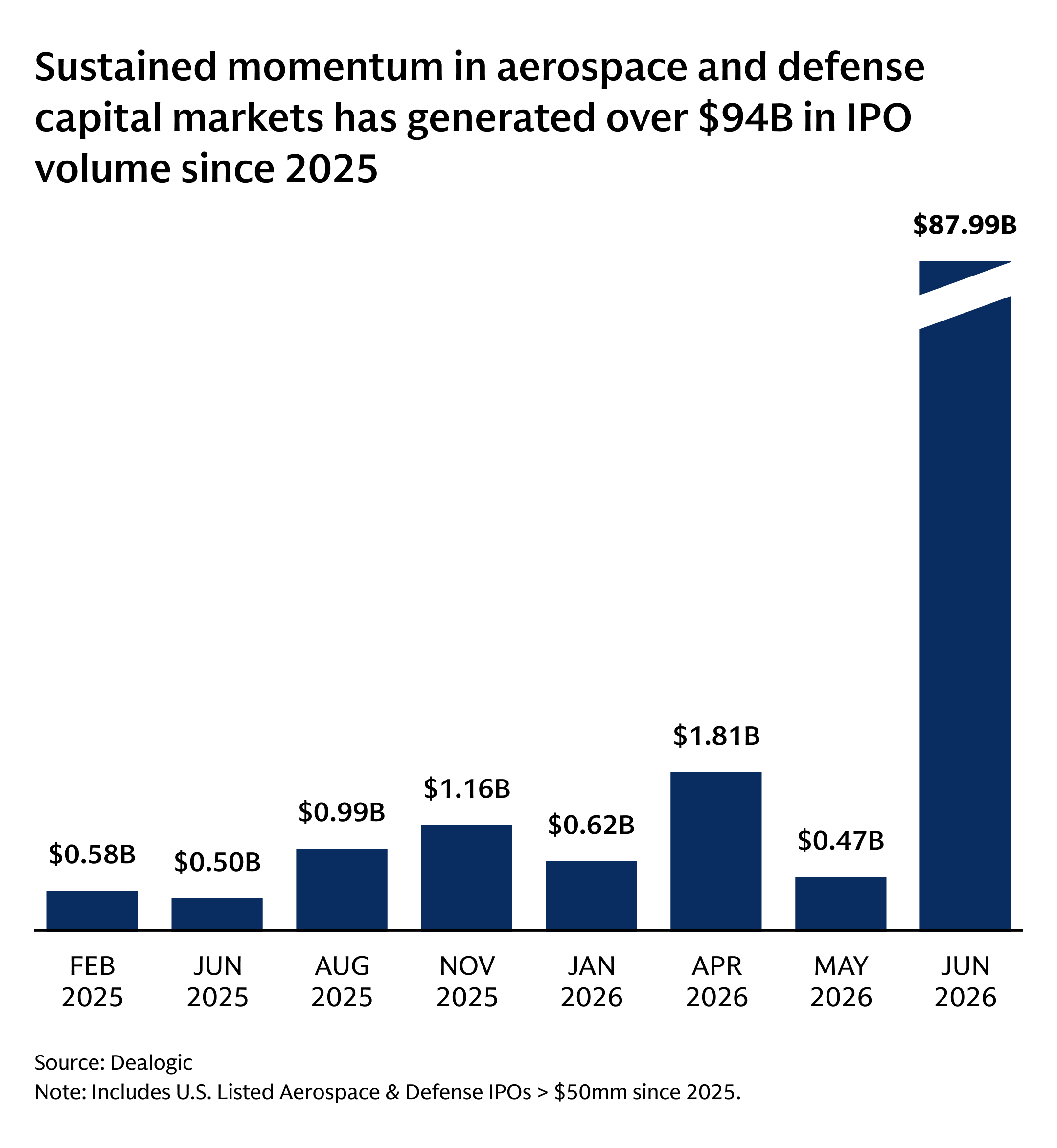
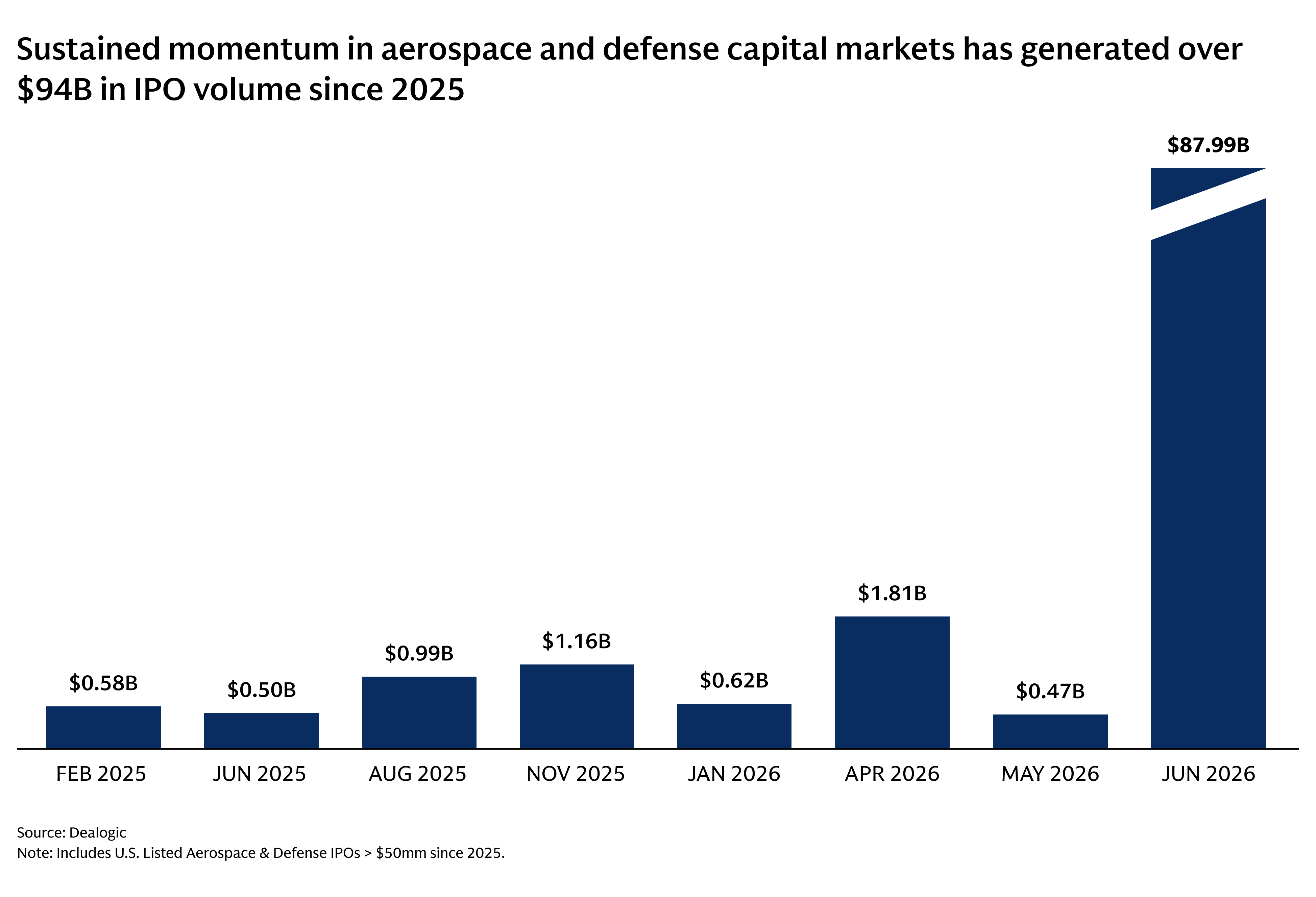
The public equity markets have also been very supportive of new entrants in the category, with a series of space and defense tech IPOs marking a paradigm shift in defense procurement, rapid unmanned systems proliferation, and a positive outlook for commercial aerospace. Within private markets, venture capital flows into defense technology have reached all-time highs, with North American and European startups raising record capital. This funding is fueling rapid valuation growth for disruptive players focused on space, autonomous vehicles, and pioneering technologies.
1 World Economic Forum, McKinsey, United Nations