

Outlooks
Why the US Economy Is Forecast to Grow Faster than Consensus Estimates

- Goldman Sachs Research predicts US GDP will increase 2.4% in 2027 (fourth quarter over fourth quarter), compared with the consensus estimate of 2.2%.
- Our economists expect consumer spending to rise 2.2% in 2027, driven mainly by stronger real labor income growth as inflation moderates.
- US job growth is expected to be healthy in 2027 as the economy expands near its potential.
- US inflation is predicted to fall substantially by the end of 2027.
Goldman Sachs Research forecasts the US economy will grow faster than the consensus of economist estimates in 2027. The key drivers of GDP expansion and inflation in 2026—the war in Iran, tax cuts, tariffs, and price pressures from artificial intelligence (AI)—are expected to have a smaller impact next year.
What is the outlook for US economic growth in 2027?
Goldman Sachs Research predicts US GDP will increase 2.4% in 2027 (fourth quarter over fourth quarter), compared with the consensus estimate of 2.2%, amid a stable labor market. Core PCE inflation is projected to fall to 2.4%, in line with consensus.
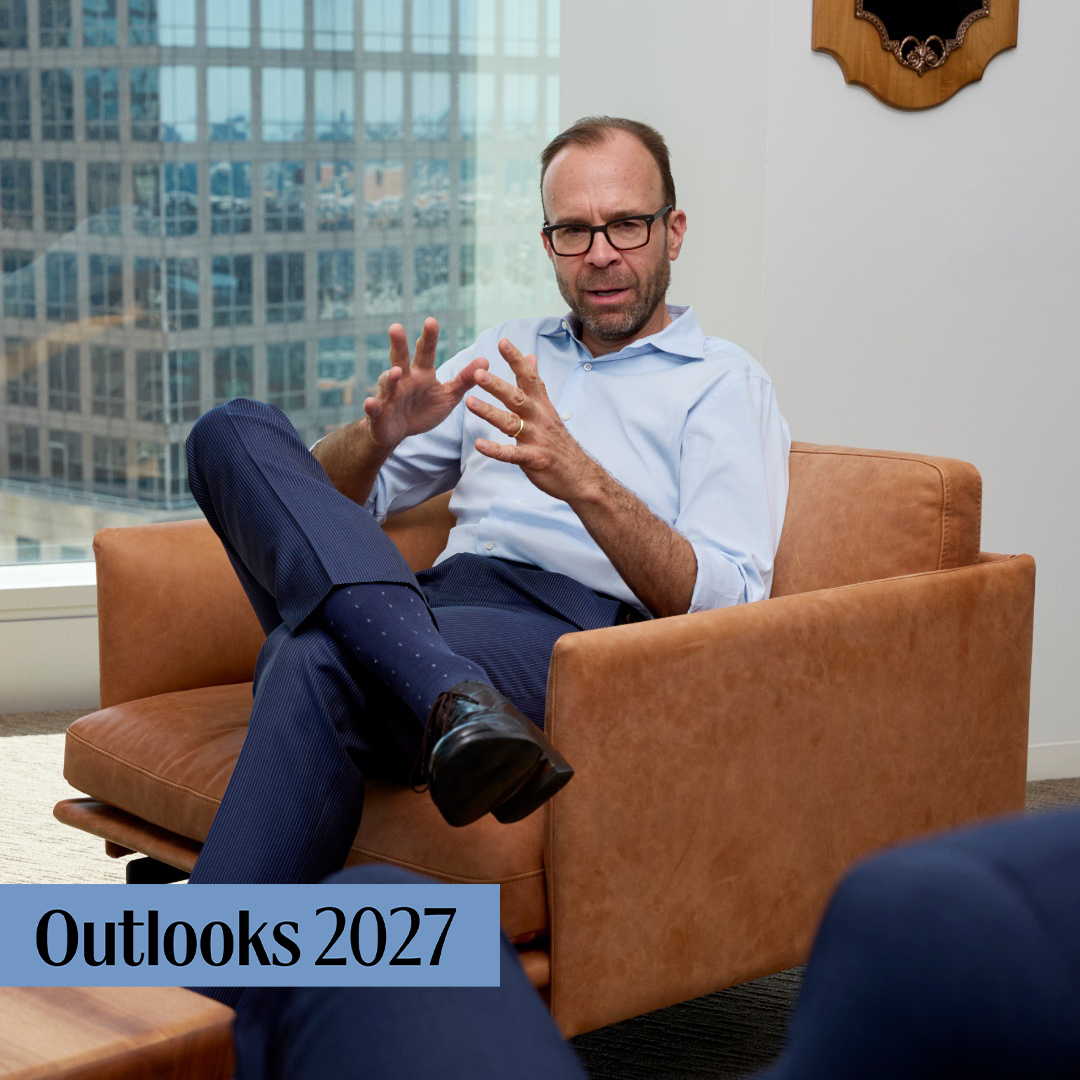
“Growth should follow the same pattern in 2027 as in 2026: solid consumption growth and strong business investment growth offset by drags from housing and trade,” David Mericle, chief US economist, writes in the team’s report. Those factors are expected to balance out to overall GDP growth that is a hair above Goldman Sachs Research’s estimate of potential growth of 2.3%.
Relative to consensus estimates, Goldman Sachs Research’s forecast for economic growth is based on consumer spending that is a touch higher, business investment that is much higher, and housing and net exports that are notably weaker. “Housing is likely to remain the weakest part of the economy in 2027 as very poor affordability continues to depress demand,” Mericle writes.
Our economists expect 2.2% growth in consumer spending in 2027, driven mainly by stronger real labor income growth as inflation moderates. Goldman Sachs Research does not expect a meaningful change in the saving rate, which is likely close to 5% after accounting for revised spending and income data that are incorporated with a lag.
How much will AI boost the US economy in 2027?
“AI will remain the dominant driver of business investment growth in 2027,” Mericle writes. Goldman Sachs Research estimates that spending on AI-related hardware and intellectual property will exceed $900 billion annualized by the end of this year (a $550 billion increase from 2025) and $1.4 trillion by the end of 2027 (a further $500 billion increase), roughly 4% of GDP.
The impact of AI on the official economic statistics will be smaller than company spending data suggest, according to Goldman Sachs Research. That is in part because semiconductor investment is undercounted in the business investment statistics and most of the technology goods used for AI are imported and are therefore netted out in the GDP calculation.
Despite the undercounting, AI drives half of Goldman Sachs Research’s forecast for business investment growth of 8% in 2027. Its impact on GDP growth is more nuanced: Our economists estimate it will contribute 0.2 percentage point to officially measured GDP growth, or 0.7 percentage point to “true GDP growth,” after adding back undercounted semiconductor investment and exports of chip design services.
What is the outlook for the US job market in 2027?
Jobless claims have fallen this year and the layoff rate has remained historically low. “Coupled with a slow pace of hiring but a stabilization in job openings at a healthy level, this has left the labor market in a slightly softer low-hire, low-fire form of full employment,” Mericle writes. Goldman Sachs Research’s slack tracker—a composite of ten measures of labor market tightness—likewise signals that the labor market is a touch softer than the unemployment rate alone suggests.
“We expect the current equilibrium to persist in 2027, with job growth remaining healthy,” Mericle writes. He also points out that companies will eventually want to use AI to reduce labor costs more meaningfully, and Goldman Sachs Research expects faster displacement of workers from AI-exposed jobs to gradually push the unemployment rate higher in subsequent years.
The convergence of Goldman Sachs Research’s wage growth tracker and survey-based wage growth expectations suggests that wage growth is stabilizing at about 3.5%. With productivity growth running above 2% this cycle, this implies subdued inflationary pressure from labor costs.
How much will inflation fall in the US in 2027?
The economy is not overheated at a macroeconomic level, Mericle writes, and Goldman Sachs Research’s tracker of bottlenecks suggests it is not overheated at an industry level either (outside of pockets tied to the AI boom). High inflation does not appear to have become entrenched in expectations. “As a result, inflation should moderate as long as the effects of tariffs, the war, and AI price pressures diminish and no new shocks emerge,” he writes.
The outlook for the Iran war remains uncertain, but Goldman Sachs Research’s commodity strategists expect Brent oil prices to remain near $100 per barrel over the next few months before easing gradually through 2027 to $80. In that scenario, Mericle’s team estimates that two-thirds of the cumulative passthrough from higher commodity prices to core PCE prices has already taken place. The impact on year-over-year core PCE inflation will rise from 0.5 percentage point now to a peak of 0.6 percentage point in coming months before declining to 0.1 percentage point by the end of 2027.
The near-term outlook for AI price pressures is also quite uncertain, Mericle notes. That said, Goldman Sachs Research’s equity analysts expect growth in prices for memory chips to slow sharply in 2027 as new production capacity boosts supply. “This should also restrain inflation for other consumer electronics,” he writes.
“Taken together, our forecasts for the effects of tariffs, the Iran war energy shock, and AI price pressures give us confidence that inflation will fall substantially by the end of 2027,” Mericle writes.
Will the Fed hike rates in 2027?
Under Goldman Sachs Research’s economic forecast, Mericle says the Federal Open Market Committee “would remain firmly focused on the inflation side of its mandate in 2027.” Our economists’ baseline and probability-weighted forecasts for the Federal Reserve are less hawkish than market pricing.
Mericle expects the Fed to make two more rate hikes of 25 basis points—one in December 2026 and one in March 2027—raising its policy rate to a peak of 4.25%-4.5% and marking a total of three hikes during this cycle. The third hike could also come earlier in January, or the FOMC could deliver more than three hikes if the next two inflation reports do not look better, as Goldman Sachs Research expects.
Mericle forecasts the FOMC to eventually begin a series of gradual cuts back to a policy rate of 3.25%-3.5%. He expects these cuts to start at the final meeting of 2027 in November (the meeting was previously scheduled for December) once inflation has declined.
This document has been prepared by the Goldman Sachs Executive Office and is not a product of Goldman Sachs Global Investment Research. The opinions and views expressed herein are as of the date of publication, subject to change without notice, and may not necessarily reflect the institutional views of Goldman Sachs or its affiliates. The material provided is intended for informational purposes only, and does not constitute investment, legal, or tax advice, a recommendation from any Goldman Sachs entity to take any particular action or be used as a basis for any other investment decision, or an offer or solicitation to purchase or sell any securities or financial products. Any forward-looking statements, case studies, computations or examples set forth herein are for illustrative purposes only. Past performance is not indicative of future results. Neither Goldman Sachs nor any of its affiliates make any representations or warranties, express or implied, as to the accuracy or completeness of the statements or information contained herein and disclaim any liability whatsoever for reliance on such information for any purpose. Each name of a third-party organization mentioned is the property of the company to which it relates, is used here strictly for informational and identification purposes only and is not used to imply any sponsorship, affiliation, endorsement, ownership or license rights between any such company and Goldman Sachs. This material should not be copied, distributed, published, or reproduced in whole or in part or disclosed by any recipient to any other person without the express written consent of Goldman Sachs.
Subscribe to Briefings
Our weekly newsletter delivers the latest insights on economic forces shaping markets—from Goldman Sachs leaders, economists, and investors around the world.
You can unsubscribe at any time. For information about how your personal data will be used, visit Privacy Information and Resources.