

Energy
Will Oil Prices Decline as Middle East Supply Recovers?
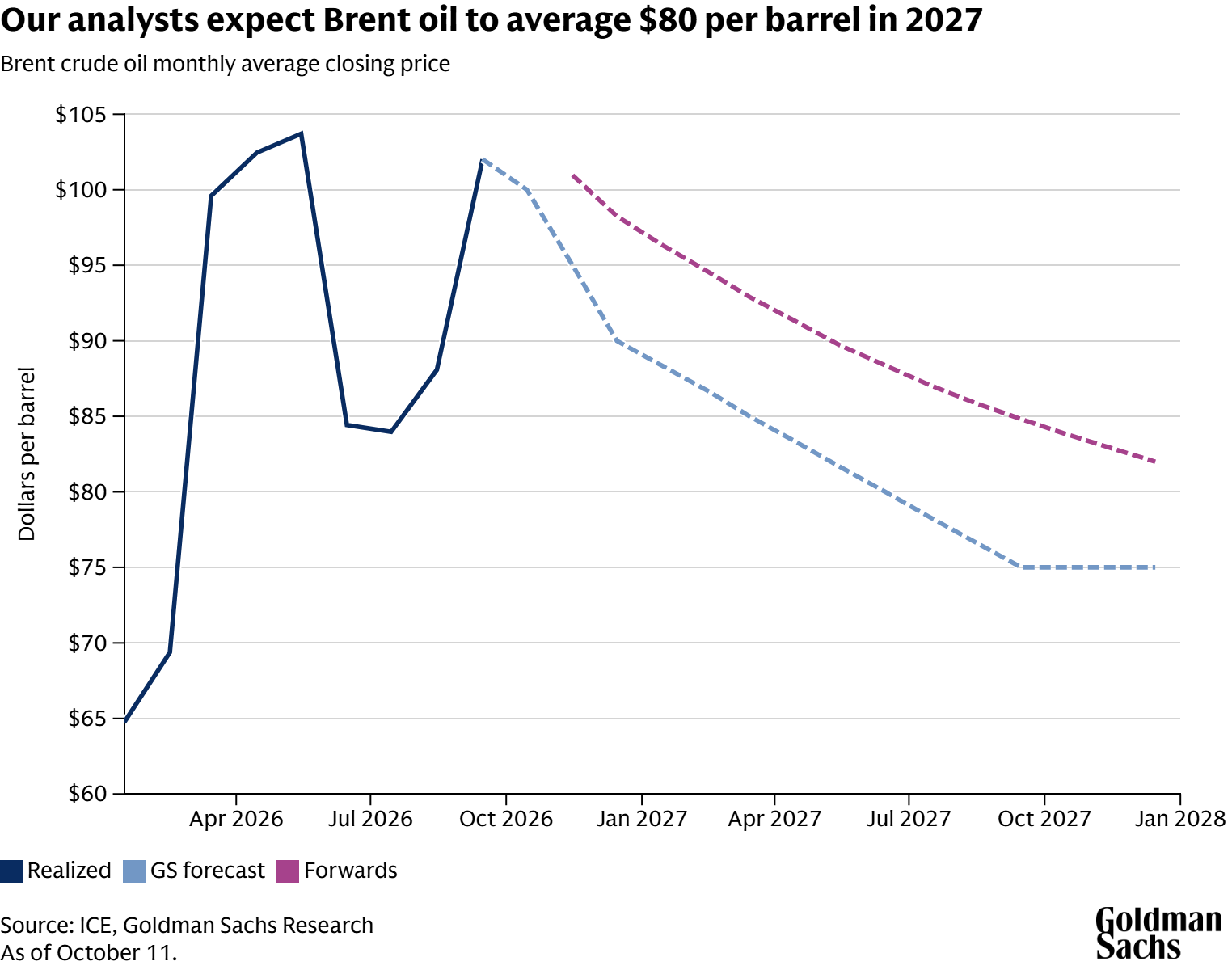
Oil prices are expected to moderate over the next year as supply from the Middle East gradually recovers, according to Goldman Sachs Research. However, high prices may last longer than anticipated given the risk of renewed escalation in the conflict involving the United States, Israel, and Iran.
A barrel of benchmark Brent crude oil is expected to trade at $90 in December 2026, a slight increase from a recent forecast of $85, according to Daan Struyven, co-head of global commodities research and head of oil research. Struyven predicts the Brent price will average $80 a barrel in 2027.
“We maintain our base case that continued adaptation of Middle East supply will eventually reduce crude oil prices, while potential renewed escalation still poses significant net upside risk,” Struyven and his team write in a report.
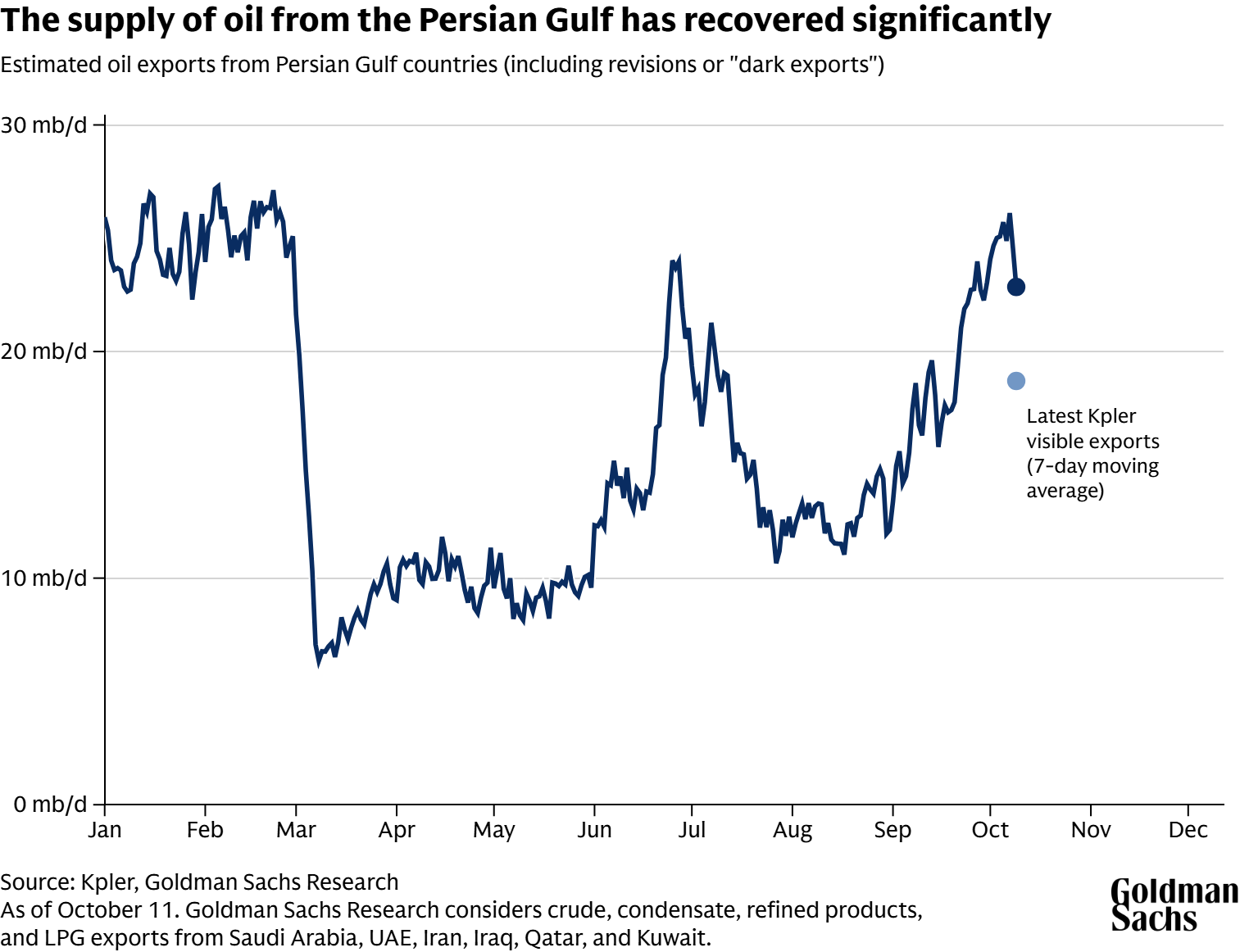
The supply of oil from the Middle East declined after the outbreak of the conflict, but exporters have adapted faster than expected. Our researchers estimate that Persian Gulf oil exports have rebounded and have been around their 2025 average since late September. That calculation includes an estimated four million barrels per day (mb/d) of “dark” exports—shipments on tankers that keep their transponders turned off to hide their movements.
Why are oil prices still high?
Given the recovery in exports from the Middle East, why is the price of oil still so high? A barrel of dated Brent crude scheduled for delivery in the next month is trading at more than $130, while benchmark Brent futures have recently been above $100.
“Physical prices remain elevated because escalation threatens supply while near-record-low global inventories fuel strong restocking demand,” Struyven writes.
For example, Iran or the Houthis could target oil infrastructure in the region, including ports, pipelines, and oil fields. Struyven estimates that spot prices for Brent crude include a nearly $25 risk premium on top of their fair value because supply could be curtailed and inventories could be drawn down further if there is an escalation.
At the same time, the sensitivity of global stocks and bonds to oil prices has created increasing demand for oil as a hedge for portfolios. This is another factor helping keep prices high.
When will global oil supply recover from the war in Iran?
Helping to keep prices in check, on the other hand, is the base case expectation that the balance between supply and demand in the global market for crude oil and other liquid fuels will shift to a surplus in the fourth quarter of 2026 and in 2027, the researchers find. Struyven describes this as “the key driver” of his team’s forecast for crude prices to moderate.
In fact, the oil market was nearly balanced in September. Goldman Sachs Research estimates that demand exceeded supply by just 0.3 mb/d that month, a dramatic easing from the 7.2 mb/d supply deficit in March.
The market’s return to balance is likely the result of higher non-Gulf oil production and a decline in global oil demand, offsetting the remaining deficit in production from the Persian Gulf. Also, the crude oil market was operating with a surplus in 2025. Global demand for oil declined by roughly 1.3 mb/d in September 2026 compared with the 2025 average as oil prices climbed, Struyven writes.
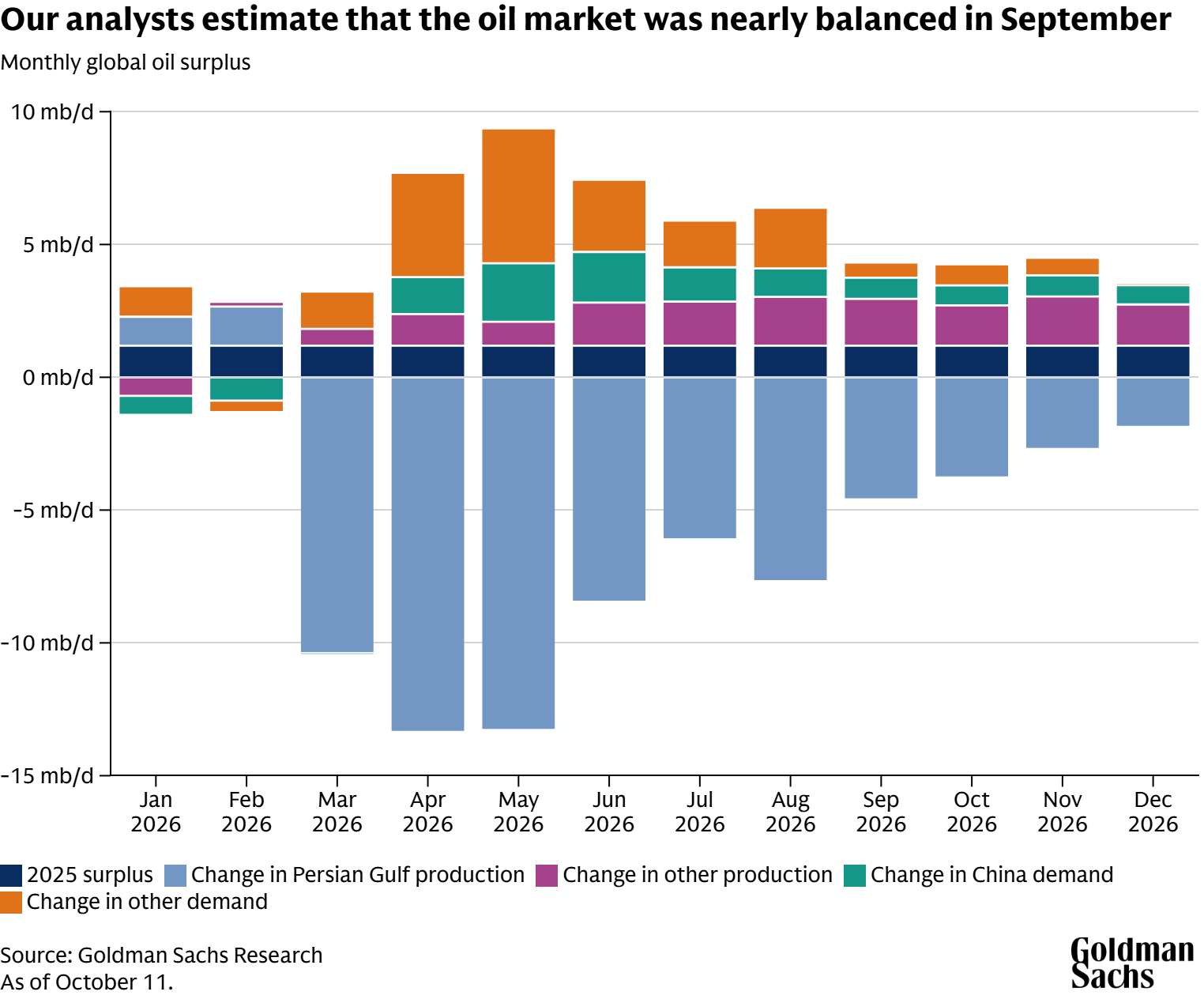
The recovery of Persian Gulf oil shipments, as producers adapt to the conflict there, also supports the base case that the oil market will soon be back in balance, Struyven writes. His team expects the supply of oil from the Persian Gulf to “trend higher as continued adaptation and added transportation resources—especially pipelines and a larger tanker fleet—support further gains,” he adds.
How has the war in Iran impacted global oil demand?
Finally, our commodities analysts say that the shock to oil flows through the Strait of Hormuz is likely to continue to weigh on the global demand for oil, bringing the market nearer to balance. Oil demand in the third quarter of 2026 was down by 3.3 mb/d year-over-year, “with much of the weakness concentrated in China, the Middle East, and OECD Asia,” Struyven writes.
Our analysts estimate that global oil demand in the third quarter was nearly 4 mb/d below its hypothetical path if there had been no oil shock from the war in Iran. They assume that 80% of this gap between actual global demand and the counterfactual will unwind by the fourth quarter of 2027, with the dropoff in demand narrowing to 0.7 mb/d as the availability and affordability of refined oil products gradually improve.
“This forecast that oil demand largely recovers is directionally consistent with the demand recovery from prior negative oil supply shocks in 2011 and 2022, and our view that the weakness in Chinese petrochemicals oil demand is largely unsustainable,” Struyven writes.
Still, the expected 0.7 mb/d hit to global oil demand that is forecast for the fourth quarter of 2027 reflects the team’s finding that the oil shock has accelerated behavioral changes, especially in the use of existing electric vehicles and trucks in China instead of oil-based equivalents and in electric vehicle sales.
This document has been prepared by the Goldman Sachs Executive Office and is not a product of Goldman Sachs Global Investment Research. The opinions and views expressed herein are as of the date of publication, subject to change without notice, and may not necessarily reflect the institutional views of Goldman Sachs or its affiliates. The material provided is intended for informational purposes only, and does not constitute investment, legal, or tax advice, a recommendation from any Goldman Sachs entity to take any particular action or be used as a basis for any other investment decision, or an offer or solicitation to purchase or sell any securities or financial products. Any forward-looking statements, case studies, computations or examples set forth herein are for illustrative purposes only. Past performance is not indicative of future results. Neither Goldman Sachs nor any of its affiliates make any representations or warranties, express or implied, as to the accuracy or completeness of the statements or information contained herein and disclaim any liability whatsoever for reliance on such information for any purpose. Each name of a third-party organization mentioned is the property of the company to which it relates, is used here strictly for informational and identification purposes only and is not used to imply any sponsorship, affiliation, endorsement, ownership or license rights between any such company and Goldman Sachs. This material should not be copied, distributed, published, or reproduced in whole or in part or disclosed by any recipient to any other person without the express written consent of Goldman Sachs.



Subscribe to Briefings
Our weekly newsletter delivers the latest insights on economic forces shaping markets—from Goldman Sachs leaders, economists, and investors around the world.
You can unsubscribe at any time. For information about how your personal data will be used, visit Privacy Information and Resources.